Ormonde Jayne — Ormonde Man
Essence
Ormonde Man is the 2004 debut masculine from London niche house Ormonde Jayne, composed by Geza Schoen (of Escentric Molecules fame) and built around an ingredient almost no one else had used in perfume: black hemlock (a Tsuga conifer absolute). The result is a translucent, green, peppery-woody scent - a cool juniper-and-pink-pepper opening drying to an abstract, Iso-E-Super-rich coniferous wood with a faint sweet undertone. It earned a five-star rating from Turin and Sanchez and a cult following as a “criminally underrated,” quietly sophisticated office-and-formal wood. The hemlock note is its calling card.
Scent Profile
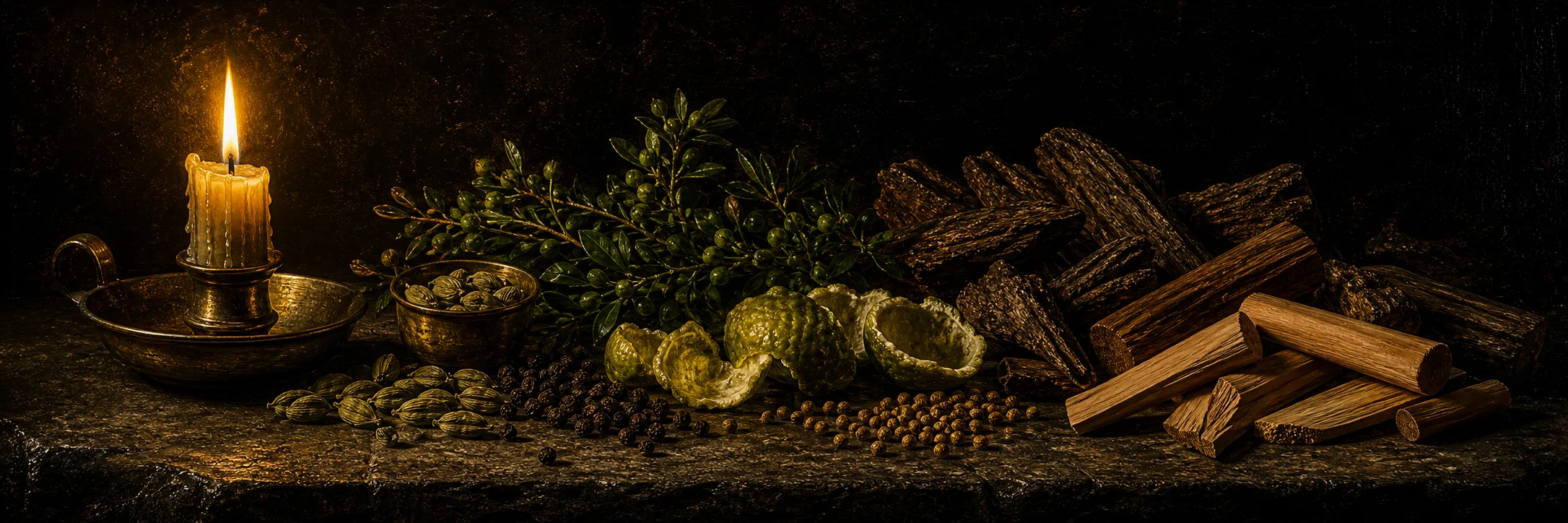
The opening is crisp and cool: a jolt of realistic coriander and aldehydes with juniper berries setting a gin-like, almost icy tone, joined within a minute or two by pink pepper that thickens into the dominant spice. Bergamot adds a brief juicy lift. Several careful reviewers note the opening is “all pepper and spice” - black pepper and a rounder pink pepper - and can read aldehydic-waxy-green. Within five to ten minutes the famous hemlock signature emerges: a dark, resinous, forest-floor green with what tasters variously call “burnt notes and black licorice,” damp earth, pine needles, and a cool mentholated edge. Crucially, the perceived intensity of the hemlock varies dramatically with quantity applied - light application keeps it one facet among many; a heavy dose can drop “a black cloud” of burnt-licorice tar over the whole thing. By the heart (1-3 hours), Iso E Super has firmly taken over and is, by many accounts, the engine of the whole composition - a peppery, woody, transparent radiance that carries the green/coniferous hemlock thread for hours. The spices (coriander, cardamom) recede; a “deep green/verdelite thread runs through it from start to finish,” giving an almost narcotic, smooth quality. Reviewers describe earthy-leathery facets and a whisper of “smoky birch tar.” The drydown (3+ hours) is smooth cedar-sandalwood-vetiver with quiet musk and a slight, only-just-there sweetness - what one critic likened to “buttered soft pretzel”/warm salted bread, others to a soft incense-like woodiness. Note honesty: the listed agarwood/oud is the most-submerged element - the strong consensus, even among fans, is “I barely detect the oud” or “no semblance of oud here”; despite house marketing of “natural Laotian oud,” reviewers widely doubt meaningful agarwood is present. Black hemlock and Iso E Super are the perceptible stars. The scent is fairly linear after its first-hour evolution. Signature accord: cool green hemlock + peppery Iso-E-Super woods.
Performance
This is Ormonde Man’s most-debated and most-criticized axis. Projection is light-to-moderate and intimate after a strong opening - most reviewers describe arm’s-length projection for roughly the first hour, after which it becomes a close, peppery skin-scent. Several call it “classy smelling fragrance ruined by terrible performance” or note projection “dulls after 4 hours to be a peppery barely-there ambiance despite such a take-no-prisoners opening.” Sillage is average - noticeable at close quarters as you pass, not a room-filler. Longevity reports cluster around eight hours, though a vocal minority gets only two to four hours on skin; the synthetics are noted as “pretty resistant to washing off,” so cloth longevity exceeds skin. Heat helps it: one reviewer notes sillage is “moderate at lower temperatures, but heat sends it wafting at a wider radius.” Best application strategy is straightforward - apply generously, since the hemlock’s character and the overall projection scale strongly with quantity; under-spraying yields the “doesn’t go anywhere” complaint, while a fuller application unlocks the burnt-licorice depth and better presence. The higher-concentration Parfum/Made-to-Measure versions exist specifically to address the modest performance.
Wearing Context
The consensus use-case is office, formal, and business wear - “a super finessed blend of conservative with a touch of edgy,” repeatedly cited as a near-perfect work scent: distinctive enough to stand apart from boring masculine office fare, quiet enough never to offend. Best in fall and winter for most, though fans note it works year-round thanks to its translucency, and heat improves projection. It’s an all-day, daytime-leaning scent. Where it falls flat: it is explicitly not a seductive “dating” or club fragrance - one reviewer flatly says it has “zero sweet or friendliness for the dating scene,” and the modest projection makes it a poor choice if you want to be noticed across a room. Social perception skews mature, refined, British, and understated; several wearers note it reads slightly unisex or even “almost feminine” on first encounter despite being marketed masculine. Good for someone who wants quiet sophistication, not statement-making.
Comparisons & DNA
Ormonde Man’s closest sibling is Ormonde Jayne Ormonde Woman (2002), from which it’s directly derived - Woman foregrounds the hemlock with violet and a sweeter, more oriental drydown, while Man pushes pink pepper and woods; reviewers call them “two facets of the same thing.” Within the house, Ormonde Jayne Black Gold (2014) is described by a perfume blog’s Mark Behnke as “a return to the style of Ormonde Man… a more casual version,” and the discontinued Ormonde Man Elixir was a darker, chypre-and-leather amplification likened to “vintage Dior Homme + Ormonde Man EDP + a barnyard oud.” Outside the house, the most-cited comparison is Creed Royal Oud (frequently floated as similar, though many say “they don’t smell that close”); others invoke Comme des Garcons peppery woods and the YSL M7 scratchy-woody-amber “oud accord” lineage that Tom Ford popularized. A controversial wearer reports claim holds it’s “nothing but an EDP version of Lalique Eau de Lalique” at a fraction of the price - a minority view. Genre neighbors repeatedly raised: Diptyque Tam Dao, Bvlgari Black, Chanel Sycomore, CdG 2 Man. A budget designer clone genuinely doesn’t exist by consensus - one reviewer wanting “a budget alternative” concluded “I can’t think of one.” Lineage: a pioneering use of hemlock that Ormonde Jayne introduced to perfumery (others later followed), making it a small but real trendsetting material moment.
Reception
Critically beloved, communally cult-status, but with a real performance asterisk. The headline endorsement is five stars from Luca Turin and Tania Sanchez in Perfumes: The Guide (both Ormonde Man and Ormonde Woman received five-star reviews). Chandler Burr, in his NYT scent column, called it “spectacular,” praising its “masculine gentleness… citrus and spice ingeniously hidden inside sweet heavy cream and warm, caressable male skin,” and dubbed it furbo (Italian for sly/cunning). a published review framed it as smelling “very British and elegant.” On fragrance wearer, fragrance wearer, wearer reports, and wearer reports the dominant themes are: praise for originality, blending quality, the unique hemlock note, and value (often ~$100-110 for 120ml at discounters, called “a deal of a century”); and criticism centered almost entirely on weak projection/longevity (“starts off with promise but ultimately doesn’t really go anywhere”). Polarization runs along originality-vs-generic lines: a vocal minority finds it “static,” “too powerfully generic,” or merely a louder spicy-fresh-boise designer type, and some are sensitive to its heavy synthetics/Iso E Super. Blind-buy verdict: reasonably safe for fans of dry green-peppery woods given the low discounter price and broad inoffensiveness - but sample first if you’re performance-sensitive or unsure about Iso E Super, since that’s the recurring disappointment.
Versions & Reformulation
Multiple iterations exist and the distinction matters. The original Ormonde Man EDP (2004) - the version reviewers reference as the cult classic - is the deeper, softer, slightly sweeter/powdery-honeyed one. Around 2023-2024 Ormonde Jayne moved to a higher-concentration Parfum (“maximum strength,” ~88ml), and discontinued the classic EDP on their own website, causing notable forum dismay; users report the Parfum is “darker, more masculine, less sweet and powdery, with stronger top notes” and longer-lasting, though some find its opening “off-putting” and worry the oud has been pushed up. There’s documented confusion because fragrance wearer initially showed the new Parfum bottle with the old EDP’s reviews. A discontinued Elixir (chypre/leather/oud, darker) also existed, plus the long-standing Made-to-Measure option offering 35%/40%/50% concentrations versus the standard ~30%. wearer split: some prefer the new Parfum’s strength; purists say post-reformulation it’s “a shadow of its former self.” Reviewers caution that Ormonde Jayne scents shift noticeably across concentrations.
Acquisition Notes
Niche/luxury pricing tier - full UK retail historically ran in the ~£90-£225 range depending on size/concentration (Ormonde Jayne “approaches Creed territory” at full retail), but the EDP was famously available around $100-110 for a generous 120ml from discounters and the grey market, making it one of niche’s great value plays. Commonly found in 120ml (classic EDP) and now 88ml (Parfum). Decant ecosystem is solid: Surrender to Chance and similar carry samples, and the house itself sometimes runs codes (e.g., FRAGRANTICA10). Buy authentic from Ormonde Jayne directly (London boutique and website) or US stockists including Saks, Luckyscent, Twisted Lily, Indigo Perfumery, and Aedes; grey-market discounters offer the best EDP prices but confirm you’re getting the EDP vs.
Notable Facts & Lore
- Ormonde Man (with Ormonde Woman) was Ormonde Jayne’s founding masculine and the fragrance that, per a perfume blog’s Mark Behnke, signaled “this was a brand which was a cut above.” The defining lore is the black hemlock: Ormonde Jayne was, by multiple accounts, the first perfume house to use the Tsuga (hemlock/spruce) note, a genuine material innovation.
- Founder Linda Pilkington has discussed the hemlock note and the brand’s sourcing philosophy in interviews; the house’s marketing claims natural Laotian oud, a claim reviewers widely dispute given the near-undetectable agarwood.
- Geza Schoen - who’d go on to launch the Iso-E-Super-monomaterial Escentric Molecules line - composed it, and his fingerprint (peppery transparent woods, abstract Iso E Super radiance) is unmistakable.
- a published review once ran an Ormonde Man giveaway framed around “what the next James Bond would smell like,” capturing the scent’s British-gentleman cult image.
- It remains a perennial “criminally underrated” recommendation in enthusiast circles.