Pierre Cardin — Bleu Marine Pour Lui
Essence
Bleu Marine Pour Lui is a 1986 men’s fragrance by Martin Gras and Raymond Chaillan whose “marine” name is a deliberate misdirection: it is not an aquatic at all. Released two years before Davidoff Cool Water set off the modern aquatic wave, it is a classic 1980s oriental-fougere that reaches for an impressionistic idea of blue freshness using entirely land-sourced materials. Today it survives as a vintage-hunter’s curiosity rather than a mainstream staple.
Scent Profile
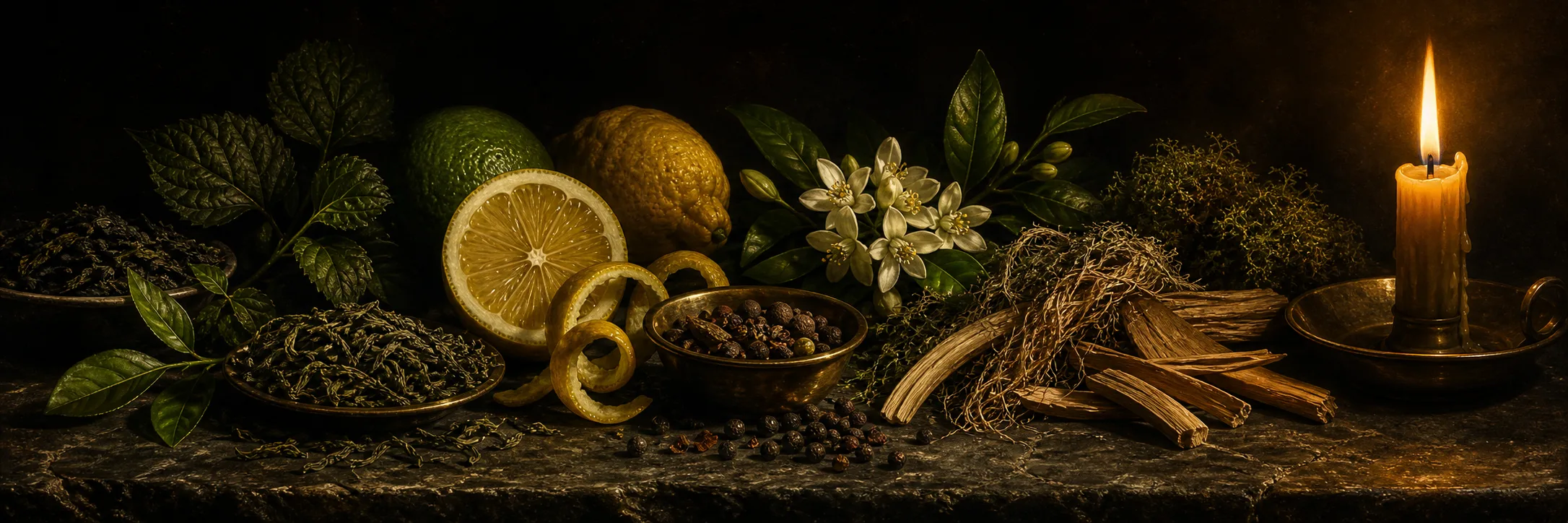
The opening is bracing and aromatic, built on green notes, basil, clary sage, bergamot and artemisia that together create a cool, herbal freshness many wearers single out as the best part of the fragrance. The heart turns spicy and warm. A cinnamon-driven, lip-smacking spiciness sits alongside a prominent eugenol facet that reads as clove and carnation, with geranium, jasmine, caraway, cedar and patchouli filling out the middle. The base is the old-school payoff: oakmoss, leather, labdanum, amber and benzoin, drying to something musky, mossy and deep, with a soft creamy vanilla-coumarin finish noted on better bottles. The overall shape is fougere in the front and amber in the back, herbal and dry rather than sweet, though the labdanum and benzoin lend a balsamic warmth. In aged bottles the citrus tops have evaporated and lavender and basil dominate, with the artemisia reduced to a trace, so the experience depends heavily on which formulation you have.
Performance
Performance is the fragrance’s most contested point and is heavily formulation-dependent. The current reformulated version is widely described as weak and short-lived, sometimes fading within fifteen to thirty minutes and inviting hourly re-sprays. Older and original batches fare far better, with wearers reporting it still detectable six hours in and projecting for the first three to four hours. Across the board it wears close to the skin with a soft mossy-amber trail, so generous application is the sensible approach.
Wearing Context
This is a cool-weather-friendly but versatile herbal fougere. The green-aromatic opening makes it workable in spring and milder conditions, while the mossy-amber base suits cooler evenings. It reads as mature, fully masculine, classic barbershop or wet-shaver territory, the kind of scent worn for oneself rather than for compliments. Its modest projection makes it fine for the office and casual daytime, while it would feel out of place as a modern club or date scent.
Comparisons & DNA
It sits among 1980s and 1990s herbal-fougere masculines. The Scented Devil places it closest to an early version of Guy Laroche Horizon, set over a dry fougere base in the manner of Enrico Coveri pour Homme, thick with clary sage and softened with amber. Wearers also liken it to Gengis Khan by Marc de la Morandiere, judging it close in character even where performance falls short, and to Live Jazz by YSL as a fellow fougere. Historically it is best understood as a proto-aquatic that helped pave the way for later releases such as New West, Aqua Quorum and Polo Sport, even as the calone aquatics it anticipated ultimately buried it.
Reception
Reception is modest and divided. Wearers who appreciate vintage eighties fougeres praise the bracing green opening, the spicy heart and a labdanum-rich base, while detractors dismiss it as a cheap-smelling cologne reminiscent of an aftershave splash. The sharpest line of disagreement is the reformulation: there is near-universal agreement that the vintage is superior and that the current Coty and Paralux version is a let-down. As a value proposition it is cheap enough to risk for anyone specifically seeking a vintage-style herbal fougere, provided an older bottle can be found.
Versions & Reformulation
Several versions exist and the difference between them is central to the fragrance’s story. It was originally produced by SNDP, later marketed by Coty, with a reformulation also attributed to Paralux. The darker-juice vintage, sometimes marked “Made by Shulton” in the US, is consistently preferred over later lighter reformulations regarded as inferior. Documented variants include the EDT as the main version, an after-shave, and a women’s counterpart, Bleu Marine pour Elle. The distinctive blue-glass sculptural flacon is praised even by those who dislike the modern juice.
Acquisition Notes
This is a budget-tier fragrance. The original is discontinued and only intermittently reissued, trading cheaply in vintage splash and spray formats. Documented sizes include a 2 oz vintage splash. Dating cues are useful: darker juice and “Made by Shulton” markings point to an older vintage, while lighter juice and Coty branding indicate a recent reformulation. The main risk is not counterfeiting but unknowingly buying the weaker reformulated version.
Notable Facts & Lore
- It launched in 1986, two years before Davidoff Cool Water effectively created the modern aquatic genre, making its “marine” idea a pre-calone effort built from conventional materials.
- Pierre Cardin was, at the time, weakened by years of over-licensing the brand name, so the release went largely unnoticed.
- Critic Frompyrgos judged the original a stepping stone toward later aquatics such as New West, Aqua Quorum and Polo Sport, now more museum piece than must-have.
- The blue-glass, Verner-Panton-esque sculptural bottle is widely admired regardless of opinion on the juice.
- Wearers note that “bleu marine” without the feminine “e” reads oddly in French, a small linguistic curiosity.