Pierre Cardin — Cardin
Essence
Cardin (also documented as “Cardin de Pierre Cardin”) is the house’s first feminine fragrance, a 1970s animalic floral chypre that today reads almost like a men’s scent - free of the sugary notes that define modern femininity, built instead on a soapy-aldehydic top, a rose-heavy floral heart, and a soft animalic-mossy drydown. It is best understood as an “affordable luxury” chypre: a competent, warmly glowing descendant of Coty’s Chypre rather than a groundbreaking original, and an inexpensive way to experience the genre that produced Miss Dior and Cabochard. The catalog dates it to 1976; a vintage editorial and several vintage advertisements place it at 1975, and the house’s official site omits it entirely, beginning its feminine history with 1981’s Choc de Cardin.
Scent Profile
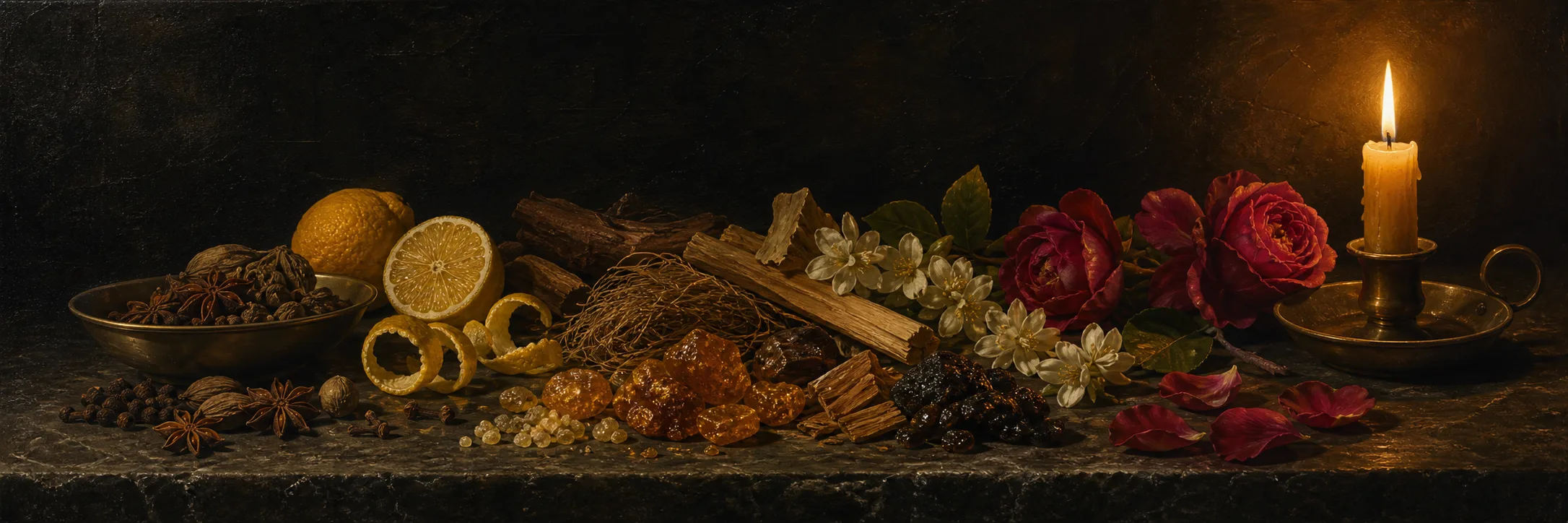
The opening is bright, soapy and spicy - a citrus-aldehyde burst threaded with clove and the slightly bitter, caraway/cumin spice that several reviewers single out as the most divisive element. This is the “expensive soap after about ten minutes” phase wearers often describe. As it settles, the heart becomes a classic rose-jasmine-ylang bouquet wrapped in a soapy aldehydic veil, with carnation lending a powdery, almost peppery edge; the rose is described as oily, warm and dominant, shining through even against the white florals. The drydown is where the fragrance earns its devotees: a soft animalic glow of honey, civet, labdanum and nitromusks over sandalwood and cedar, “warm and dark and slightly spicy.” One caveat: a reviewer-analyst argues the advertised oakmoss is faint and patchouli essentially absent, suggesting the composition is closer to a floral-aldehyde than a textbook mossy chypre - so don’t expect a green, bitter oakmoss bomb. It is fairly linear once the animalic base establishes itself, and the signature accord is best summarized as soapy aldehydic florals melting into a honeyed, musky-civet warmth.
Performance
Reliable wearer evidence converges on weak-to-moderate performance for the lighter concentrations. The EDT is frequently called short-lived - “only a couple of hours on my skin” according to one wearer, though it clings far longer to clothing and hair. A vintage fragrance column makes the same point about the EDP: it “burns down from the citrus-aldehyde beginning in about a couple of hours, leaving behind only the soft fluffy tail” of musk. Sillage is generally moderate and “work safe.” The vintage pure parfum is the exception - reviewers report it as potent and long-lasting, “very potent, and long lasting,” behaving more like an extrait. Wearer records note the parfum’s projection and longevity as above average. Practical reading: seek the parfum or EDP for satisfying wear; treat the EDT as an intimate, close-to-skin scent and apply generously, ideally to clothing.
Wearing Context
This is an autumn, spring and winter fragrance - multiple wearers explicitly recommend it for cooler weather, with one calling it “great for autumn and spring, also will be nice for winter.” It skews mature, formal and “femme fatale,” frequently described as sophisticated, “a woman-of-the-world.” Because of its richness and animalic warmth, one reviewer specifically avoids wearing it to work, finding it too “creamy, rich and definitely romantic,” while others call it work-safe given its modest sillage - the split depends on concentration and application. By modern standards it reads as gender-neutral or even masculine-leaning; one wearer says that if it were released now it might be labeled masculine.
Comparisons & DNA
The most repeated comparison from wearer accounts is to Ivoire de Balmain (Pierre Balmain, 1979), especially in the drydown, with the delta that Ivoire is more grassy-green via vetiver while Cardin is more balsamic and honeyed. Several reviewers also cite Knowing (Estee Lauder, 1988) and the original Nina (Nina Ricci, 1987) as kin. A vintage editorial places it alongside Cachet (Prince Matchabelli) and La Nuit (Paco Rabanne) as a softer, cozier member of the 70s/80s animalic-chypre family, tracing its pedigree to the American version of Chypre (Coty). Within the house itself, it is distinct from the lighter, lily-of-the-valley-driven Choc de Cardin (1981) by Francoise Caron. There are no designer or clone alternatives in the modern sense - this is a vintage-hunt fragrance, not a dupe target.
Reception
Documented reception is warmly positive among vintage-chypre lovers but acknowledges the fragrance is “nothing unusual” - a well-made, humble example of its genre rather than a masterpiece. Common praise centers on the natural-smelling, high-quality middle and the seductive animalic drydown; one admirer called the vintage “liquid gold, tears of an angel.” Common criticisms are the weak longevity of the lighter concentrations and the polarizing caraway/cumin spice. A recurring lament is the difficulty of finding it and the house’s erasure of it from official history. Blind-buy verdict: a confident yes for chypre fans buying cheaply, given how inexpensively vintage bottles surface - but go in expecting a soft, soapy, animalic classic rather than a powerhouse.
Versions & Reformulation
Documented in at least three concentrations - Eau de Toilette, Eau de Parfum and pure Parfum. Wearer testimony strongly favors the Parfum and EDP for both quality and performance; the EDT is the weakest. Because the line was discontinued long ago, there is no modern reformulation to compare against - all bottles in circulation are vintage stock, and top-note degradation is a real risk on older minis. Note that “Cardin” should not be confused with the house’s other feminine releases (Choc de Cardin, Paradoxe, Rose Cardin) or the masculine Pierre Cardin Pour Monsieur.
Acquisition Notes
Discontinued; available only on the secondary market. This is genuinely budget vintage - one wearer scored a mint mini at a thrift shop for AU$2, and vintage buyers often treat it as a cheap-find chypre. Cardin/Cardin de Pierre Cardin parfum minis and coffrets often surface with period peers such as Cabochard and Ivoire de Balmain; the fragrance also appeared as small minis, coffret sets, EDT vapo-sprays, and shower gel. Because Pierre Cardin licensed the name widely, watch the exact name and bottle: you want “Cardin” / “Cardin de Pierre Cardin,” distinct from Choc, Paradoxe, Rose, Emotion and the many later Pierre Cardin men’s releases. Counterfeiting is not a notable concern at this price; the real risk is degraded juice rather than fakes.
Notable Facts & Lore
- Sergey Borisov noted that Pierre Cardin’s official fragrance history omits Cardin and begins its feminine timeline with Choc de Cardin.
- Vintage advertisements and bottles point to a 1975/76 launch, which explains the dating discrepancy.
- Elena Vosnaki framed Cardin as evidence that some widely licensed Pierre Cardin fragrances were better than their bargain image suggested.
- After Pierre Cardin’s death on 29 December 2020, forgotten feminine chypres like this gained renewed vintage-hunter interest.