Ralph Lauren — Lauren
Essence
The 1978 Ralph Lauren women’s debut, launched in tandem with the original Polo green and conceived by Bernard Chant (with Nicholas Calderone) as a green floral chypre in the late-1970s Estee Lauder lineage. It is, in Chant’s catalog, the missing link between Estee Lauder’s Alliage Sport Spray (1972) and Aramis Devin (1978) - a green-pineapple-rose-oakmoss construction that uses the period’s photographic-realist floral language in the service of an “American sportswoman” image. Significant reformulation and IFRA-driven gutting of the oakmoss base have created a sharp vintage/modern divide; what’s currently sold under the Lauren name is, per Luca Turin, a “muguet pretender,” and serious admirers chase Warner-Lauren-era bottles from 1978 - 1984.
Scent Profile
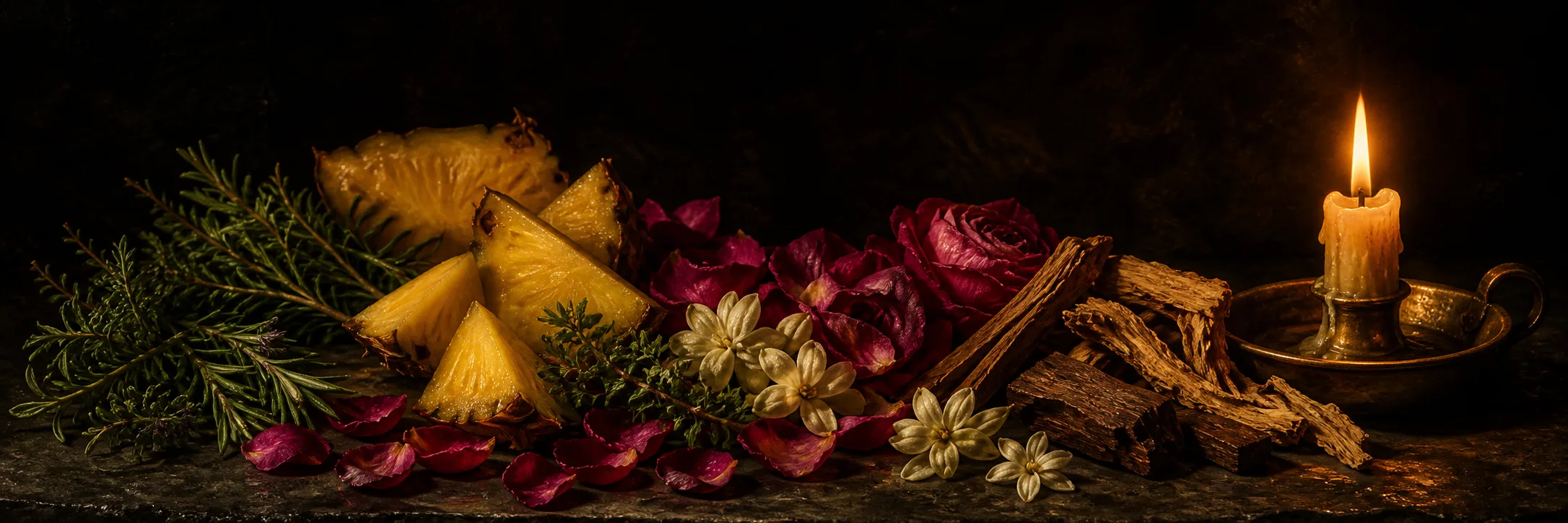
The Non-Blonde describes the pineapple as “more aromatic than juicy” - its job is to brighten and aerate the greenery rather than to read as fruit. Clary sage, rosewood, and a broad “green-notes” accord (galbanum-adjacent dryness, hyacinth-leaning brightness) build out the opening into a deeply vegetal, slightly damp, almost dewy impression. Bernard Chant’s compositional fingerprint is the “sculpting” or contouring approach - letting individual notes enter at staged intervals rather than crashing as a blend - and the commentary credits this technique for Lauren’s oxygenated rather than dense character. The heart is the classic late-1970s floral chypre bouquet: rose (Bulgarian), violet, lily-of-the-valley, lilac, cyclamen, jasmine - with carnation (technically catalog-base here but functionally heart) adding the spicy-clove tilt that distinguishes Lauren from purely powdery muguet florals. The pineapple from the opening keeps echoing through the heart, which is unusual and is the move most identified with Lauren among writers covering the fragrance. Multiple wearers describe a slightly leathery, slightly soapy facet that emerges in the mid-phase, and the Scented Devil/ essay specifically notes a “sliver of something leathery” in vintage examples. The drydown is bracing oakmoss, vetiver, cedar, sandalwood - a true chypre base of the era, dry, mossy-earthy, with a tobacco-adjacent darkness. Critic-reviewer Octavian Coifan-style technical description would note real oakmoss content in pre-1990s bottles, which IFRA restrictions later forced out and which is exactly what’s missing from the current production. Linearity is moderate - it morphs through distinct phases - and the signature accord is unambiguously the pineapple-rose-oakmoss chord, with carnation-clove as the spicy heart accent.
Performance
Vintage bottles project strongly and last well - multiple long-time wearers describe 8+ hours from parfum-concentration vintage stock and call the perfume “big and heavy” while keeping its freshness via the pineapple. The current L’Oreal-era production is widely panned for both performance and character: The Non-Blonde describes it as “20 minutes of a thin, but OK representation of the middle part of a chypre perfume, followed by a horrible chemical ‘bug spray’ musk.” Application strategy if you have vintage: less is more - this projects. If you have modern, layering helps and EDT is reportedly weaker than parfum even within the current line. Reliable performance discussion applies only to the vintage; modern performance is poor enough that the comparison breaks down.
Wearing Context
Spring and fall are the natural slots - the green-floral-chypre construction is built for transitional weather and outdoor light. Vintage Lauren handles cold weather better than most florals because the oakmoss-vetiver base provides anchoring warmth; modern Lauren doesn’t have enough base to perform in cold. Daytime is the obvious primary use case, but the depth of the original makes it work for evening too. Office, dressy-daytime, garden party, casual-elegant - the use-case is mature-feminine-American-classic. Social-perception skew is decidedly mature and “old money”; one Vivir piece explicitly calls it the smell of “old money, but the kind earned through spirit and intelligence.” It will read as anachronistic in younger casual settings, which is part of its current cult appeal - it’s a deliberately retro signature for those who know what they’re reaching for.
Comparisons & DNA
DNA-wise, Lauren sits squarely inside Bernard Chant’s late-1970s Lauder corpus. Direct comparisons in the long-form essay name Estee Lauder Alliage Sport Spray (1972) - Chant’s earlier green-sporty composition - and Aramis Devin (1978) as the immediate sibling references, with Lauder for Men (1985, partly Calderone’s work) as a downstream descendant sharing some compositional DNA. Outside the Chant catalog, the broader late-1970s green floral chypre family includes Estee Lauder Aliage (1972), Chanel No. 19 (1971), Givenchy III (1970), and Cabochard (Chant’s 1959 Gres classic, his most famous green chypre) - Roja Dove explicitly traces Lauren back to Cabochard in his analysis cited on. The pineapple-floral facet is the unusual element that distinguishes it from the broader category. Modern dupes don’t really exist; the closest currently-buyable adjacent territory is vintage Aliage or carefully sourced pre-reformulation Polo for women’s wear of the same vintage.
Reception
Among vintage-perfume-wearers critics, vintage Lauren has solid masterpiece-tier respect. The Non-Blonde returns to it as a personal long-favorite, the Bois de Jasmin / long-form retrospective treats it seriously, and Luca Turin’s Perfumes: The Guide and subsequent A-to-Z review the (reformulated) modern version unfavorably - Turin’s two-star “muguet pretender” line is the most-repeated critical assessment in circulation. Common praise for vintage: distinctive pineapple-rose-oakmoss construction, real-oakmoss depth, the elegance of Chant’s pacing, longevity. Common criticism, all directed at the modern: hollowed-out muguet-musk character with chemical edges, no chypre base to speak of, anonymous. Polarization runs entirely along the vintage-vs-current axis rather than across wearers taste. Blind-buy verdict: vintage Warner-Lauren from 1978 - 1984 is a confident yes if you can find a good bottle; current production is a hard no.
Versions & Reformulation
This is the headline issue with Lauren. The production timeline runs Warner-Lauren (1978 - 1984) → Cosmair (1984 - 1999) → L’Oreal Luxury Products (1999 - present), with each handoff bringing reformulation pressure. The Warner era is the gold standard. Cosmair-era bottles are usually still good but already begin showing thinning. The L’Oreal era is where the IFRA oakmoss restrictions and broader reformulation choices reportedly hollowed out the base. Critical and wearers consensus is that current production bears only nominal resemblance to vintage.
Acquisition Notes
Lauren sits in Ralph Lauren’s designer fragrance tier as an EDT. Catalog pricing is not documented in the catalog. Official formats vary by market and release cycle. Confirm the exact flanker, concentration, and packaging because Ralph Lauren names often repeat across related releases.
Notable Facts & Lore
- Lauren and Polo together were Ralph Lauren’s debut fragrance launch in 1978 - the women’s scent paired with the men’s green leather-chypre Polo, both Bernard Chant compositions and both originally produced under the Warner-Lauren license.
- The two have followed parallel reformulation arcs, though Polo has had more sustained brand attention and Lauren has been comparatively neglected by L’Oreal - a recurring complaint in wearer discussion.
- The 2018 fortieth-anniversary moment passed without significant restoration effort from L’Oreal.
- The bottle design, attributed to Ben Kotyuk, is a square red-glass flask with a brass-toned cap, an unusually masculine bottle silhouette for a women’s fragrance of the era and part of Ralph Lauren’s deliberate cross-gender American-classic aesthetic.
- No major celebrity-fronted campaign defines its history; its cultural footprint is the smell of late-1970s and 1980s American sportswear womenswear - exactly what the fragrance was engineered to be.