Ralph Lauren — Ralph Wild
Essence
Ralph Wild is a 2008 fruity-floral EDT, the fourth entry in Ralph Lauren’s youth-targeted “Ralph” sub-line (after Ralph 2000, Ralph Cool 2004, and Ralph Hot 2006). It is, by near-universal wearers description, a strawberry-and-watermelon scent - a loud, candied summer fruity-floral aimed squarely at teens and twenty-somethings of the late-2000s. Now discontinued, its identity in 2026 is defined as much by nostalgia and the hunt for a remaining bottle as by the juice itself, which most agree is simple, fun, and very sweet.
Scent Profile
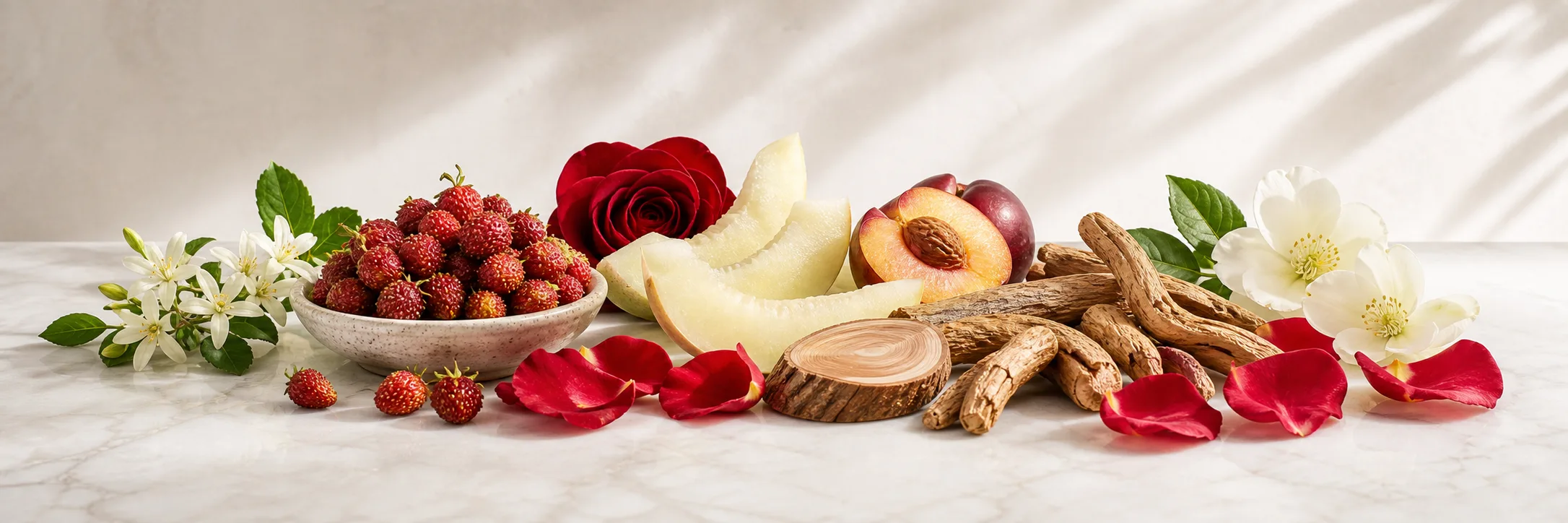
The opening is the whole show for many wearers: a “KAZAAM” of ripe strawberry, tempered by juicy watermelon, with one widely echoed wearer asking, “Is this really perfume or home-made strawberry jam and watermelon gelati?” and concluding it “does come across as liquified strawberry candy.” The cherry-blossom/rose/jasmine heart is real but subordinate - it surfaces as a faint clean, almost shampoo-like floral that keeps the fruit from being purely gourmand, with the strawberry remaining the clear protagonist. The musk-and-sandalwood base is light and supportive rather than transformative; several reviewers (including men who wear it) note it barely evolves - “on my skin it doesn’t evolve at all, all I smell is the intense fruit.” So it is essentially linear: a sweet, fresh, fruity accord from open to close, with the strawberry the signature note. Distinct from its siblings, Wild is the strawberry one (Cool is the watermelon/cucumber aquatic; Hot is the cocoa/coffee gourmand).
Performance
Longevity reports are genuinely mixed, and wearers are split: some wearers report it lasting “for hours and hours” on skin (men who wear it cite roughly 5 - 6 hours), while at least one wearer found “the longevity is not great (4 hours).” The one point of broad agreement is fabric performance - the scent is repeatedly reported to “last days on clothes” and to “smell wonderful on fabric,” lingering on clothing and hair well after it has faded from skin. Projection/sillage is moderate - noticeable but not a powerhouse. Weather behavior strongly favors heat: it’s a summer/warm-weather scent, and reviewers specifically frame it for “lazy weekends,” beach, and spring/summer wear. Application strategy is straightforward: it’s potent and sweet, so a conservative spray is plenty for the intended casual context, and spraying clothing exploits its best trait.
Wearing Context
This is daytime, warm-season, casual wear - explicitly coded young. Wearers frame it as a “girly,” “young, giggly” scent for teens, while also conceding it appeals “to the young at heart.” It works for school, daytime outings, and summer; it is not pitched as an evening, office, or formal fragrance. Social perception is “fun and approachable” rather than sophisticated - popular sentiment describes men and women alike reacting to it as smelling “good enough to eat.” It is the olfactory equivalent of a specific late-2000s teen-pop moment, which several reviewers explicitly invoke (“this IS 2007-2008”).
Comparisons & DNA
The most useful comparisons are within Ralph Lauren’s own house: Ralph Cool (Ralph Lauren) is the closest sibling - watermelon-forward and more aquatic where Wild is strawberry-forward and longer-lasting; reviewers literally wish “Wild & Cool could have a baby.” The original Ralph (Ralph Lauren) is the cleaner apple-freesia progenitor of the line. Outside the house, reviewers most often reach for Marc Jacobs Daisy Eau So Fresh (Marc Jacobs) as a similar sunny fruity-floral (with Wild credited as longer-lasting), and DKNY Be Delicious (DKNY) as an adjacent fruity scent some wearers layered with the original Ralph. One reviewer flagged Armaf Beach Party (Armaf) as smelling “almost the same as Ralph Lauren Wild” - the nearest thing to a wearers-named cheaper alternative, though offered tentatively. No widely-confirmed dupe exists.
Reception
Wearer sentiment is warm but unpretentious: this was never a critically ambitious fragrance, and wearers evaluate it accordingly. Reviews cluster around two poles. The affectionate camp loves it as a nostalgic, well-performing, fun summer candy scent and mourns its discontinuation (“another nice frag discontinued and therefore ’wild’ly expensive now”). The critical camp finds it one-dimensional and juvenile - “is this really perfume or home-made strawberry jam,” “liquified strawberry candy,” fine but “non-impressive.” Polarization is essentially about expectations: judged as a cheap-thrills teen fruity-floral it succeeds; judged as a serious composition, it is simple and linear. The dominant 2026 theme is scarcity-driven nostalgia. Blind-buy verdict: only worth the now-inflated discontinued prices if you specifically want the strawberry-watermelon nostalgia; otherwise the genre is easily matched.
Versions & Reformulation
Ralph Wild was a single EDT composition, released in 30, 50, and 100 ml bottles (bright red juice/bottle with a light-blue cap). It is part of the four-fragrance “Ralph” flanker line: Ralph (2000, Alain Alchenberger), Ralph Cool (2004, David Apel & Pierre Negrin), Ralph Hot (2006, Pierre Negrin), and Ralph Wild (2008). Catalog credits Wild’s authorship to Olivier Gillotin, James Krivda and Linda Kramer. The entire Hot/Cool/Rocks/Wild sub-line has been discontinued; wearers widely lament this and note that Ralph Lauren replaced that energy with the later “Big Pony” women’s collection, which fans consider “vastly inferior.” No reformulation history is documented - it was discontinued rather than reworked. Single composition, no known reformulations.
Acquisition Notes
Ralph Wild sits in Ralph Lauren’s designer fragrance tier as an EDT. Catalog pricing is not documented in the catalog. Official formats vary by market and release cycle. Confirm the exact flanker, concentration, and packaging because Ralph Lauren names often repeat across related releases.
Notable Facts & Lore
- The “Ralph” sub-line was an explicit early-2000s exercise in market-segmenting teen-girl “personality types”: a brand spokesperson described the original Ralph as for “a preppy and confident girl,” Cool for “trendy and adventurous,” Hot for “flirty and sexy,” and the line’s marketing leaned hard into MP3-era youth culture (Ralph Rocks’s tagline was “Add it to your playlist today!”).
- Wild’s lore is almost entirely generational nostalgia: reviewers tie it to a specific 2007-2008 cultural moment, name-checking the era’s teen icons and “clunky CD players.”
- Its discontinuation, alongside the rest of the sub-line, is the most-cited controversy: a steady drumbeat of “please bring this back, Ralph Lauren” that mirrors the louder grief around the house’s discontinued and reformulated classics like Lauren and Safari.