Ralph Lauren — Romance
Essence
Romance is Ralph Lauren’s 1998 flagship feminine fragrance, a clean, soapy floral by Harry Fremont that became one of the defining American department-store classics of its era and a multi-generational signature for countless women. It is a luminous, watery floral-woody-musk: a chamomile-and-citrus-tinged rose-and-white-flower bouquet over a soft musk, oakmoss, and patchouli base, built to read as fresh, comfortable, and quietly elegant rather than sexy or loud. Nearly three decades on, it remains a top-selling, widely gifted reference floral, loved by fans and dismissed as generic by critics in roughly equal measure.
Scent Profile
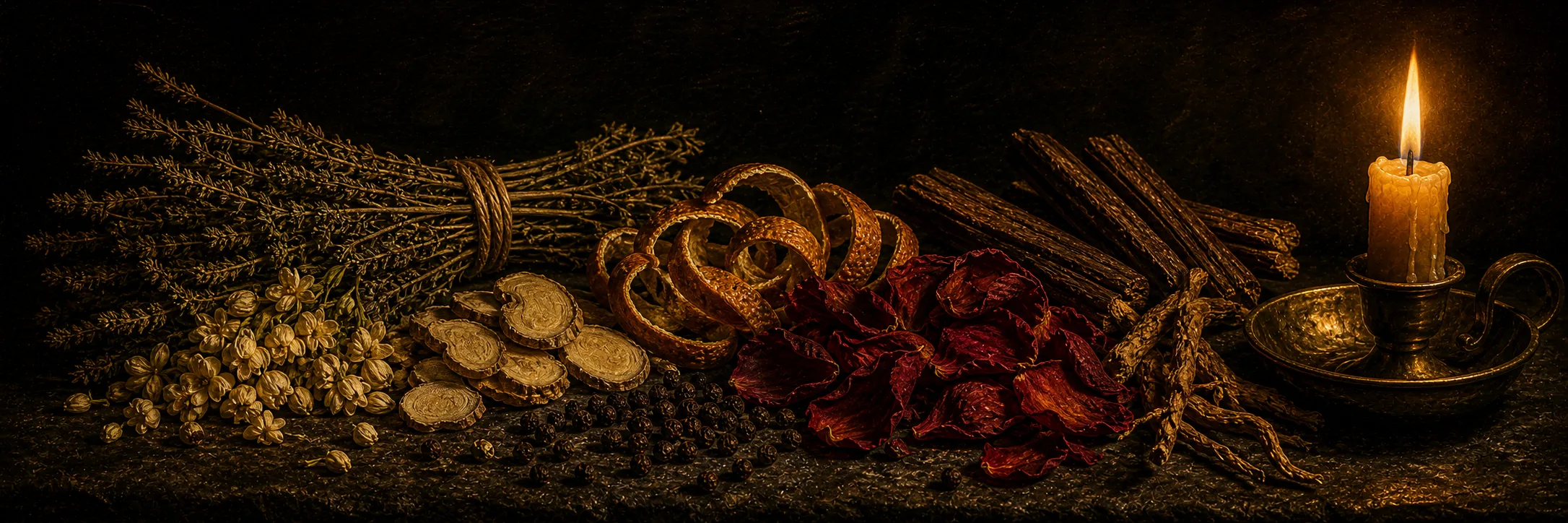
The opening is the most-praised phase: a soothing lemon-and-chamomile combination that several wearers compare to drinking chamomile tea, lifted by a spicy-fresh ginger note and a dewy, slightly dirty freesia that was a 1990s staple. It is bright and watery rather than sharp. The heart is a soft, aqueous floral — lotus, lily, rose, and violet, described again and again as a watercolor painting or water and lily pads in a pond. A touch of carnation adds subtle spice that keeps the bouquet from turning prim. This is the phase that gives Romance its clean, slightly aquatic character. The drydown is the divisive part: a soft musk over oakmoss and patchouli that some find comforting and ambery and others read as a dirty, soapy, or generic-shampoo finish. The composition is moderately linear after the opening — the florals dominate throughout and the base stays soft. The signature impression is a clean, soapy, slightly aquatic rose-and-white-flower floral with a chamomile-citrus top, very much of its late-90s aquatic-floral moment.
Performance
Performance reports are mixed but cluster around good early, moderate overall. Many wearers report above-average projection and sillage in the first hours, with longevity around six hours on skin and all day on clothing, while more typical recent reports give medium projection and roughly five hours of wear. A recurring complaint about current bottles is that they have become lighter and shorter-lived, and very old stock can fade toward a plain alcohol smell. The historic extrait/parfum concentration is reported to perform more strongly than the standard eau de parfum. It rewards generous application, including onto clothing, and is forgiving enough to over-apply without becoming offensive.
Wearing Context
Romance is best documented as a spring and summer daytime scent, though many wear it year-round as a signature. It is repeatedly called office-appropriate, casual-elegant, and versatile — equally at home with a black dress or a pair of jeans — and wearers evoke fresh white laundry, a windswept early-summer beach, and post-shower freshness. A minority prefer it as an intimate scent in cool, rainy weather. Its social read is strong and well-documented: classic American elegance, the girl-next-door, the clean-girl aesthetic, and frequently the suburban mom or “smells like the 90s” association — nostalgic charm to some, a dated knock to others. It is widely considered safe and crowd-pleasing, and reads near-unisex to several noses.
Comparisons & DNA
Romance lives in the late-90s clean floral-woody-musk family and has many useful neighbors. Estée Lauder Pleasures and Clinique Happy share its clean, freshly-showered idiom. Chanel Coco Mademoiselle has the same elegant-feminine character but is more intense and longer-lasting. Lancôme Trésor is a warmer, classic floral-woody cousin. Maison Francis Kurkdjian Féminin Pluriel is described as a really close alternative, the main difference being an added iris note that makes it cleaner and more elegant but pricier. Within the house, it spawned a large flanker tree and a discontinued masculine counterpart, Romance for Men, that shares its subtle soapiness and understated elegance.
Reception
Romance is genuinely polarizing along a love-versus-competence axis, which is unusual for so mainstream a scent. In aggregate it is well-liked across many thousands of votes, with a large signature-scent and “my mom wore it” contingent praising it as clean, fresh, elegant, versatile, and nostalgic — often a first perfume or first designer fragrance. The criticisms are just as consistent: generic, soapy shampoo, dated, synthetic in cheaper or older batches, and “not romantic” despite the name. The headline critical verdict is dismissive — Luca Turin and Tania Sanchez gave the feminine Romance a two-star review and called its masculine counterpart so unmemorable that the only fitting review was that “it has a smell.” The disagreement runs along two axes: nostalgia and comfort versus perceived genericness, and vintage quality versus reformulated softness. As a purchase it is broadly safe, inexpensive, office-friendly, and a reliable gift, with the caveat that scent enthusiasts find it unremarkable and current bottles can perform modestly.
Versions & Reformulation
Romance has been reformulated over its long life, with many long-term wearers preferring the smoother, longer-lasting pre-reformulation version; the brand’s current marketing pyramid differs somewhat from the original 1998 note list while preserving the citrus-top, rose-heart, musky-woody-base DNA. Concentration variants include the standard eau de parfum, a stronger extrait/parfum, and the lighter Romance Eau Fraîche. Most notably, Romance anchors one of the largest flanker lines in designer perfumery — among them Tender Romance, Romance Rosé, Beyond Romance, the charity Pink Pony Edition, Romance Parfum, Romance EDP Intense, and Romance Elixir — with the 1998 original remaining the reference point against which all are judged.
Acquisition Notes
Romance is a mainstream designer-tier scent and very widely available in 30 ml, 50 ml, and 100 ml eau de parfum, heavily discounted at the usual outlets and frequently gifted. The 100 ml runs around $120 at full US retail. As a high-volume, long-running release it is a common target for counterfeits and grey-market diversion, and aged stock can smell flat, so buying from authorized retailers or the Ralph Lauren site is the safest path. Because “Romance” listings span many flankers, confirm you are buying the original 1998 eau de parfum. Decants and samples are abundant.
Notable Facts & Lore
- It launched in 1998 as Ralph Lauren’s flagship women’s scent and won FiFi Awards for Fragrance Star of the Year and Best Advertising in 1999.
- The masculine counterpart, Romance Men, won its FiFi categories in 2000, giving the line back-to-back wins.
- The men’s campaign paired photographers Bruce Weber and Irving Penn, set to Carly Simon’s “My Romance” sung as a duet with her son Ben Taylor.
- At launch, Ralph Lauren framed it as being about romance’s power “to heighten emotion, enrich experience and capture love.”
- It is endlessly cited as “my mom’s scent” and an emblem of late-90s classic American femininity.
- It remains on Ralph Lauren’s best-seller list nearly three decades after release.