Ralph Lauren — Safari for Men
Essence
Safari for Men is the masculine counterpart to the 1990 Safari women’s release and one of Ralph Lauren’s most fully realized masculine compositions - a spiced aromatic fougere built around a creamy sandalwood-and-leather core, framed by a barbershop-classic herbal heart of basil, thyme, clary sage, and cinnamon-leaf clove. It belongs to the “Class of 1992” alongside Pasha de Cartier and Aubusson Homme, all chasing the post-Jazz revival of dense, lavender-and-spice fougeres that Zino Davidoff and YSL Jazz had reopened in the late 80s. Among RL’s masculines it sits second only to Polo Green in enthusiast estimation, and is widely regarded by wearers as the most adult, “old-money” thing the house has made. The colonial-decanter bottle, faux croc box, and crested cap are part of the identity; this is fragrance-as-heritage-prop, and it knows it.
Scent Profile
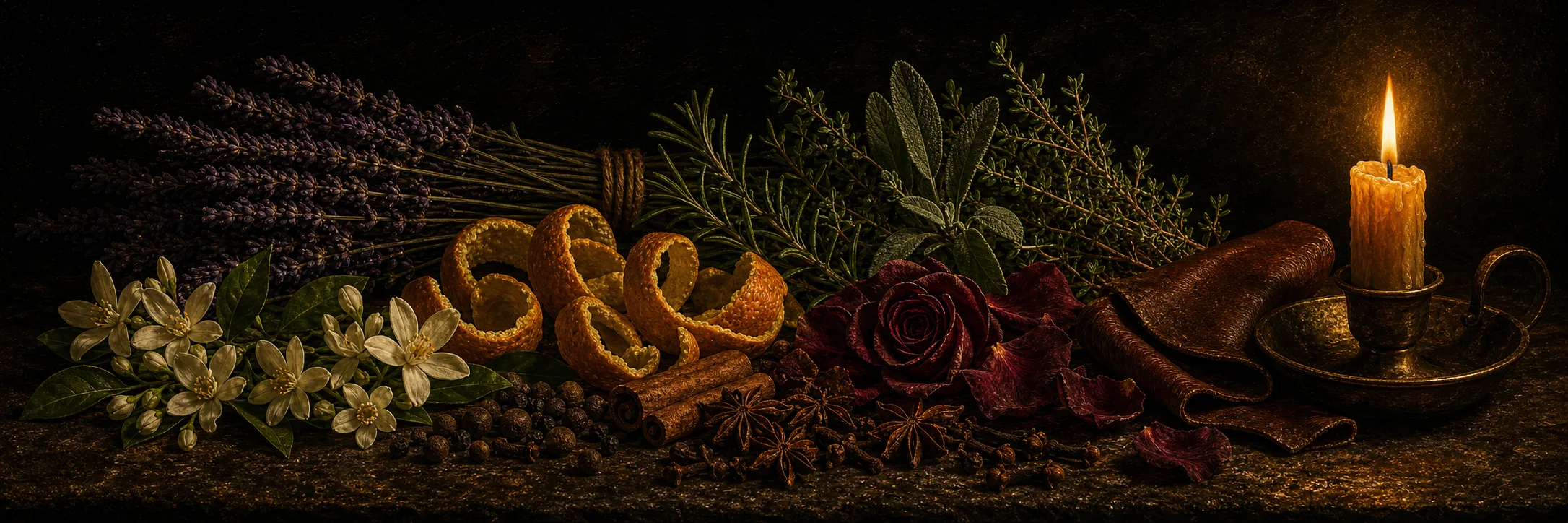
The opening reads less like a citrus burst than a green-aromatic salvo: bergamot, lemon, and a slug of bracing aldehydes throw a soapy-clean lift over an unmistakable lavender/coriander/artemisia herbal core, and there’s a clearly perceptible eucalyptus impression in the top that most experienced reviewers single out - it gives the opening a slightly medicinal, almost mentholic edge that distinguishes Safari from its 1992 siblings (Pasha leans mintier, Aubusson sweeter and apple-pie warm). The neroli is submerged and structural rather than legible. The heart is where Safari announces what it is: a herbal-spiced fougere where basil, thyme, rosemary, and clary sage are pushed forward more aggressively than in the period’s norm, with a clearly naked cinnamon-leaf clove threading through. Documented reviewers consistently describe the heart as “barbershop” - warm, spicy, slightly soapy, with the lavender still pulsing underneath rather than receding cleanly. Carnation and rose are detectable but supporting; this is not a floral chord, it’s an aromatic one. The base is the payoff and the most-cited stage of the fragrance: a creamy, soapy sandalwood reading that listeners describe as “buttery” and “harmonical,” cushioned with oakmoss (in vintage formulations), patchouli, amber, and a quietly suede-like leather that never gets animalic. The musk is clean and slightly powdery. Cedar grounds the wood accord without sharpening it. The signature accord is essentially sandalwood + leather + cinnamon-clove + lavender residue, all draped in oakmoss in vintage and approximated by synthetics in current bottlings. Development is gradual and well-blended rather than sharply linear or pyramidal; reviewers frequently note that the notes are “hard to isolate” because the composition is so smoothly woven.
Performance
Wearer consensus on performance is consistent and specific. Longevity reports cluster at 6 - 9 hours on skin for current production, with vintage Cosmair bottles running about an hour longer. One wearer describes an 8 - 9 hour clock on fabric with a roughly four-foot scent bubble for the first two hours; posters with multiple-vintage comparisons report 6 hours on 4 sprays for current juice versus 7 - 8 for vintage with the same application. Projection is described as moderate-to-strong out of the gate (notably the aldehydic-lavender opening), settling to a quieter but persistent bubble after the first couple of hours. It is versatile across temperatures - reviewers wear it in heat, humidity, and cold without obvious failure modes - though the herbal-aromatic register reads better in cool-to-temperate weather and in dry heat than in muggy summer.
Wearing Context
Reviewer consensus places Safari firmly in mature, “grown-man” territory - multiple accounts explicitly say it’s not a fragrance for someone in their early 20s unless they’re already temperamentally rugged. It’s positioned for business meetings, formal-ish daywear, dinners, and what one reviewer called “work and church.” It is not a club fragrance, not a flirt-bomb, and not particularly aimed at the young-compliment-seeker market; it skews paternal, professional, and old-money. Cooler weather and shoulder seasons (fall, early winter, spring) are the most-cited sweet spots, though summer use is endorsed by people who like dry-heat aromatics. Time of day skews daytime-to-early-evening; it’s competent at night but is not a sexed-up dark scent. Social perception is strongly skewed “classy/mature/dignified,” with a meaningful minority reading it as dated.
Comparisons & DNA
The most-named comparison in documented wearer discussion is Chanel Egoiste Platinum, with Safari described as the more masculine, more rugged, more leather-driven cousin and Egoiste Platinum as the cleaner, more metallic-rosemary one. Pasha de Cartier (1992) gets cited as the closest sibling - same launch year, same fougere-with-sandalwood blueprint, but Pasha runs mintier and arguably higher in finish. Aubusson Homme (1992) is the apple-pie-warm third panel of the 1992 trio. YSL Jazz (1988) is widely treated as the modern ancestor for all three. Aramis (1965) and Zino Davidoff (1986) sit in the same broader aromatic-leather corridor but are darker and tobacco-leaning. Aramis New West has been called out as a structural cousin in the citrus-green-aldehydic top.
Reception
Across long-tail reception, Safari is treated as a designer classic and frequently cited as the best masculine RL has produced or among the top two with Polo Green. Praise centers on three things: the creamy sandalwood/leather drydown, the harmoniousness of the herbal heart (reviewers consistently note that no single note dominates), and the “mature classy” character. The bottle and presentation are praised as some of the best in mainstream designer fragrance. Criticism falls along two axes. First, the reformulation: vintage Cosmair (pre-2010, with bigger oakmoss content) is widely held to be richer, denser, and longer-lasting than the post-restriction juice, with some reviewers calling the current bottle “watered down” or “flat” and others - including reviewers with side-by-side bottles - saying current production is 95 - 98% there and only loses an hour of longevity. Second, polarization around the lavender-aldehyde opening: a meaningful minority finds the lavender overdose and the aldehydes harsh, sharp, or dated. The blind-buy verdict is broadly yes for fans of classical masculines, and many treat it as a signature-scent candidate.
Versions & Reformulation
There are three rough generations wearers discusses. Vintage Cosmair (early 90s to roughly mid-2000s) is the most oakmoss-dense and is held in highest regard. A first reformulation post-2008/2010 follows IFRA oakmoss restrictions and is noted as a noticeable but not catastrophic step down. A second adjustment around 2013 is sometimes flagged by closer listeners as “not even remotely close” to pre-2013 bottles, though many drinkers can’t tell more recent batches apart from early-2000s juice. Concentrations have included EDT and an aftershave splash; the aftershave is reported as smoother and is often hoarded by enthusiasts. There are no flankers of consequence - RL has never spun Safari into a line the way they did with Polo.
Acquisition Notes
Safari for Men sits in Ralph Lauren’s designer fragrance tier as an EDT. Catalog pricing lists 110 USD / 125 ml. Official or commonly documented bottle formats include 4oz, 125ml. Confirm the exact flanker, concentration, and packaging because Ralph Lauren names often repeat across related releases.
Notable Facts & Lore
- Safari for Men launched in 1992 as the male counterpart to Safari (1990), with an integrated ad campaign that explicitly leaned into colonial-adventure imagery
- African safari motifs, cameras, photography, exploration.
- The crystal-decanter bottle is widely described as based on vintage liquor decanting sets and is part of why so many reviewers treat the package itself as a centerpiece.
- The fragrance’s perfumer credit is sometimes given as Annie Buzantian alone (as in the catalog facts) and sometimes co-credited to Alberto Morillas; some current listings cite both names.
- There is no widely-circulated celebrity or viral lore around this fragrance - it predates the influencer era and has never had a Jeremy Fragrance-style resurgence.
- Its cultural footprint is generational: it’s a 30-something-and-up “dad scent” for people who came of age in the early-to-mid 1990s, and a recurring entry in nostalgia discussions whenever the “best discontinued or fading designer classics” topic comes up..