Tommy Hilfiger — Dreaming
Essence
Dreaming (2007) is Tommy Hilfiger’s “Tommy Girl grown up”: a soft, clean fruity-floral built around a realistic, faintly metallic peach layered over white florals (tuberose, freesia) and a powdery musk. The marketing leaned on old-Hollywood glamour, but the juice itself is far more understated than the campaign suggests — pale, pretty and easy to wear. Now discontinued, it retains a small but genuinely fond following among fans of clean peach-florals.
Scent Profile
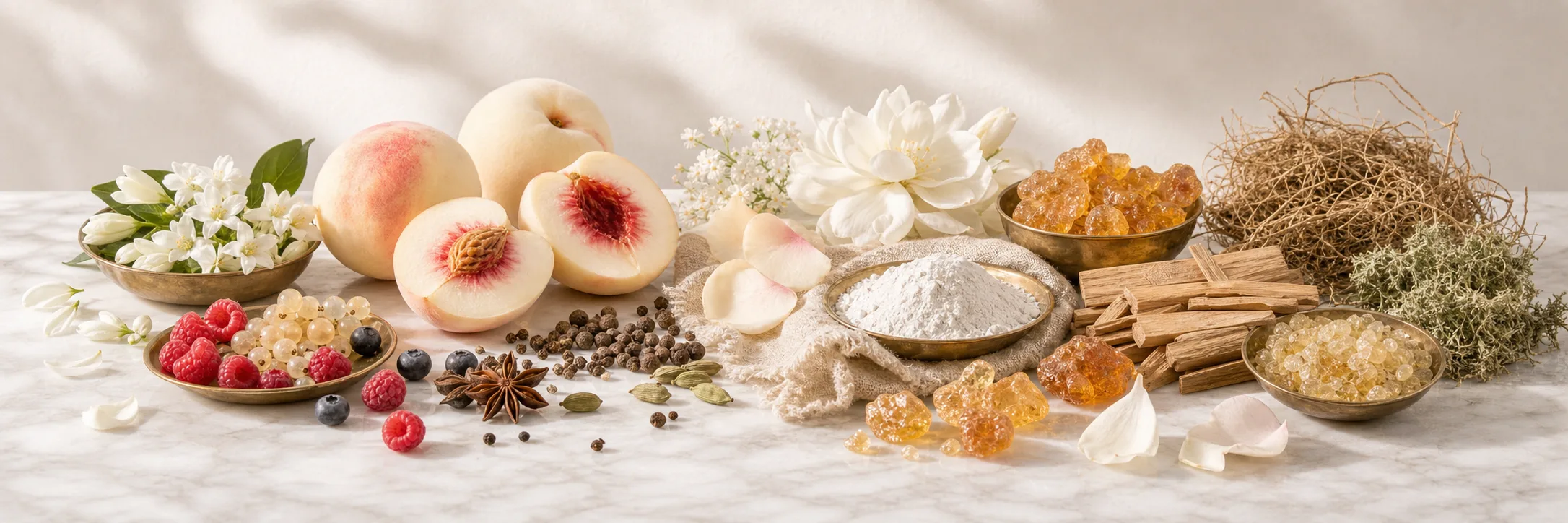
The signature is a juicy, soft white peach that most wearers read as natural and un-candied, though a notable minority perceives it as slightly synthetic — “metallic peaches” or “peachy pencil shavings” with a quicksilver edge. Pink pepper lends a brief spicy sparkle and blackcurrant a touch of tartness before the florals arrive.
Tuberose and freesia build a restrained, blended white bouquet rather than a heady soliflore — some wearers also pick up lily and a faint gardenia impression. It stays gentle and non-indolic throughout, closer to a soft floral wash than a statement flower.
The finish is a clean, powdery musk warmed by sandalwood and amber — “a velvet finish,” in the words of critic Now Smell This. The overall arc runs sweet and sparkling up top, peppery-floral through the heart, and cool and musky-woody at the base, staying pale and clean throughout; some wearers find it edges toward fabric-softener territory rather than perfume-like depth.
Performance
Performance is Dreaming’s most consistent complaint: sillage is low and longevity runs poor to moderate, with several wearers reporting it fades to nothing within a few hours or is hard to detect at all — comparisons to the famously faint Calvin Klein Eternity Moment come up more than once. A smaller group reports it lasting all day, including a recurring account of it seeming to vanish and then resurface in the afternoon, suggesting real skin-chemistry variance. Treat it as an intimate, close-to-skin scent: apply generously and plan to reapply rather than expecting all-day projection.
Wearing Context
This is a daytime, warm-weather, casual fragrance — brunch, the office, spring and summer — repeatedly described as safe enough for almost anyone to wear without objection. It skews young and feminine, with several wearers recalling it as a first perfume around age 18, and reads innocent and romantic rather than sexy despite the old-Hollywood ad campaign. It is the wrong choice for anyone wanting a statement scent, a powerhouse, or evening complexity; its natural home is comfort, no-think daily wear rather than a special occasion.
Comparisons & DNA
The clearest reference point is Tommy Girl, the brand’s own classic, to which Dreaming is positioned as a grown-up counterpart — some wearers actually prefer Dreaming as the softer of the two. Its own direct successor, Dreaming Pearl (2009), reworks the same peach-tuberose-freesia idea into something fresher and lighter. Calvin Klein Eternity Moment is invoked specifically for shared faintness rather than shared scent character, useful for calibrating how little projection to expect. No designer or niche dupe is well documented; Dreaming reads as its own take on the mid-2000s clean fruity-floral white-musk lane.
Reception
Sentiment is gently positive, carrying a strong undertow of “underrated” affection and frustration that it was discontinued. The praise is consistent: clean, easy, pretty, “innocent but not naive,” and a strong pick for tuberose-and-peach fans specifically. Criticism clusters on two points — weak performance and a peach note that a vocal minority finds synthetic, veering toward “pencil shavings” or “syrupy quicksilver.” Critic Now Smell This was lukewarm to negative, praising the ad campaign but calling the scent itself pale and lacking personality.
Polarization mostly tracks expectations: those wanting soft and clean are satisfied, those wanting presence or complexity are not. As a blind buy, it’s low-risk for peach-floral fans willing to accept its softness, though discontinuation has made sampling harder and pushed prices up.
Versions & Reformulation
Dreaming was sold as an EDP in 30, 50 and 100 ml, with a 15 ml parfum offered at launch alongside a dream-interpretation booklet and a removable bottle charm; a matching body lotion and body wash rounded out the line. Its main flanker is Dreaming Pearl (2009), a lighter, more peach-forward successor in a pearl-necklace bottle. No specific reformulation of the original is documented beyond ordinary age-related batch variation, and it is now out of production.
Acquisition Notes
Now discontinued, Dreaming survives on the secondary market — discounters, marketplace sellers, and discontinued-fragrance specialists — at prices that have climbed above its original retail. It was sold in 30, 50 and 100 ml EDP. Because remaining stock is aged, freshness and storage are real considerations, and the usual authenticity caution applies to any gray-market purchase; buy from sellers who can vouch for both.
Notable Facts & Lore
- Marketed explicitly as the “Tommy Girl grown up,” reframing the original’s “declaration of independence” as “the sophistication of a woman.”
- The campaign leaned on old-Hollywood glamour and white-sheets imagery, fronted by Swedish model Mona Johannesson.
- Launch merchandising was unusually elaborate: the parfum came with a dream-interpretation book and a removable bottle charm.
- Critic Now Smell This credits the composition to perfumer Stephen Nilsen, while catalog records list Trudi Loren as the nose of record — the two attributions have never been reconciled.
- Its main lore today is its discontinuation and the loyal, quietly nostalgic following that has followed.