Tommy Hilfiger — Hilfiger Athletics
Essence
Hilfiger Athletics is a 1998 grapefruit-driven fresh-citrus cologne that has become, two decades after its discontinuation, the connoisseur’s pick from a house better known for its 1995 flagship Tommy and 1996 Tommy Girl. It belongs to the late-1990s “sport” wave but, as reviewer reviewers repeatedly stress, it is not a sport fragrance in the aquatic-calone sense - it is a tangy, bittersweet citrus with a green-herbal spine. It was released to support Hilfiger’s “Athletics” apparel sub-line, and the juice mirrored that line’s positioning: casual sportswear rather than gym kit. The defining trait is an unusually loud, long-lasting grapefruit accord seasoned with star anise - a combination that almost no other designer release of the era attempted.
Scent Profile
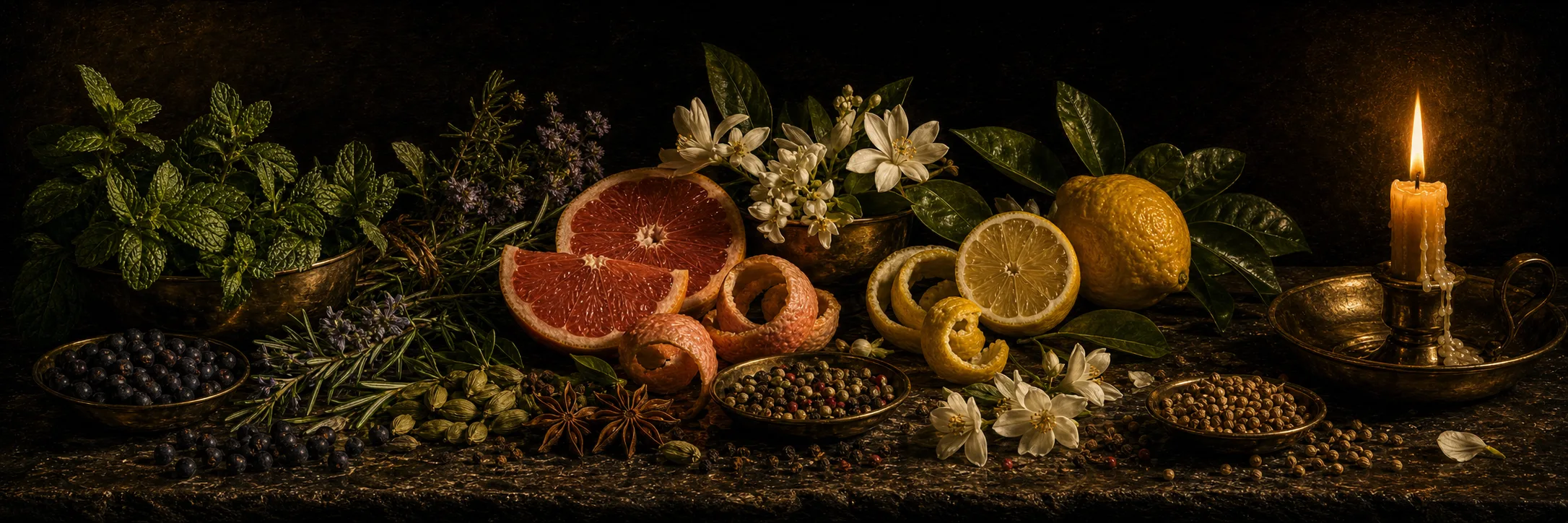
The structure is front-loaded and citrus-dominant. The opening is a bittersweet grapefruit-bergamot burst lifted by warm star anise; one reviewer reviewer describes it as “bittersweet citruses and warm anise, an uplifting and zingy combination fresher and more ethereal than Pi Neo’s opening notes.” Several wearers single out a candied-ginger nuance in the brightness, comparing the effect to Burberry Sport and Lacoste’s yellow L.12.12. The reviewer consensus is blunt: “a long-lasting Grapefruit accord that totally dominates here, everything else is a distant 2nd.” Beneath the citrus sits a green herbal heart - grass and sage - described by one reviewer not as fresh-mown grass and culinary sage but as a cooler, more tropical green. The cotton-flower base provides a clean, soft white-musk landing that most reviewers find pleasant but unremarkable; reviewer notes “the base is very ordinary and not long-lasting.” The grapefruit is acknowledged as synthetic but reads as “somewhat natural” by period standards. One reviewer user positioned its citrus between the natural Hermes Eau d’Orange Verte / Creed Pampelmousse end and the candied synthetic sweetness of Clinique Happy, landing closer to Fresh Hesperides and Acqua di Parma Arancia di Capri in overall feel - but lasting far longer than any of them.
Performance
Performance is polarizing and heavily climate-dependent. In temperate conditions, multiple reviewers report it collapsing to a skin scent within an hour or two - one reviewer veteran recalled “a really vivid grapefruit opening, but soon dissipated to some sage and white musks after a while. Minimal performance unless you’re outside in the heat.” But in hot, humid climates the picture inverts dramatically: an Indian reviewer reported 12+ hours and being able to smell it the next morning in the shower, noting the matching deodorant stick amplified it. This heat-activation is the fragrance’s signature quirk: it was engineered for warm weather and genuinely rewards it. Sillage is moderate and intimate in cool conditions, stronger in tropical heat. The fragrance generated frequent unsolicited compliments, a point reviewers raise repeatedly.
Wearing Context
Squarely a hot-weather daytime scent - spring and summer, casual settings, and especially tropical or high-humidity environments where its performance peaks. reviewer data skews it toward casual wear and a youthful 19 - 25 audience, consistent with its late-90s teen/college following. Reviewers describe it as a grab-a-newspaper-or-lunch fresh spritz rather than an office or evening fragrance, and several note it as a post-workout shower scent. It is too sharp and citrus-forward for cold weather. As a “completist” Hilfiger collector put it, it is “sporty but not a SPORT fragrance.”
Comparisons & DNA
The most useful internal comparison is to the broader Tommy Hilfiger fresh-American lineage: the 1995 flagship Tommy (Annie Buzantian and Alberto Morillas) built a clean grapefruit-mint-cranberry “Real American Fragrance,” and Athletics pushes that house tendency toward citrus to its extreme, isolating and amplifying the grapefruit. Within the house, wearers verdict is strikingly consistent that Athletics is “Hilfiger’s best fragrance by a country mile.” Externally, reviewers compare the grapefruit-citrus character to CK Truth for Men (though CK leans more watery-green), Fresh Hesperides, and Acqua di Parma Arancia di Capri, while noting none of the recommended “smells like” alternatives actually match it - a recurring frustration among former owners hunting for a replacement. The star-anise-plus-grapefruit combination is what makes it hard to clone; one reviewer’s wish was simply “another green citrus fragrance with star anise.”
Reception
Among the enthusiast wearer Athletics enjoys a near-cult reverence wildly disproportionate to its original commercial profile. On reviewer it reportedly held a unusually positive reception, and reviewer reviews are dominated by nostalgia and lament: “best light summer scent ever, and best scent from Tommy Hilfiger ever. Underrated - if it was from Dior, YSL or Chanel it would be a bestseller.” Dissent exists and is worth flagging: reviewer houses sharply negative takes (“Monkey pee! Pure acid!”) and a more measured criticism that it is “rather insignificant… absolutely interchangeable with many others from this genre; no distinctive character.” A sober reviewer counterpoint warns that “the hype is purely because of the high collector’s price after discontinuation… Couldn’t give it away for the longest time, always in places like Ross and TJ Maxx.” That tension - beloved relic vs. ordinary 90s freshie inflated by scarcity - is the honest center of its reputation. No major critic (Turin/Sanchez, Burr, or the major blogs) appears to have reviewed it; its reputation is entirely wearer-built.
Versions & Reformulation
Released in 1998 as an Eau de Cologne / EDT concentration with a matching aftershave, deodorant, and ancillary line tied to the Athletics apparel collection, packaged in a distinctive bright-yellow box and bottle. The fragrance was produced under license by the Estee Lauder Companies (Aramis and Designer Fragrances division), which held the Tommy Hilfiger fragrance license for nearly thirty years; that license transferred from Estee Lauder to Give Back Beauty effective June 2023 (per reviewer: “US fashion brand, Tommy Hilfiger, has signed a new fragrance license agreement with Give Back Beauty. The license was previously held by Estee Lauder Companies”), as Lauder wound down its Aramis & Designer Fragrances division. Athletics had been long discontinued well before that handover. There is no documented reformulation history because the fragrance was discontinued rather than reissued; the practical “reformulation” problem reviewers cite is age-related spoilage of surviving stock - “if you manage to track down a bottle it has probably spoiled.”
Acquisition Notes
Discontinued and now a secondary-market item only. Prices have climbed substantially: reviewer and eBay reports range from roughly $35 shipped for unboxed bottles to $65 - $150+ for sealed 100ml, with the upward trend documented over the last several years. wearers caution is twofold: (1) verify freshness, as the citrus-heavy formula degrades and many circulating bottles have turned; and (2) temper expectations against the collector hype, since one experienced reviewer flatly warns “if you believe the hype and pay the $150+ price for 100ml, you will get burned.” Numerous “type” oils and dupes exist (Nantucket Perfume Company, Fragrance Revival) but former owners overwhelmingly report none replicate the original. The matching deodorant is especially scarce.
Notable Facts & Lore
- The yellow bottle generated a persistent identification mystery for nostalgic former owners; one reviewer user spent years convinced it was a Nautica release because he couldn’t place “what Nautica fragrance came in yellow” before finally identifying it.
- It was sold at period American department stores including Burdines for around $40 at launch, and frequently ended up in discount retailers (Ross, TJ Maxx) before discontinuation made it scarce.
- The fragrance is a product of the high-water mark of the licensed-designer “lifestyle fragrance” model, when Estee Lauder produced Hilfiger scents explicitly marketed around “the American dream” and the brand’s preppy-Americana imagery.
- It is genuinely anomalous within the 1990s fresh-masculine landscape: while Cool Water clones and aquatic calone scents dominated, Athletics bet on a loud bittersweet grapefruit with star anise - a choice wearers now reads as ahead of its time and the reason it aged better than many of its aquatic contemporaries.