Tommy Hilfiger — Loud for Her
Essence
The irony is baked into the name: a fragrance marketed as “Loud,” pitched as rock ‘n’ roll in a bottle for a denim-clad younger crowd, that turned out to be one of the quieter, more classical rose-patchouli chypres of the 2010 designer landscape. Created by Aurélien Guichard and Yann Vasnier, it was half of a his-and-hers duo tied to Hilfiger’s “Get Loud” denim campaign, complete with a theme song written by British rock duo The Ting Tings. It flopped commercially and was discontinued, but has since become a cult cheap-thrill for rose-patchouli lovers who discover, usually via a blind buy off the clearance bins, that Tommy Hilfiger accidentally made something genuinely classy under a garish pink vinyl-record bottle.
Scent Profile
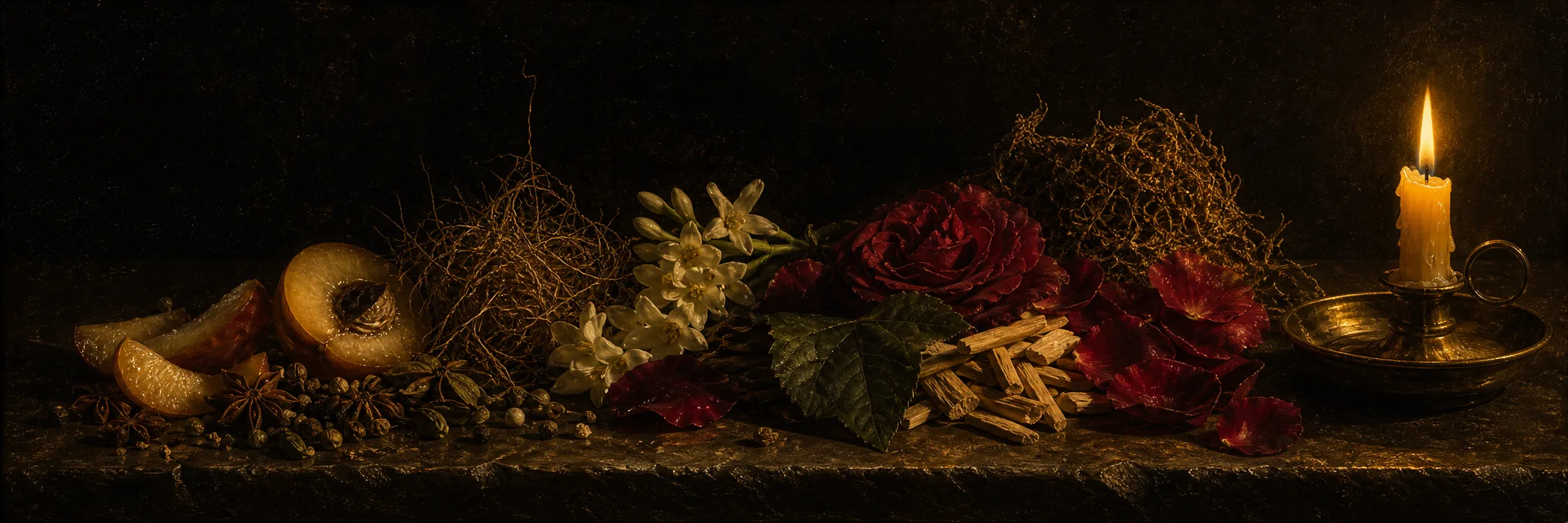
Structurally it’s a compact fruity chypre: a lychee-led fruity top, a rose heart, and a patchouli-and-woods base. In practice wearers describe a fuller build than the official pyramid suggests — a fuzzy, slightly ozonic-fruity opening (the lychee reads to some as aquatic, one of the few genuinely dated touches) that resolves quickly into a woody rose with a grassy green streak from the patchouli. A richer materials set sits behind the scenes — mandarin, geranium, pink pepper, nectarine, rose apple, heliotrope, vanilla, and specialty woody-musk aromachemicals — which explains why the rose reads jammy and fruity rather than dewy. The drydown is where the “classy” reputation comes from: a dry, powdery rose-patchouli that wearers repeatedly compare to far pricier chypres, with one striking comparison calling the whole thing “a very light Agent Provocateur.” It is smoother and more blended than most drugstore rose-patchoulis — the “loud” blast, when it happens at all, is confined to the first twenty minutes before the composition settles into its true, quiet register.
Performance
Performance is the fragrance’s weak point and the source of its sharpest criticism. Both longevity and projection run modest to weak, with accounts describing it vanishing within a few hours or being nearly undetectable even close to the skin. Others fare better, finding a subtle-but-tenacious skin scent with decent staying power once it settles, though projection stays gentle regardless. The honest expectation: a soft, close-wearing fragrance that lives near the skin after the first half hour. Given how inexpensively it can be found, reapplication is a non-issue for fans, and the low price buys real forgiveness for the weak performance.
Wearing Context
This reads as an office and daytime rose — subtle and sophisticated enough for professional settings. Its softness and classical dry-rose register make it versatile across seasons but best in cooler-to-temperate weather, where the patchouli has room to ground it. It skews more mature than its youth-marketed packaging implies; the gap between the “trying too hard to be down with the kids” campaign and a scent that wears like something a more elegant, older woman would choose is a recurring observation. It is an easy, non-challenging, non-offensive rose — essentially the antithesis of its own marketing, and a solid choice for understated daily rose-patchouli wear.
Comparisons & DNA
The recurring reference point is Agent Provocateur (2000), the spicy, musky, saffron-rose chypre, with Loud read as its lighter, cheaper, fruitier descendant. From there the lineage runs to the genre’s flagship, Frédéric Malle Portrait of a Lady — released the same year as Loud — the maximalist dark-rose-patchouli benchmark against which all rose-patch compositions get measured; Loud is essentially a whisper-volume, fruit-topped budget cousin. It is also compared to Yves Saint Laurent Rive Gauche, sometimes used as a substitute once that scent was discontinued, and to the “rock ‘n’ roll” rose of Jean Paul Gaultier Ma Dame, which shares Loud’s music-and-youth theme and 2010-era styling. Within the fruity-rose-patchouli mainstream, it also sits near Narciso Rodriguez For Her. Its own-house sibling, Loud for Him (patchouli, rose, tobacco), is the masculine mirror and is, by most accounts, the better-regarded of the two — a modern masculine rose some rank among Hilfiger’s most sophisticated releases.
Reception
This is a textbook misunderstood flop. At retail it died quickly, with store-level accounts describing shelves of unsold box sets. But after discontinuation, sentiment softened considerably, coalescing around a “marketing problem, the juice is just fine” verdict that recurs almost verbatim across independent reviews. Aggregate quality scoring sits middling, dragged down by the performance complaints and the whiplash between the name and the actual scent, but the qualitative commentary skews warmer than the numbers suggest — many wearers describe rediscovering the fragrance and being pleasantly surprised. Critical coverage is essentially nonexistent, since this was always a budget designer release; its reputation is entirely wearer-built. The dominant narrative: Hilfiger made something genuinely nice and then sabotaged it with a concept and a bottle that promised the opposite.
Versions & Reformulation
No documented reformulations — its commercial life was too short. Note-list sourcing is inconsistent across records: some reduce it to lychee, rose, and patchouli, while others list a considerably more elaborate mossy-woody pyramid with mandarin, geranium, opoponax, Bulgarian rose, nectarine, rose apple, Georgywood, musk, heliotrope, and vanilla. The catalog’s lychee/rose/patchouli should be treated as the ground-truth skeleton, with the longer lists representing the fuller materials palette. It launched in Europe in October 2010 and reached the US in spring 2011, marketed under the Estée Lauder Companies license before discontinuation.
Acquisition Notes
Discontinued, but a cheap grail rather than an expensive one — for now. It circulates on discounter and clearance channels and the secondhand market at low prices, and the appeal has always been getting a classy-feeling rose-patchouli for pocket change. As remaining stock dries up, expect prices to creep, but there’s no vintage-grail premium yet. Buyers should double-check they’re getting the feminine “Loud for Her” (pink bottle) rather than “Loud for Him” (black) — the two are distinct compositions. Because the fragrance is so soft to begin with, a degraded or improperly stored bottle will be nearly imperceptible, so condition matters more than usual here.
Notable Facts & Lore
- British rock duo The Ting Tings wrote “We’re Not The Same” specifically for the Loud campaign and reportedly had input into the fragrance’s development.
- The bottle is styled as a vinyl record — pink and translucent for her, transparent black with stereo-knob-style silver stoppers for him — a deliberate music-object gimmick from designer Chad Lavigne.
- One especially memorable characterization describes Loud as smelling like “the dirty t-shirt of a teenage girl after doing a cheerleading performance.”
- The house’s masculine counterpart, Loud for Him, is generally considered the better-regarded of the pair.
- The enduring joke around the fragrance is that something named “Loud” is remembered for being anything but.