Ensar Oud — Blue Kalbar
Essence
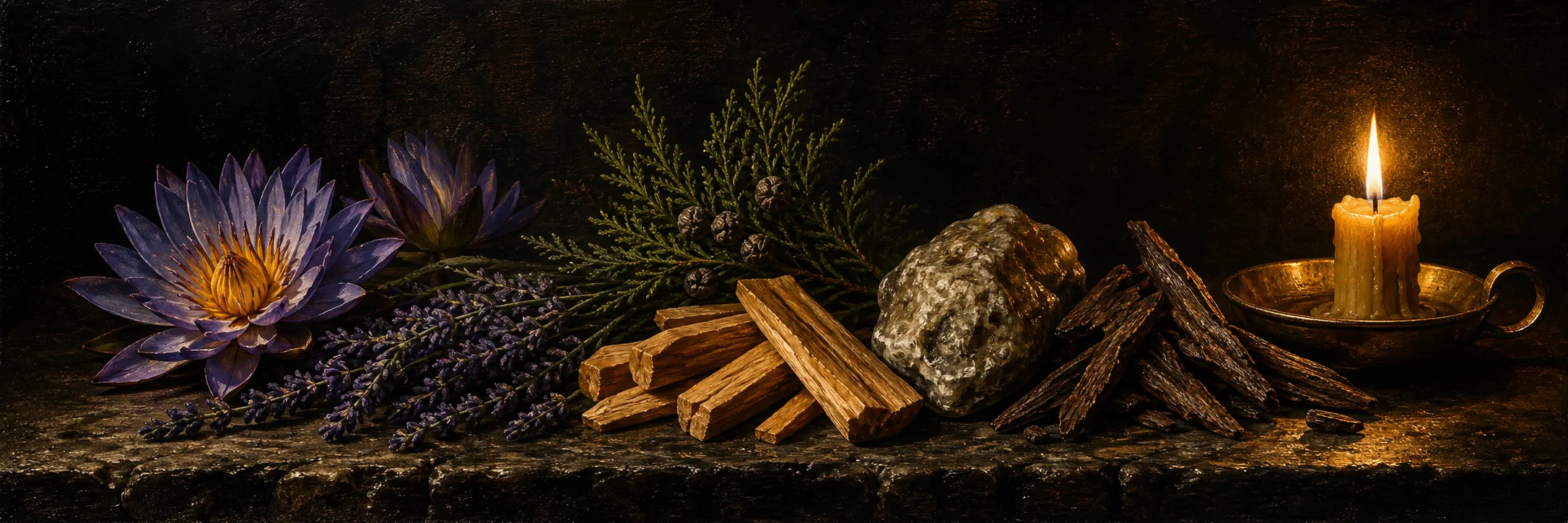
Blue Kalbar is one of the clearest blue-lotus-first fragrances in Ensar Oud’s universe: a musky-floral oriental where lotus, lavender, cypress, sandalwood, ambergris and civet matter more to the lived experience than any loud oud effect. What makes it distinctive is the tension between airiness and density - it can smell cool, breezy and almost aquatic from a distance, yet up close it turns creamy, powdery, musky and faintly animalic. It is not a brute-force artisanal oud; it is a blue floral aura with expensive materials under the skin.
Scent Profile
The opening is where the lotus earns the fragrance’s reputation, centering blue lotus, lavender and a dry green-cypress frame. The first few minutes can read airy, aromatic and slightly soapy, the lavender and cypress giving a cool breeze rather than a sweet bouquet. Some find it beautiful and calming; others hear something generic or chypre-adjacent, even a little potpourri-like. The listed mimosa, magnolia and orange-blossom effects rarely appear as separate flowers, instead thickening the opening’s abstract floral glow into an unmistakable cool, ethereal blue wash over sap, air and polished wood. In the heart it becomes creamier and more textural, sandalwood and ambergris rounding the structure while cypress, cedar and pine keep it from turning buttery or cosmetic. The strongest reviews describe a balanced contrast between airy lotus and dense floral-woody materials. Critics counter that the base is too quiet: cedar shows more than sandalwood, and oud, civet and ambergris register as texture and undertone rather than legible notes. If you come for dirty oud or obvious civet it may feel too polite; if you come for lotus over creamy wood it makes sense. The drydown either becomes transcendent or underwhelming depending on expectations. Admirers find a powdery musky base where lotus survives, wrapped in ambergris and civet and smoothed by sandalwood; detractors hear a base that goes bland too quickly. The signature accord is blue lotus over creamy sandalwood and ambergris, on a dry cedar-cypress chassis with a faint animalic halo. Evolution is moderate, shifting from airy blue florals into a softer musky-woody hush while staying recognizably itself.
Performance
Performance is concentration-dependent and one of the most disputed parts of the profile. The pure parfum is rated for good longevity and a moderate trail, while reviews split more sharply: some report moderate-to-strong projection with good longevity, others only around six hours with little sillage. A cautious synthesis is moderate projection in the first hours, roughly 30 to 60 cm off skin when fresh, tapering to a close aura, with about 6 to 8 hours on skin for many wearers and more from the richer parfum. The EDP and pure parfum differ: the EDP has a brighter opening and loses the animalic edge, becoming gentler and office-friendly, while the parfum carries deeper, longer-lasting body. Application should stay controlled, especially in oil form, where dabbing beats flooding.
Wearing Context
Blue Kalbar is easiest to place in spring, early summer and temperate indoor wear; the lotus-lavender-cypress profile keeps it from feeling seasonally heavy, while the creamy sandalwood and ambergris keep it from going transparent. It is suited to quiet proximity rather than public projection - cool offices, galleries, dinner tables, train rides where you want a refined aura rather than a statement cloud - and reads meditative and breezy, like dry wood, sap and cool air. It can feel wrong anywhere that calls for unmistakable impact or overt sensuality; expecting a roaring oud-animalic or a tropical white-floral bomb, it can feel too courteous. Socially it is intimate, polished and slightly esoteric, and its real risk is anticlimax rather than offense.
Comparisons & DNA
Within Ensar’s catalog, Kam Kyoryo is the obvious house reference: Blue Kalbar sits in similar green-chypre territory but reads deeper with better florals. Against the house’s Mystical Lotus, several wearers prefer Mystical Lotus decisively for its oudy bottom and compositional force, making Blue Kalbar the earlier, airier, lotus-sandalwood idea and Mystical Lotus the fuller, more rose-and-oud-developed relative. Ensar Oud Borneo Zen shares an animalic oud backbone but pushes greener jasmine and tea, where Blue Kalbar is oilier, more lotus-led and more saline-creamy. Areej Le Dore Musk Khabib occupies the same animalic floral cedar-chypre space but is judged compositionally stronger. There is no convincing cheap clone lineage here; the relevant alternatives are other artisanal naturals.
Reception
Reception is broadly positive on scent and much more divided on value and performance. The core praise is unusually consistent: blue lotus is the reason to smell it, with that narcotic, serene, cooling or buttery-lotus effect feeling special and sandalwood and ambergris giving a beautiful cushion. Several wearers call it warm, inviting, calming, even hug-worthy, and in blue-lotus discussions it is a recurring reference point. The recurring criticism is equally stable: the oud, civet and ambergris sit too quietly relative to the reputation and price, some hear soap or headache-inducing abstraction, and value complaints are everywhere, with reviewers questioning the cost when cheaper artisanal competitors cover similar ground. The honest verdict is strongly no for a blind buy unless you already know you respond well to blue lotus, soft animalics and airy sandalwood; sample first even as an experienced wearer.
Versions & Reformulation
Blue Kalbar has a more visibly branched release history than most niche fragrances. The 2019 original exists as an attar and later spray variants, with both EDP and pure parfum forms listed as concentration variants. The EDP gives a brighter, more projected opening, while the pure parfum carries deeper body and the house’s characteristic lasting punch. A 2021-era update was described as superior to the original, with upgraded ingredients, a move from Siberian to Tibetan musk, smoother texture and better longevity. The line continues to branch, with a 2025 EDP and a 2026 version in the EO Monuments collection; the newer release is described as more balanced, creamy and woody-spicy while still recognizably blue at the center - a refinement of the same lotus-led theme rather than a rewrite.
Acquisition Notes
Blue Kalbar is firmly ultra-luxury, with pricing framed around $20 per ml for the pure parfum and a correspondingly expensive sampling ecosystem. Access points less to mainstream decant sites than to direct-house purchase, gifts-with-purchase and word-of-mouth, with a typical path being a tiny bottle, a rare restock and a tipoff. Common sizes include small oil bottles, 10 ml or gift-sized sprays, and 30 ml parfum or EDP formats on the secondary market. Counterfeit risk is less street-fake than provenance ambiguity in the artisanal-oud secondary market, so buy direct or through known forum-connected sellers rather than anonymous discounters.
Notable Facts & Lore
- The launch story centers an exceptional blue-lotus oil Ensar personally sought across the Thai countryside, with difficulty re-sourcing the material cited as the reason for the fragrance’s long hiatus.
- A reproduced note claims regional blue-lotus absolute production runs only around three kilograms annually, needing roughly three tons of flowers for one kilogram of oil.
- Blue Kalbar’s identity is inseparable from blue lotus, and its stop-start availability is part of its lore.
- It is a standard reference in blue-lotus conversations, remembered less as an oud perfume than as a balanced, approachable blue-lotus composition with serious materials beneath it.
- When enthusiasts ask for luxury blue-lotus perfumery, it is one of the first names that comes up.