Ensar Oud — Hajar Aswad
Essence
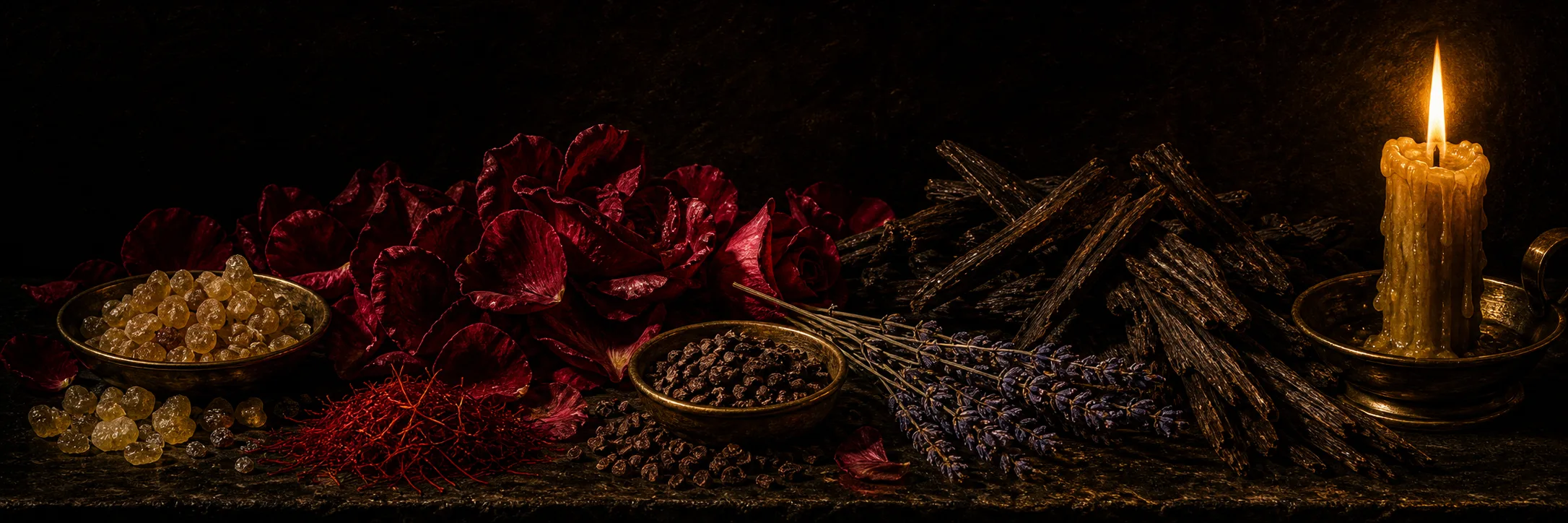
Hajar Aswad is an artisanal rose-oud-incense spray from Ensar Oud, released in 2021 as the house’s first perfume rendition of Hajar Aswad and pitched as a Ramadan homage, “the pilgrim’s perfume.” Built around real artisanal oud (Maroke and Sumatran), saffron-and-coffee-draped rose, frankincense, spices, and an ambergris carrier, it aims to bottle the smoky vapor of burning oud rather than mere resinous richness. Rare, expensive, limited-release, and now largely sold out, it is artisanal enough to have essentially no clone.
Scent Profile
Hajar Aswad opens on a soft cedar-frankincense suaveness laced almost immediately with smoky oud, captured as smoke — “the vaporous heated scent of oud smoke wafting from your shirt” — rather than the more common resinous undertone. A bright fruited-floral accent appears early: depending on edition, raspberry, saffron, and rose, or a coffee-draped rose, with cardamom, lavender, and lemon balm up top. The effect is incense-smoke shot through with red, glowing floral-fruity streaks, the raspberry, rose, and saffron keeping the composition from going too dry or unbearable. The heart, which carries the bulk of the wear since this is a relatively linear oud-centric perfume, is a rich flowery incense: saffron- or vanilla-draped rose petals sinking into a cinnamon-sandalwood note, with jasmine and orange flower threading through, all steadily incensed into wafts of oud smoke. A recurring, distinctive impression is of an honest cigarette-tobacco note in a well-worn leather armchair, a smoky, slightly leathery, contemplative facet that arises from the oud-incense interplay even though no tobacco is listed. Spices read as pepper and cardamom dipped in cacao, with cocoa and coffee in the base adding a dark, dusty richness. The drydown is what Ensar calls agarose, his coined term for the unitone chord where rose and agarwood fuse into a single seamless oud-rose accord rather than separable notes. The base is oud, Hojari frankincense, sandalwood, cocoa and coffee, and a Sultan Qaboos ambergris tincture used as the sole carrier to lift and project the whole. Oud, rose, incense, saffron, the fruity raspberry lift, and cocoa are perceptible, while sandalwood, jasmine, and vanilla support rather than star, since it is difficult to smell past the oud. The arc moves modestly from brighter smoky-floral to a deep oud-rose-amber unitone, the oud-incense core dominant throughout.
Performance
Performance reports are genuinely split. One summary calls projection and longevity above-average, and the house credits the Sultan Qaboos ambergris with impressive lift and beautiful sillage. Independent reviewers temper this: one EDP wearer reported 10 to 12 hours of longevity with rather mediocre sillage, and an aggregator rated both merely fair, even calling it suitable for hot weather. A reasonable expectation is strong longevity of roughly 10 to 12-plus hours on skin and longer on clothing, with projection that is moderate and intimate rather than beast-mode, though a few users report heavy projection, indicating real skin-dependence. As an oud and ambergris composition it should bloom in warmth while remaining a cool-weather natural, and a light hand of a couple of sprays goes far. There is a genuine evidence gap, with no critic measurement and only sparse informal data.
Wearing Context
Hajar Aswad is best for cooler weather, evenings, and contemplative or spiritual occasion wear, framed by the house as a Ramadan and pilgrim’s perfume not meant to inspire the ego, something to pair with a cup of introspection. Reviewers echo an almost spiritual, calm-reflection mood, though its smoky oud intensity makes it a statement on anyone unaccustomed to real oud. It is unisex in the Middle-Eastern idiom of rose, oud, and saffron. It shines as a luxurious, meditative oud-rose for special occasions, religious observance, and oud connoisseurs who want artisanal materials, while in Western or office contexts the smoky real oud can read as intense and polarising. It is emphatically not an easy compliment scent — one oud-averse recipient passed it on over its intensity — and hot, casual, mass-social settings are a poor fit.
Comparisons & DNA
Built on real distilled oud and a genuine Sultan Qaboos ambergris tincture, Hajar Aswad has no clone or designer dupe, and one effectively cannot exist, since the specific vintage materials are not reproducible at scale. Comparisons are therefore impressionistic and category-level. The closest reference points are other Ensar Oud rose-oud compositions and, for the general smoky rose-oud-incense idiom, mainstream niche oud-roses such as Amouage and Montale rose-ouds, which use reconstituted or blended oud accords and so smell cleaner, louder, and more perfumey than this raw artisanal oud. As a quality register rather than a smell-alike, one reviewer called the pure-parfum “the luxury version of The Moon by Frédéric Malle.” A useful disambiguation: many Middle-Eastern makers use the name Hajar Aswad for traditional Kaaba attars, but the Ensar release borrows only the sacred name and theme and descends from the house’s own oud-perfumery lineage.
Reception
Documented reception of this specific perfume is very thin, with deep oud-forum coverage essentially absent — a genuine evidence gap rather than consensus. One major listing carries zero reviews, and the prominent forum thread asking whether a Hajar Aswad fragrance exists is actually about traditional Kaaba attars by other makers. The few real independent reviews are mixed-to-respectful rather than ecstatic: one EDP wearer called it a very solid fragrance that offers nothing special and no wow effect, citing 10 to 12-hour longevity and mediocre sillage, while a pure-parfum reviewer admired the craftsmanship but was not blown away. Others split sharply — a fan finds the incense-cocoa-oud base smooth and addictive enough to need a backup bottle, while an oud-averse recipient could not justify keeping it. The house’s own testimonials are uniformly glowing but vendor-curated. The consensus, such as it is, is that this is expensive, polarising real oud best sampled rather than blind-bought.
Versions & Reformulation
Multiple editions and concentrations exist, and the picture is genuinely tangled. The house offered Hajar Aswad as an Eau de Parfum and a higher Gold / Pure Parfum tier, with a Silver Edition Pure Parfum surfacing on the secondary market. The 2021 original and a later edition differ in stated notes — the earlier copy describes three artisanal ouds, vanilla, Bornean cinnamon, and Mediterranean spices, while later copy specifies Maroke and Sumatran oud, coffee and saffron, and Arabian spices with cocoa — so buyers should expect edition-to-edition variation typical of small-batch artisanal releases. Both the EDP and Pure Parfum are marked apparently discontinued. There is no single canonical Hajar Aswad, only batches and editions, so matching what you buy to a specific edition’s notes matters.
Acquisition Notes
This sits in the ultra-luxury artisanal tier. At an authorised reseller the perfume has ranged from $29.99 for a 1ml sample up to $499 for the top size, offered in 1ml, 30ml, and 50ml and in both EDP and Pure Parfum as a limited release, while the house values the 50ml Gold Pure Parfum considerably higher, around $999. As of mid-2026 the house’s own pages show it out of stock and it is listed discontinued, though an authorised reseller may hold limited remaining stock. A 1ml sample is the main official sampling route, since mainstream splitters do not reliably carry artisanal Ensar oud. The bigger authenticity concern here is dubious Sultan Qaboos material claims generally, so buy direct from the house or a trusted authorised reseller; no batch-code decoder applies.
Notable Facts & Lore
- The house framed Hajar Aswad as its first perfume rendition of the theme, created to honor Ramadan as “the pilgrim’s perfume” meant to instil “humble reverence, with a whiff of what lies yonder.”
- Ensar stated the intent plainly: “This wasn’t going to be just another Oriental perfume. I wasn’t chasing the 1001 Nights.”
- The technical challenge was capturing smoky rather than merely resinous oud.
- He describes it as “at once Jamali and Jalali, beautiful yet powerful,” and coins the term agarose for its fused oud-rose drydown chord.
- It uses a prized Sultan Qaboos ambergris tincture as the sole carrier.
- The name invokes the Hajar al-Aswad, the Black Stone of the Kaaba, which is why the perfume centers on pilgrimage and introspection rather than ego.
- It has appeared in a Harrods advent calendar, putting a sacred-themed artisanal oud in front of a mainstream luxury audience.