Ensar Oud — EO No 1
Essence
EO No 1 is Ensar Oud’s first spray perfume (2018) and effectively the proof-of-concept that an all-natural artisanal oud distiller could build a Western-style cuir rather than a swipe-on attar. It is a leather-oud-rose composition in the Cuir de Russie lineage, built around real Taif rose, multiple high-grade ouds, deer musk, civet and a raw ambergris-tincture base instead of plain ethanol. Distinctive because almost nothing in it is synthetic, which gives it a density, “buzz” and roughness mainstream leathers don’t have — and a polarizing price. It is the cornerstone of the EO No 1 franchise.
Scent Profile
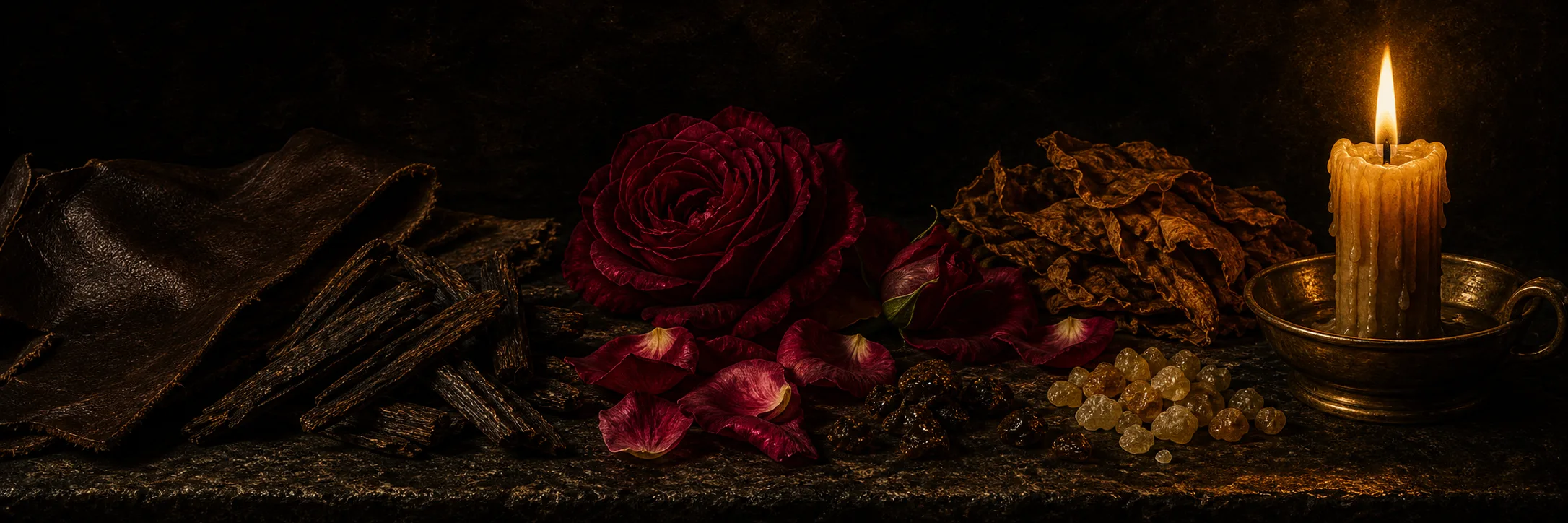
Given the listed leather, oud, four roses (Taif, Turkish, French, Bourbon), tobacco, lavender, jasmine, ylang, oakmoss, incense and animalics, the wear breaks into three clear movements. The opening (first 10–20 minutes) is the most divisive: a dense, spicy-herbal blast where lavender and a green/peppery facet collide with raw animalics — civet and a castoreum-like funk reviewers repeatedly call “stalky,” “barnyard” or “medicinal.” Some batches read as a hard slap of cooling Taif rose; others open almost fecal-rubbery, gasoline-tinged, behind a muddled essential-oil haze. This is not a clean designer top. The heart (1–3 hours) is where it resolves: the multi-rose accord turns jammy and smooth, tobacco and a hay-like nuance join, jasmine adds indole, and the leather emerges slowly — soft, smoky, “vintage horse-saddle.” The drydown (3+ hours) is the consensus high point: leather recedes and a sweet, resinous incense takes over, with sandalwood, oakmoss and brown tobacco leaf supporting a deep oud-and-ambergris base. As a skin scent it is warm, woody, balsamic and faintly sweet. Perceptible notes: leather, rose, tobacco, lavender, incense, oud and the animalics. Submerged/structural: ylang and jasmine read mostly as indolic lift rather than distinct flowers; oakmoss is a textural shadow, not a chypre spine. The signature accord is leather-oud-rose fused over ambergris — Ensar’s own framing is “leather and oud go together like king and crown.” It is evolutive, not linear: a genuine top-to-base arc that several wearers describe as “shapeshifting,” getting something different each wear. The rawness of all-naturals means the experience is less polished than a synthetic leather and more like smelling the constituent materials in motion.
Performance
Wearer reports converge on strong longevity and restrained sillage — an unusual profile driven by the natural materials. Longevity on skin is routinely cited at 11–12 hours, with several wearers reporting the scent still clearly present at 12 hours; on clothing it can persist far longer (the leather pouch some editions ship in famously holds the scent for weeks). Projection is moderate: punchy for the first hour, then close to the skin, with sillage frequently described as “not effervescent” — i.e., this is not a beast-mode room-filler despite its intensity. A minority report 2 meters of projection and very heavy early sillage, suggesting batch and application variance. Heat amplifies the animalic and resinous facets (some find it too much in high heat); cooler, dry conditions flatter the leather and incense and are the safer bet. Application strategy that recurs: dab or 1–2 sprays rather than full blasts, because the concentration is high and the opening is intense to an untrained nose; several owners note it improves and “settles” with months of maceration, so freshly received bottles can read quieter than aged ones.
Wearing Context
Best in autumn and winter and in cool evenings — the leather, tobacco, incense and oud profile is a cold-weather, dress-up scent. Time of day skews evening and “occasion”: weddings, formal dinners, cigar-and-whisky settings. Multiple wearers report feeling “elegant” in formalwear with it and getting heads turning. Where it shines: intimate, indoor, sophisticated contexts and on people who appreciate naturals and animalics. Where it falls flat: hot, humid daytime, offices and crowds — the animalic opening can read as off-putting or “barnyard” to the uninitiated, and one wearer noted that when he let many people smell it, “really NOBODY liked the scent.” Social-perception skew: it is a connoisseur’s leather, not a crowd-pleaser; it rewards a wearer who is comfortable that bystanders may not “get” it. It is fully unisex but leans classically masculine/elegant in the leather-tobacco register.
Comparisons & DNA
EO No 1 sits squarely in the cuir tradition Ensar explicitly invokes — Chanel Cuir de Russie and Knize Ten are its reference points; one reviewer noted that the real musk-and-herb facet in EO No 1 is precisely what old animalic leathers like Knize Ten try to recreate with synthetics, making EO No 1 “the real thing” but rougher. Within Ensar’s own catalog, it is widely reported to be built on Ensar Oud Sultan Leather Attar — one owner blind-bought it and was “shocked that it is simply Sultan Leather Attar,” and Ensar’s own narrative credits Sultan Leather’s success as the trigger for making EO No 1. Against artisanal peers, Areej Le Doré (leather-oud work) and Bortnikoff occupy the same all-natural niche; EO No 1 is rosier and more leather-forward than typical Bortnikoff ouds. A sharp critical comparison pits it against Francesca Bianchi The Lover’s Tale, arguing Bianchi’s floral-leather-animalic is arguably better blended and roughly one-seventh the price — a useful louder, more value-driven alternative. No true designer or mass-market clone of EO No 1 exists; the all-natural materials make it effectively un-cloneable, and the closest analogues are other natural leather-ouds rather than flankers.
Reception
Reaction is genuinely split, and the splits are predictable. Praise centers on depth, complexity, “shapeshifting” evolution, a “to die for” drydown, and the unmistakable quality of real oud, real ambergris and real deer musk; admirers call it “complex, deep, challenging and… wonderful” and “the product of a nose who has tasted the sublime.” Criticism clusters on three axes: the opening, described as a “confused mishmash” and “just not blended well” by a skeptical wearer who found it not premium-smelling; value, since at a frequently cited ~$600/30ml several wearers flatly reject the price; and performance expectations, since buyers expecting beast-mode sillage are disappointed by its moderate projection. The polarization is essentially naturals connoisseur versus value or conventional-performance buyer. No major critic — Bois de Jasmin, Now Smell This, Çafleurebon, Colognoisseur, Persolaise, Luca Turin, Chandler Burr or Denyse Beaulieu — has covered it. The recurring blind-buy verdict is to sample first, ideally an aged sample, because the opening and the high concentration take acclimation; owners who love it tend to love it deeply, while detractors find it overpriced for the experience.
Versions & Reformulation
EO No 1 launched in 2018 in two concentrations — an Eau de Parfum and a Pure Parfum. The Pure Parfum is the more intense, more animalic, longer-lasting reading; the EDP is described as “a brighter and more toned down version” of the Pure Parfum. Because the materials are natural and finite, Ensar has reissued the No 1 profile repeatedly with different oud sourcings, each retaining the core DNA but shifting dimension: No 1: Manipur (an early second iteration, Hindi-oud-forward), EO 1: Assam (rounder, more traditional Assamese oud, marketed as the closest to the original and steeped in Sultan Qaboos’s ambergris), EO 1: Sultani (2023, spicier leather, aged Assam oud, more refined Taif rose), EO 1: Hainan 2005 and No 1: Kynam (the highest-concentration version, with kynam added on top of the standard No 1 base). These are flankers/limited editions rather than reformulations of the original; each is its own batch, and Ensar notes the naturals mean no two batches are exactly reproducible.
Acquisition Notes
Ultra-luxury pricing: roughly $600 per 30ml for the Pure Parfum is the figure most often cited, with bottle sizes including 15ml, 30ml and 50ml across editions. Ensar Oud’s own policy is that they do “not split or decant” their offerings, so there is no official sampling channel and access to small quantities comes through informal splits. Fakes are a documented problem for Ensar’s pure oud oils, and the house does not use serial numbers or batch codes, which complicates authentication — so the safest route is buying direct from the house’s own site rather than marketplace listings. Editions are distinguished by sticker or plaque styling rather than printed batch codes.
Notable Facts & Lore
- Ensar framed No 1 as his deliberate entry into the European cuir canon — “an OUD-inspired rendition to the legacy of Cuir de Russie et al.” — describing leather and oud as “king and crown.”
- He said that after “15 fragrant years” distilling oud he was “finally taking off my jungle jacket for a tie” to make his “debut spray parfum.”
- The launch materials list unusually conspicuous ingredients: a “$2,500/3gr ‘Oud Kyara Mustafa oil,’” “Wild Oud Hainan Sinensis from China,” “13 Years Pure Thai Oud,” and aged rose oil “from the Private Collection of Sultan of Oman Qaboos.”
- Ensar claims the composition is infused into a “high-concentration, genuine raw ambergris tincture instead of just plain ethanol,” saying similar tinctures sell for around £400 for 30ml on their own.
- This was the first Ensar Oud spray, positioned as proof that connoisseurs wanted wearable blends, not just neat oils — the foundation of EO’s entire perfume line.
- It seeded the No 1 dynasty of flankers (Manipur, Assam, Sultani, Hainan 2005, Kynam), each a different oud sourcing over the same DNA.