Ensar Oud — Homeros
Essence
Homeros is Ensar Oud’s “Odyssey” perfume, a dense, shape-shifting oriental-woody built around oud, ambergris, deer musk, tobacco, leathery animalics, and a bouquet of Mediterranean florals and citrus. Conceived during the 2020 lockdown on the Antalyan coast facing the Greek islands, it was the house’s first collaborative composition, refined through feedback from a circle of artisanal-perfume connoisseurs. Deliberately non-linear and complex, it blasts open with musky citrus and bitter florals over charred driftwood, then settles into a salty-ambergris, oud-tobacco-leather base, distinctive for its “every wearing is different” reputation.
Scent Profile
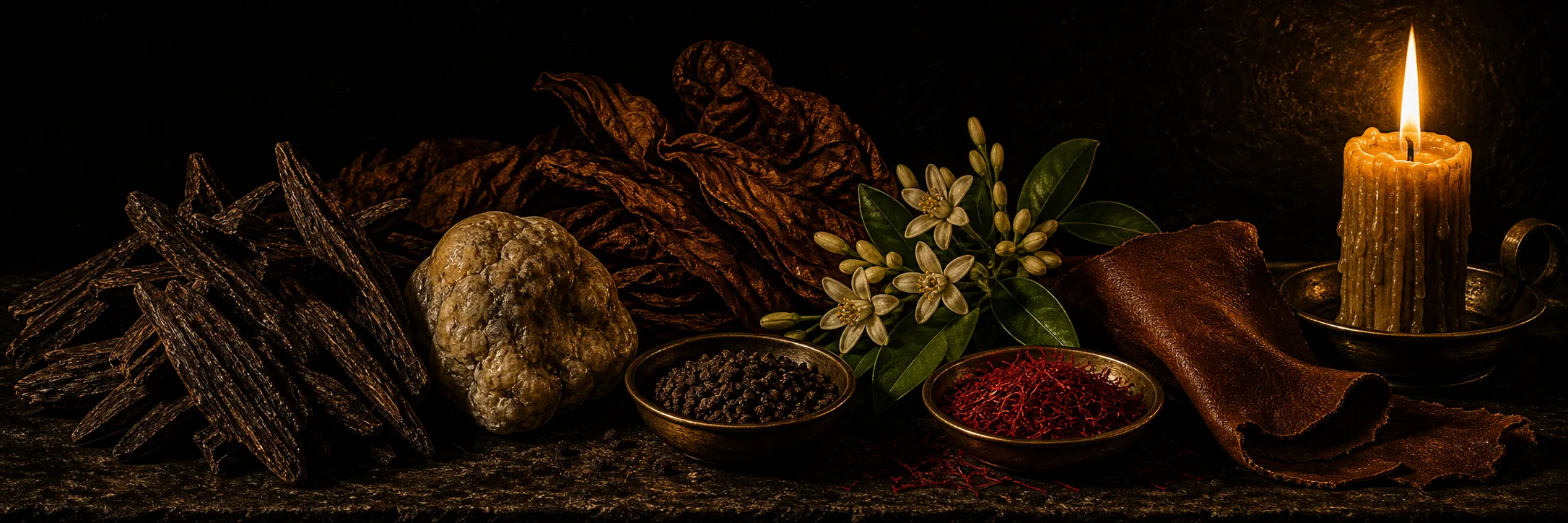
The structure is unusually loaded, and the house warns that Homeros “is not a perfume where you remove the top notes to reveal the heart.” In practice, the opening over the first 10 to 20 minutes is a blast of musky, citrus-laden bitter florals: bergamot and orange-blossom brightness immediately cut by animalic castoreum and a lurking civet, with green, resinous cypress and a charred-driftwood smokiness, while saffron carries currant, agarwood, and orange-flower facets. The heart, from one to three hours, turns darker, smokier, and cooler, a dry, bitter smokiness with a faint eucalyptus edge. The florals — rose, osmanthus, mimosa, orange blossom — are more sensed than spotlit, blurring into the whole exactly as the house intends, while the tobacco plays hide and seek, sometimes acrid, sometimes a dry cured-Burley accord that leans animalic. The drydown past three hours is the house signature: earthy, woody, leathery oud, salty white ambergris, Siberian deer musk, tobacco, tolu balsam, patchouli, oak, and a whisper of cacao. Ambergris, oud, tobacco, the castoreum and civet animalics, and cedar are perceptible, while the individual florals, elderflower, mimosa, and cacao register as nuance rather than distinct notes. The fragrance is genuinely evolutive rather than linear, with owners reporting different notes taking the lead on different wearings. The signature accord is a salty-ambergris, smoky oud-tobacco-leather chord with an animalic underbelly and a bitter-citrus-floral overlay.
Performance
Projection and longevity rate above-average to strong, though reports conflict. Many cite longevity over 12 hours with quite powerful sillage in the opening, and one Pure Parfum owner reports two sprays lasting well over 14 hours with excellent projection. A dissenting account finds sillage dies down quickly and wear time fleeting, unable to smell it past the fourth hour, a split likely reflecting batch maceration and skin chemistry. The opening is the loudest phase, after which the scent grows more intimate, a denser skin-level aura that one wearer framed positively as not annoying anyone. The natural-materials build and strong opening make a conservative one to two sprays to skin the norm. Skin versus clothing longevity is not separately documented.
Wearing Context
Homeros is a cool-weather, evening-leaning fragrance whose smoky, leathery, animalic, tobacco-and-oud weight suits autumn and winter and after-dark or special-occasion wear far better than hot daytime use. Its Mediterranean-summer inspiration of salty sea air and citrus groves lives in the concept and the bright opening, but the dominant character is dense and warm. It skews masculine-of-unisex through its leather, animalic, and tobacco profile, though it is sold and worn unisex. It shines as a contemplative art-piece scent that owners count among the most complex bottles in their collections, best in cool, intimate settings where its evolution can be appreciated. It would fall flat in heat, in scent-sensitive professional environments, or for anyone wanting a clean, crowd-pleasing fragrance, since the animalic opening is polarizing.
Comparisons & DNA
Within the house, Homeros is most often tied to EO No 1, which one critic claims it simply beefs up in the drydown, with kinship in the opening to Oud Zen and Saringkarn. For external comparison, a critical reviewer names Areej Le Doré’s Oud Zen and Oud Luwak, plus Bortnikoff’s Oud Monarch, as very similar, arguing Homeros is more stuffed and busily blended than those alternatives. Another likened the original Parfum to a vintage Creed Bois du Portugal, while the salty-animalic-ambergris facet draws a cross-reference to Areej Le Doré’s Baikal Gris. As an obscure artisanal natural composition, Homeros has no clone or designer dupe.
Reception
Reception is favorable but low-volume and notably polarized, with no mainstream critic coverage. Praise clusters around complexity and craft: owners call it a complex work of art, the most complex bottle in their collection, and “God tier” among their artisanal fragrances, with several buying backups. The shape-shifting “every wearing is different” quality and the quality of the naturals draw the strongest admiration. The criticism is unusually pointed for the house: one detailed reviewer argues it is neither original nor worth its extreme price and that its sillage dies down quickly, while another found the Parfum too loud, too aggressive, and too consistent in a negative sense. Others simply say it is not worth the price. The polarization axis is complexity-and-quality enthusiasts versus value skeptics who find it derivative of EO No 1. The consensus is to sample or decant first rather than blind-buy.
Versions & Reformulation
Homeros is not a single static product. The original launched in 2020 as a Pure Parfum, with an EDP-style spray also referenced. A strictly limited Homeros Ambre of 42 bottles worldwide followed, with darker juice, more sourness in the rose, less smoke, and more pronounced ambergris and civet, built to follow the recipe’s original course before the final Homeros made a U-turn. A Homeros Attar version exists, which one experienced owner judged the most beautiful and best-balanced of the lot. In 2022 the house re-released Homeros SQ, smokier, sweeter, more tobacco- and chocolate-leaning and more mass-appealing, with more oud and added cypress. These are distinct editions rather than reformulations of one formula, and the original 2020 release is regarded as belonging to a creative era that will not exist again.
Acquisition Notes
This sits in the ultra-luxury tier, listed at $595 on the house’s offerings page and consistent with its $400 to $800 spray-parfum band, while the limited Ambre and attar commanded more secondhand. The house does not officially decant or split, so trial quantities come via individual splitters rather than the major decant services, which generally do not stock it. The realistic risks are turned or aged juice, misidentified editions, and unmacerated fresh bottles underperforming, so confirm exactly which edition you are buying since they smell different. Resale is active secondhand; buy authentic directly from the house or trusted resellers and verify the specific edition.
Notable Facts & Lore
- Homeros has the most documented backstory of its siblings: it “was born during lockdown, because of lockdown,” composed while Ensar was stranded in southern Antalya within sight of the Greek islands.
- The house states it “was composed by an anosmic perfumer through the prism of his fellow fragheads’ input and feedback,” with collaborators acting as his “surrogate nose.”
- Named contributors steered the final formula, which “made a U-turn” away from the five original Odyssey iterations.
- The white ambergris is again attributed to a Sultan Qaboos source.
- Its naming theme of Homer, Odysseus, Ithaca, and Ogygia makes it the house’s most literary release.
- The only recurring controversy is the broader critique of the house’s pricing and self-laudatory marketing.