Ensar Oud — Jungle Kinam
Essence
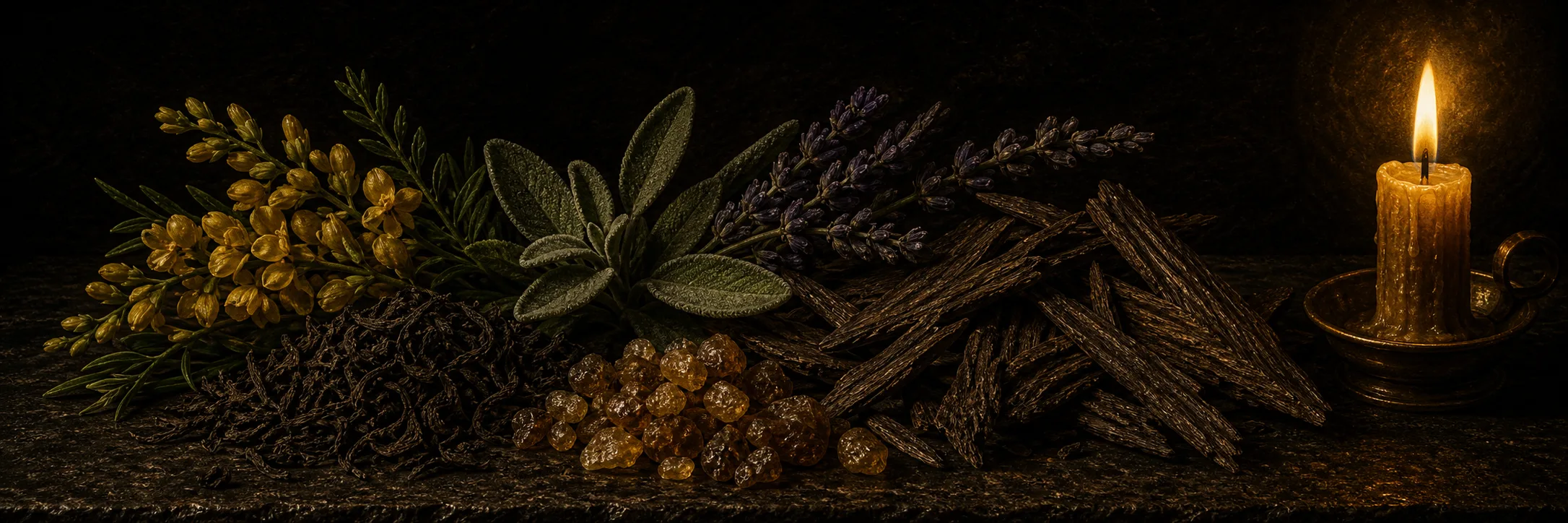
Jungle Kinam is the green-black side of Ensar Oud: a damp, bitter, smoky aromatic-oud composition built around tea, sage, broom, lavender, and two oud signatures that read more swamp, bark, and herbal resin than polish or luxury gloss. What makes it distinctive is not a pristine kinam illusion in the Japanese-incense sense, but a jungle-floor realism that many wearers describe as musty, bitter, leathery, amaro-like, or even birch-tarry. When it works, it smells like tropical rot and green fire; when it does not, it smells hostile.
Scent Profile
The opening is dark and immediately divisive. Some find a sweet tea-and-incense entrance with smoked wood, while others reach for harsher language: toasted dark chocolate, leather, damp smoke, mugwort, mentholated herbs, birch tar, even a bug-spray bitterness. This is a perfume where the note list is technically accurate but incomplete as lived experience. Tea and sage are perceptible and lavender is present, but the overall effect is not a tidy herbal fougère; it is a smoky, humid, resin-soaked green mass, with the aromatics acting like flashes of light through foliage rather than isolated notes. The oud in the opening is usually green rather than funky, woody rather than medicinal, and often less obviously kinam than the name implies. In the heart, the composition becomes more coherent and more obviously jungle, with a split personality: a marshmallow-y herbaceous bitterness from the oud-dark base offset by sweet blue and purple flowers, particularly lavender. Wearers add bitter green tea, leathery undertones, hot resin sinking into earth, sage sparks, and astringent teak-like wood. This is where broom, tea, sage, and lavender are most legible. The dark green-brown oud becomes the chassis, but not in the barnyard mode some oud wearers expect, and several critics complain it lacks obvious oud or kinam character, coming across more woody-vetivery than oudy. That complaint defines the polarization: lovers want the jungle accord, detractors want more oud payoff. The drydown stays in the same ecological zone but loses some of the opening’s aggression. A cedar- or vetiver-like woody dryness becomes more apparent, with bitter-tea and sage tones still staining the composition, a green-brown oud takeover, a delicate animalic undertone, and a final impression of rotten fibers, swamp light, and damp wood rather than plush amber or clean incense. It evolves by moving from harsh, bright bitterness into a denser, wetter wood-smoke hush. The signature accord is bitter green tea and sage over smoked Papuan and Thai oud, with floral-lavender illumination and damp jungle-floor darkness underneath.
Performance
Jungle Kinam wears more persistently than its airy-green profile suggests, though the EDP has thinner coverage than the pure parfum. The pure parfum rates well for longevity and moderately for sillage, and a cautious read suggests roughly 7 to 10 hours on skin for many wearers, with a noticeable but not room-filling aura through the first few hours before it settles close. Reports are split, from strong and even oppressive to a skin scent after four or five hours, so the fairest description is variable, usually persistent, and sometimes surprisingly quiet for the material profile. Cooler weather flatters it, the bitter-smoky-herbal profile making more sense in cold or rainy conditions than in heat. Application should be cautious, two or three measured sprays rather than a heavy hand, since the opening’s bitterness can dominate if you overshoot.
Wearing Context
Jungle Kinam is best in autumn, winter, rain, and low light. It reads like damp bark, smoke, tea leaves, herbs, and swamp resin, so it belongs in settings that can absorb that mood: nighttime walks, cold-weather casual wear, solitude, cafes, bookish settings, and enthusiast gatherings where strange naturals are read as interesting rather than wrong. It works for people who enjoy smelling dark without defaulting to leather-amber heaviness, since its greenness is not fresh but wet, tannic, and shadowed. Where it feels wrong is anywhere expecting instant approachability; one reviewer flatly calls it “not blind buy safe,” and wormwood, birch tar, crushed herbs, mustiness, and strange smoky sweetness are all common reactions. It can fail in offices, on warm bright days, or around people who associate green with lightness and cleanliness. Socially it skews niche-enthusiast rather than compliment-seeking, and the relevant axis is simply one’s tolerance for bitter, smoky, vegetal darkness.
Comparisons & DNA
Jungle Kinam is positioned as one of the Ensars that breaks away from the house’s familiar internal DNA, contrasted with the EO1, Sultan Leather, Tigerlust, Homeros, and Kyara Koko cluster and recommended to those who want something outside that family. It is less leathery-musky-gilded and more bitter-smoky-herbal. Compared with Kyara Koko it is the riskier, darker, more crushed-herb option, while Kyara Koko is the safer choice. Compared with Monsieur Oud, another new-DNA Ensar, it is much less citrus-bright and far more swampy and dense. Externally, its oud style recalls Ensar’s own Aroha Kyaku, a dark, mentholated, herbal-birch-tar effect, and an amaro analogy to Averna and Fernet Branca captures its bitter-sweet medicinal-herbal tension. There is no serious clone economy here; this profile lives in the small artisanal-natural world, not in substitutes.
Reception
Reception is positive at the ratings level and polarized in the text: the average rater likes it. The strongest praise focuses on atmosphere, with fans calling it a dense mossy jungle floor, dark smoked tree resin, or bitter green tea with leather, and even admirers describe it as immersive and transportive rather than conventionally beautiful. The criticism is severe but coherent: detractors hear mustiness, wormwood, mugwort, birch tar, bug spray, or general over-green unpleasantness, and several question the amount of oud relative to the name and price, arguing it smells more like a woody-vetiver-herbal construction than a great kinam-oud statement. Opinion runs from “love it” to “one of the worst Ensars I tried,” about as clear a polarization signal as exists. No mainstream critic reviewed it, and the verdict is unanimous on one point: this is sample-only territory, not a blind buy, even for experienced oud wearers.
Versions & Reformulation
Jungle Kinam has at least three version stories: the 2021 original, a later “Jungle Kinam PP 2022” ranked fairly highly for smell and performance though sparsely documented, and the 2025 Jungle Kinam: Pekanbaru in both pure parfum and EDP. Pekanbaru is described as a sweeter, spicier release, with early impressions calling it a fruity verbena thing, signalling a meaningful shift away from the original’s bitter swamp profile. There is not enough side-by-side reporting to map a clean vintage-versus-current verdict for the original formula, so the safe conclusion is that the line has multiple later continuations, with Pekanbaru the clearest departure: sweeter, more spice-forward, and less swamp-dark than the 2021 scent.
Acquisition Notes
Jungle Kinam sits in the ultra-luxury artisanal tier, with pricing data unusually explicit: a 30 mL bottle is cited around $600, and secondary-market listings show 30 mL pure parfum bottles in circulation. A 2021 “Classics” EDP set also contained 9.5 mL bottles of it. The practical landscape is therefore tiny-format EDPs, scarce 30 mL pure parfum bottles, and forum-mediated sampling rather than broad retailer stock. Provenance matters with all artisanal oud, since authentication is harder than with mainstream perfume and there is no standardized batch-code system; the safest route is a direct-house purchase when available or a trusted seller in known enthusiast circles.
Notable Facts & Lore
- Its biggest lore point is its name: in oud circles, “kinam” is a loaded word, and some hobbyists are skeptical when perfumers use kyara or kinam language for bottled oils and perfumes.
- One critique argues that oud oils and perfumes can imitate only some kinam nuances, never the full depth of real heated kyara, an expectation the fragrance does not consistently meet.
- Ensar describes kyara and kinam as a long-term obsession, saying that capturing the “green dragon’s” breath became a defining prism for many of his projects.
- The 2025 Pekanbaru edition, filed under the EO Resin collection, shows Jungle Kinam is part of an ongoing attempt to bottle green, resinous, kinam-adjacent atmospheres.
- Even admirers frame it as immersive and transportive rather than pretty, smelling “like one has crawled out of the rainforest.”