Lancôme — Jasmins Marzipane
Essence
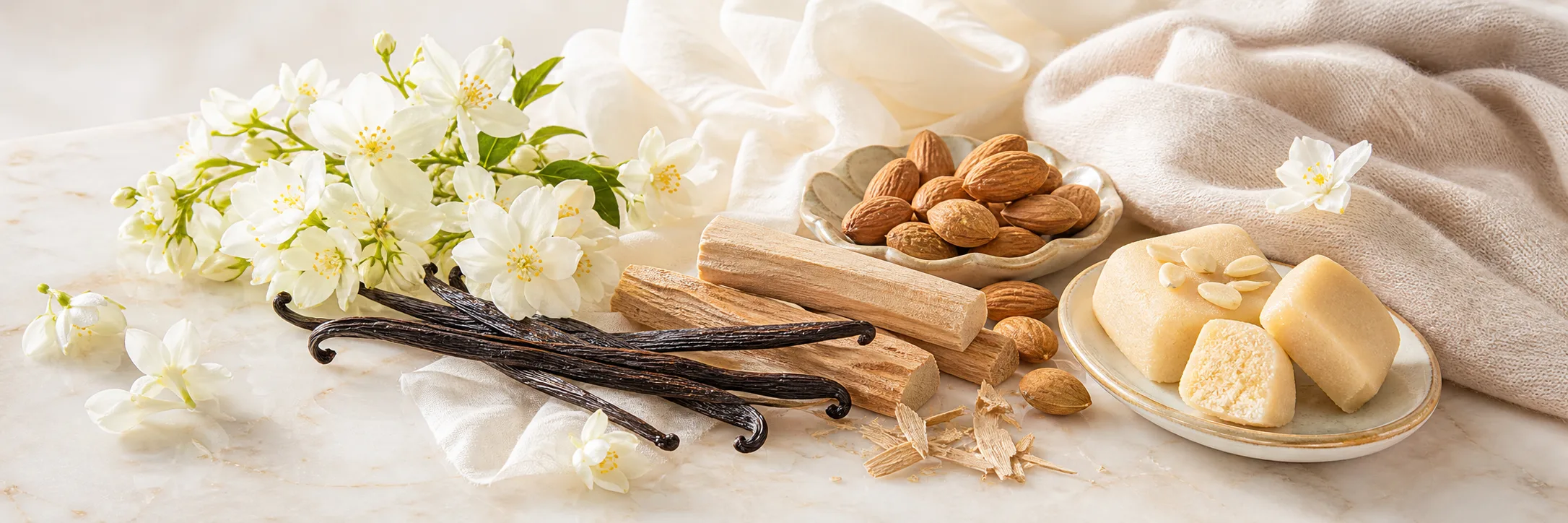
Jasmins Marzipane is a 2016 release from Lancôme’s upscale Maison Lancôme “Grand Cru” collection, composed by master perfumer Dominique Ropion. Despite the dessert-evoking name, it’s not a gourmand — it’s a rich, full-bodied, near-soliflore jasmine (sambac plus grandiflorum) with only a soft sprinkle of nutty-vanillic marzipan and a clean musky-woody base. Elegant, “expensive”-smelling and slightly old-school, it divides wearers between those who find it a beautiful creamy jasmine and those who find it soapy, sterile or simply too pricey. Now discontinued.
Scent Profile
The opening is jasmine-forward and bright: a lush, slightly indolic sambac jasmine, often with a lemony or astringent-citrus lift that a few find harsh for the first minute before it settles. Some get a quick hit of sweet almond alongside; others smell almost no almond at all and find it juicy-fruity jasmine that quickly turns cleaner. Within the first fifteen minutes the indolic/green edge calms and the composition becomes woodier and nuttier — at this point several reviewers compare it to Givenchy Organza.
Through the heart (one to three hours) it’s “all about the jasmine,” and a pretty one — fuller-bodied than the thin, green Hedione-driven jasmines, sweeter, with a noticeable indolic twang that softens over time. The marzipan is present but subordinate: a hazy, vanillic-almond nuttiness that rounds the flower rather than competing with it; this is emphatically not a foody almond gourmand. Some skins read it as soapy/clean “laundry-detergent jasmine,” others as creamy and cuddly. Around the fourth-to-fifth hour the cashmeran (cashmere wood) becomes more noticeable, lending an abstract berry-woody facet — one detailed reviewer caught a “caramelised wild strawberry” effect.
The drydown (three hours-plus) resolves into a clean white musk infused with a fading sweet-jasmine floralcy, with sandalwood and cashmeran providing a soft, slightly dry woody floor. As a skin scent it’s a gentle musky-jasmine whisper. Linearity: fairly linear in theme (jasmine dominates the whole arc) but with a perceptible shift from indolic-green opening to creamy heart to clean musky-woody base. Signature accord: full, slightly indolic sambac jasmine over hazy marzipan and clean musk. Perceptible: jasmine (dominant), almond/marzipan (soft), musk, cashmeran. Submerged: vanilla (subtle), sandalwood (supporting); the “creamy” quality is debated.
Performance
Performance is the most common complaint. Projection is light to moderate — many call it soft, intimate, even “a whisper” sitting close to skin; one wished it could be turned “from a 2 to a 9.” Sillage is modest, appropriate for a refined floral but underwhelming for the price. Longevity is the bright spot and is paradoxically strong: many report 6–10+ hours, with some saying it “lasts and lasts” close to the skin even as projection stays low. wearers ratings reflect this split: scent ~7.9, longevity ~7.6, sillage ~7.2 (several hundred ratings). It can run sweeter and heavier in heat; reviewers warn it could feel overwhelming above ~30°C, suiting it better to spring and cooler seasons. Best strategy: apply generously (it rewards more sprays given the soft projection), and to pulse points and clothing for the longevity.
Wearing Context
Best in spring and autumn, and workable year-round except high summer heat where the sweetness can intensify. It reads feminine and elegant — “warm and feminine,” “smells expensive,” a “fancy perfume for special occasions” per its fans — but is billed unisex and the clean, non-sugary jasmine could work on anyone who likes white florals. It shines as a refined daytime or office floral (its softness is an asset there) and for dressed-up occasions; it’s a compliment-getter for many wearers. Where it falls flat: anyone expecting a sweet almond gourmand from the name will be disappointed, and beast-mode seekers will find it too quiet. Those who dislike indolic or soapy jasmine should avoid it.
Comparisons & DNA
The single most-cited comparison is Dior Pure Poison (and its Pure Poison Elixir drydown) — reviewers, including one who suspects Ropion essentially “recreated” Pure Poison, call Jasmins Marzipane a softer, creamier, less laundry-ish, sweeter cousin; many find JM more coherent and the jasmine more pronounced. Equally frequent is Van Cleef & Arpels California Réverie — described as nearly the same vibe (clean sambac jasmine), to the point some owners of one see no need for the other. Tom Ford Jasmin Rouge comes up repeatedly as the richer, more challenging, more interesting relative (“about 70% less interesting” but less challenging, per one). Other comparisons: Givenchy Organza (woody-nutty jasmine in the early phase), Serge Lutens À La Nuit (JM is the muted, creamier, sharp-edges-removed version), and Acqua di Parma Mandorlo di Sicilia (for the almond facet — one called JM “the love child of Pure Poison and Mandorlo di Sicilia”). For a near-exact dupe, wearers point to indie house DUA’s “Jardin de Jasmine” as “uncannily” close. Its DNA sits in the lineage of polished designer jasmines, executed with niche-quality materials at a prestige price.
Reception
wearers sentiment (wearer reports, wearer reports, wearer reports) is genuinely split. Admirers call it “the best jasmine fragrance,” “undeniably beautiful,” creamy, feminine and compliment-pulling, and lament its discontinuation. Detractors — including some who revere Ropion — are harsh: “Dominique Ropion how could you make something so basic?”, “laundry-detergent jasmine,” “medicinal … sterile … hand soap,” and several frustrated that the marzipan/almond is barely there and the price is steep for what it is. CaFleureBon’s Ida Meister was favorable, grouping the Maison Lancôme Grand Crus as skewing “towards the gourmand in the loveliest manner possible … premium quality components in the capable hands of perfumers with proven expertise,” and crucially advised it be “dabbed, not sprayed” to avoid “Murder By Sillage.” Axes of polarization: name-vs-reality (gourmand expectation vs. floral reality), soft performance vs. the price, and soapy-clean vs. creamy-pretty skin readings. Blind-buy verdict: risky given the price and divisive soapy/soft tendencies — sample first, especially if you want sweetness or projection; safe mainly for confirmed jasmine lovers who value elegance over power.
Versions & Reformulation
Single EDP composition within the Maison Lancôme collection; no documented reformulations during its run. It is now discontinued, which has elevated its desirability among fans (multiple “why would they discontinue this?” laments and backup-bottle buying). It sits alongside its Grand Cru siblings — Lavandes Trianon and Parfait de Roses (and others like Roses Berberanza, also discontinued) — which share the collection’s “art of blending around a main note” concept and the distinctive two-gold-plate bottle.
Acquisition Notes
Luxury/niche-prestige pricing tier — Maison Lancôme Grand Cru was priced well above Lancôme’s mainstream line (wearers references put it around 150 euros for 50ml in some markets). Commonly available in 100ml (and smaller eBay-circulating 15ml) EDP. As a discontinued item it now trades on the secondary market (eBay) and via decanters: Scent Split and The Perfumed Court-type splitters carry it, making sampling feasible. Counterfeit risk is moderate for a discontinued prestige floral — buy from reputable sellers; the heavy two-gold-plate bottle is part of the line’s identity and a quality tell. No widely published Lancôme batch-code decoder is essential here, but verify authenticity through seller reputation given discontinuation-driven scarcity and rising prices. For a near-identical alternative, the DUA “Jardin de Jasmine” is the wearers-cited option.
Notable Facts & Lore
- Maison Lancôme was launched as a homage to founder Armand Petitjean, with Lancôme appointing top contemporary perfumers and framing the line around “the very French art of blending,” each scent “crafted in the same manner that one composes a wine of the most superior grade (Grand cru).” Lancôme’s own copy for Jasmins Marzipane emphasizes a “duo of the highest quality natural hand-picked jasmine,” with “Sambac jasmine absolute, gathered at dawn from the first harvests.” The persistent wearers talking point is the name-vs-reality gap: a fragrance called “Marzipane” that is overwhelmingly jasmine and only faintly almond, which sets up disappointment for anyone expecting a sweet almond gourmand — a recurring theme in reviews.
- Its discontinuation turned it into a quiet cult favorite, with fans hunting backups and seeking dupes.
- No major celebrity or viral-TikTok moment is documented; its lore is the Ropion pedigree, the Pure Poison-recreation theory, and the discontinuation-driven scramble among jasmine devotees.