Lancôme — Oud Bouquet Eau de Parfum
Essence
Oud Bouquet is Lancôme’s mainstream-luxury take on the Middle Eastern rose-oud genre, sweetened into something closer to a gourmand than a traditional attar. It’s a sticky, jammy rose laid over a soft “Western” oud, with a praline-chocolate base that gives it a bonbon edge most rose-ouds don’t have. Distinctive less for innovation than for being an approachable, polished, department-store-priced gateway oud — and infamous in the wearers as the original of which Swiss Arabian’s much cheaper Shaghaf Oud is a near-identical clone.
Scent Profile
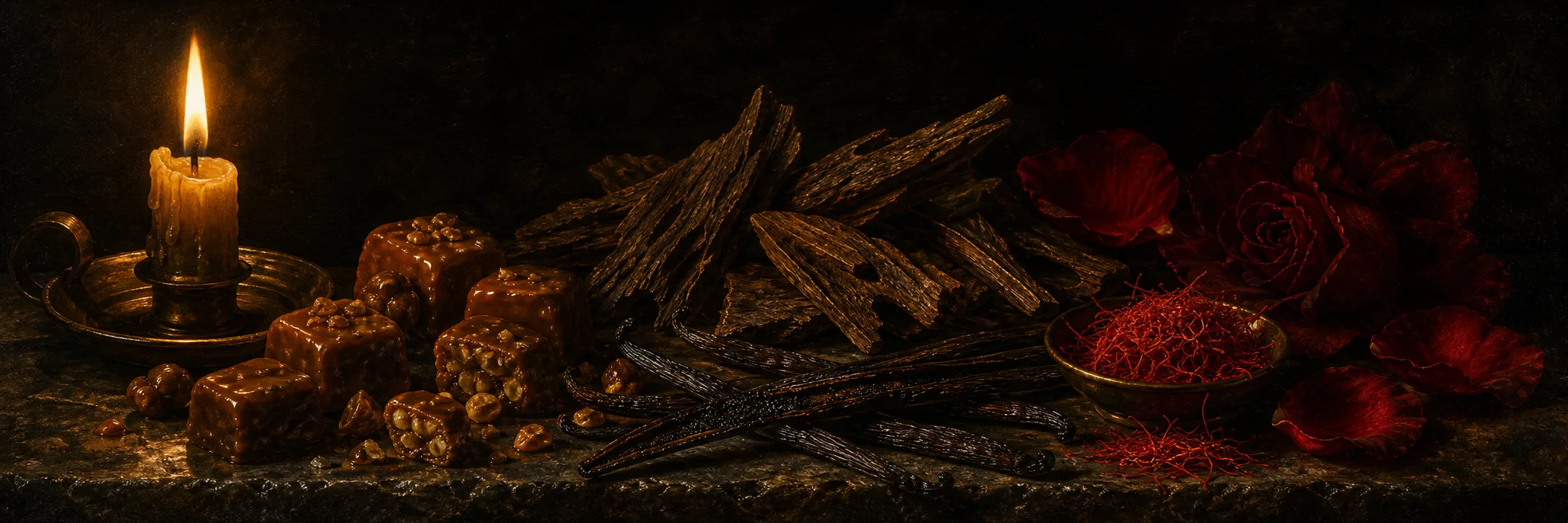
The listed pyramid (saffron top; rose and oud heart; praline and vanilla base) does not unfold as a tidy three-act pyramid in wear — multiple reviewers describe the notes as “dancing around you,” surfacing in rotation rather than sequence. The opening is the most conventionally “oud-rose” stretch: a gentle, slightly dry saffron paired with a lush, plush red rose that reads jammy rather than fresh-cut. The rose is not especially distinctive or naturalistic — it’s a sweet, almost candied rose. The oud arrives within minutes and is the friendly kind: not the barnyard/medicinal agarwood of true Hindi oud, but a smooth, clean, cedar/sandalwood-adjacent woodiness that several note “is more woody than actual Oud.” Saffron and rose carry the first 10–20 minutes.
In the heart (roughly 1–3 hours), the composition’s defining move emerges: the praline. This is the signature accord — a creamy, nutty, genuinely chocolate-bonbon praline that sweetens the rose into something edible. It’s what separates Oud Bouquet from the dozens of rose-ouds it sits beside. The vanilla reinforces this, smoothing the woods. Whiffs of mild smokiness and woody hints come and go. The oud stays present but submerged — supporting, never dominating. Anyone expecting a dense, dark, smoky oud will find it conspicuously absent; the dominant mid-stage character is sweet, semi-gourmand rose with a praline drizzle.
The drydown (3+ hours) is where it settles into its skin-scent identity: a creamy vanilla-praline base with the rose and a soft woody-oud thrum underneath. Some compare the far drydown to vintage YSL M7’s woody base “with cotton candy tacked on.” It is broadly linear after the first hour — evolution is subtle, mostly a matter of the praline and vanilla swelling forward as the saffron/rose recede. Perceptible notes: rose, praline, vanilla, saffron. Submerged: the oud (always background), with the saffron fading fastest. The signature accord that defines its character is unquestionably the rose-praline pairing.
Performance
Performance is a genuine strength and was rated above-average by wearers aggregators. Projection is strong in the opening — one reviewer noted it “vanished every other smell in the room” at an office. It’s a several-spray-maximum fragrance; it can easily overwhelm. Expect strong projection for the first 2–3 hours settling to a moderate arm’s-length presence, then an intimate skin scent. Longevity on skin is commonly reported at 7+ hours, with many citing all-day wear; on clothing it is tenacious, with reports of it surviving until the garment is washed. It performs best in cold weather — multiple wearers call it a winter/cold-evening fragrance that can turn cloying in heat. The sweetness and density mean humidity amplifies it; dry cold flatters it most. Best application: go light (one to two sprays) and let it bloom rather than layering sprays.
Wearing Context
This is a cold-weather, evening fragrance first and foremost. Best in autumn and winter, mostly at night, and it shines in intimate, dressy, or cozy settings — a gala, a date, or curling up at home. The Tea Scented Library blog summarized it as “luxurious enough for a gala event and comforting enough for cozying up with a book and a blanket.” It falls flat in heat and bright daylight, where its density reads as heavy or “old-fashioned.” Social perception is genuinely split and relevant: it skews feminine-leaning unisex, and reactions polarize hard — some find it seductive and sophisticated, while detractors (including family members in cited anecdotes) read it as “old grandma mixed with incense and a strong medicine smell.” It’s a fragrance to test before committing, not a crowd-pleasing safe blind buy.
Comparisons & DNA
The single most important comparison: Swiss Arabian Shaghaf Oud (the gold-bar bottle) is a near-exact, far cheaper clone of Oud Bouquet — multiple owners of both say “side by side in dry down I can’t tell the difference,” with Shaghaf’s opening slightly more oud-forward. Given Oud Bouquet’s discontinuation and inflated secondary pricing, Shaghaf is the wearers’s default recommendation. Jo Malone Velvet Rose & Oud is frequently floated but is drier and lacks the praline sweetness — not a true match. Lancôme’s own L’Autre Oud (2012) is the predecessor in the same oud line. Within the rose-oud-gourmand space, it sits near Tom Ford Black Orchid (one reviewer suspects Pellegrin “had Black Orchid in mind” — both rich, sweet, earthy, complex) and Maison Francis Kurkdjian Oud Satin Mood (sweeter, heavier rose-oud; Oud Bouquet is the more “foamy/fluffy” textured of the two). Armani Privé Rose d’Arabie is comparable but Oud Bouquet is described as a slightly bolder, faster-fading version. Other dupes cited include Morph’s Indomable (sweeter) and Alhambra layering tricks. This is a follower, not a trendsetter — a mainstream house’s competent entry into the rose-oud trend that Montale, By Kilian, and the Arabian houses had already established.
Reception
available critical coverage is thin — no documented–2 critic (Turin/Sanchez, Bois de Jasmin, NST, Colognoisseur, Persolaise, Çafleurebon) published a review of Oud Bouquet that surfaced; this dossier leans on documented wearer signal. wearer consensus on wearer reports, wearer reports, and wearer reports is broadly positive but polarized. Praise centers on the well-blended quality, the standout praline, strong performance, and the bargain value when it could be had cheaply from discounters. wearer reports’ Varanis Ridari (Scented Devil) gave it a thumbs up, calling it “a relatively approachable, high-value Western oud with a lot of uniqueness” — but only “if the price is right,” noting the original ~$30 discounter price made it a “My First Oud” staple, a recommendation he can no longer make at inflated current prices. The major axes of polarization: oud purists find the oud too faint and the whole thing too sweet/synthetic; others find it cloying or “medicinal/grandma.” A recurring complaint is reformulation degradation (see below) and that the “2023 version” is “weak and bad.” Blind buy verdict: NO — both because of polarizing scent and rampant fakes/reformulation confusion; sample first or buy the Shaghaf clone.
Versions & Reformulation
This is genuinely complicated and matters. There are at least three iterations under the “Oud Bouquet” name: the original 2014 version signed by Christophe Raynaud (Reynaud), launched exclusively at Harrods at £120 for 75ml (per launch coverage, succeeding the 2012 L’Autre Oud); a 2016 version attributed to Fabrice Pellegrin (folded into the “Maison Lancôme / Les Parfums Grands Crus” collection, and given its own separate wearer reports entry with a slightly different note list including guaiac wood and copahu balm); and a 2018/later edition with no perfumer credited and a redesigned bottle. wearer consensus: the original 2014 Raynaud blend was oudier with a more pronounced praline and “projects beastly,” while later versions softened the opening oud “funk” and lean more rose/woods and less sweet (read by many as more unisex). The Scented Devil reports smelling all three and finding “no substantial difference aside from the 2014 one having a bit more kick in the opening.” A bottle redesign was confirmed around 2021, and reports of a weaker 2023 batch circulate. Collectors specifically hunt the original 2014 formulation.
Acquisition Notes
Pricing tier: positioned as mainstream-luxury (Lancôme’s premium “Grands Crus” line), originally £120 for 75ml at its Harrods launch and roughly $200 at US retail. Now discontinued in most markets, which has scrambled the market: it bounced through discounters (FragranceNet, etc.) at one point as low as ~$30–37, but legitimate stock is now scarce and secondary prices are elevated. Counterfeit prevalence is high and explicitly flagged by wearers (“it has been so hard to find one that isn’t a fake”). Decant ecosystem coverage exists but is patchy given discontinuation. Practical guidance from the wearers: because authentic bottles are hard to source and fakes abound, the pragmatic move is Swiss Arabian Shaghaf Oud as a near-identical alternative at a fraction of the price. If buying the Lancôme, verify formulation/batch and buy from reputable sellers; a 5–10ml decant is recommended before a full bottle because it’s potent (one or two sprays suffice).
Notable Facts & Lore
- The launch was a Harrods exclusive in 2014, succeeding 2012’s L’Autre Oud — Lancôme’s deliberate push into the oud trend then sweeping Western perfumery.
- The most enduring piece of lore is its status as the textbook “starter oud”: when discounters were flushing the original Raynaud formula at ~$30, wearer reports recommended it as the entry-level Western oud, effectively a next-tier Lancôme fragrance at a ground-floor price.
- Its other claim to fame is the Shaghaf Oud clone phenomenon — it’s one of the most cited examples in the hobby of a cheap Middle Eastern “dupe” matching a discontinued luxury original so closely that owners of both can’t tell them apart in drydown, prompting endless “don’t buy the Lancôme, get the Swiss Arabian” threads.
- No documented perfumer statement specific to this fragrance surfaced in available sources, and the multiple uncredited reformulations are themselves part of its murky reputation.