Lancôme — Miracle Homme
Essence
Miracle Homme is an early-2000s woody-spicy masculine and one of Francis Kurkdjian’s first designer commissions, built around an unusual coffee-and-maple-syrup idea folded into dry, mossy woods. It is the rare mainstream men’s release of its era that smells more like a quiet watercolor than a department-store powerhouse: subdued, semi-gourmand, slightly austere. Discontinued and now a collector’s curiosity, it is remembered as a “hidden gem” whose distinctiveness — burnt-sugar warmth over peppery cedar and vetiver — was undercut by famously weak performance.
Scent Profile
The opening is the most divisive ten minutes: a pepper-green-woody accord that reads astringent, dry and faintly bitter, with a slightly aquatic, “goofy” top note that several reviewers single out as oddly placed. The listed pimento (red pepper) is perceptible as a juicy, tea-like piquancy; oakmoss is structurally present rather than loud, lending a mossy-bitter spine. Within the first 20 minutes the impression is of a sour, dry sharpness contrasted by a “fresh feel” rather than any single citrus.
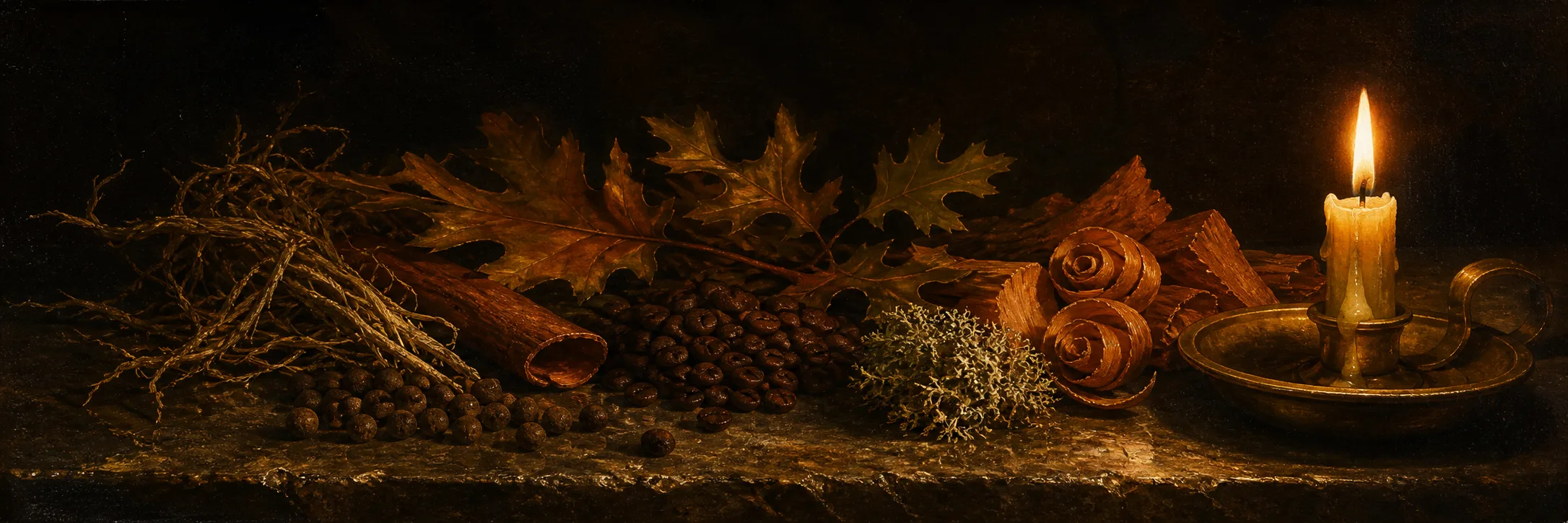
As it warms (roughly the first 1–3 hours), the cedar and Brazilian rosewood push forward, becoming rounder and warmer than the opening suggested. This is the stage most fans love: a woody-spicy-powdery middle in which the coffee note appears — but reads less like espresso and more like a mellow, roasted, silky-powdery suede, sweetened by the signature maple/maple-syrup accord. Reviewers repeatedly describe a “burnt maple leaves and cooled coffee” character; some perceive frank maple-syrup sweetness, others a nutty, apple-sweet “foliage” note. The composition stays gourmand-adjacent without tipping into dessert.
The drydown (3+ hours, when it survives) is a soft guaiac-vetiver waft over the woody base, with mahogany providing a faintly boozy, austere edge and the maple lending residual sweetness. Mahogany and guaiac are largely submerged, felt as texture more than distinct notes; oakmoss fades early on many skins (one detailed reviewer reports “no oak moss at any point”). The frag is more evolutive than linear — opening, warm woody-coffee heart, and quiet suede-wood base are genuinely distinct — but the whole thing is rendered in muted, low-contrast tones. The signature accord is the coffee-maple-over-dry-cedar idea: a cooled-coffee, burnt-sugar warmth sitting on peppery, mossy woods. It is this combination, “never encountered before” per one reviewer, that defines its character and its cult.
Performance
This is Miracle Homme’s Achilles’ heel and the single most consistent complaint across every available sources. Projection is light to at most light-moderate; multiple wearer reports, wearer reports and reviewers call it soft, understated, with poor projection and a quiet, close-to-skin presence after the first hour. Sillage is modest — an intimate bubble rather than a room-filler. Longevity on skin is commonly reported around 4 hours, with several wearers saying it becomes “undetectable after an hour or so.” On clothing it fares better and lingers longer, as the woody-mossy base clings to fabric — vintage samples are sometimes described as smelling “soapy” in late drydown due to age. Because it was conceived as a soft, twilight, “office-safe” scent rather than a projection monster, this restraint is partly by design, but even sympathetic reviewers wish the coffee-cedar heart lasted longer. Best application strategy: overspray generously (4+ sprays), concentrate on clothing as well as skin, and treat it as a close-wear comfort scent rather than a statement. Given the discontinued status and rising prices, the weak performance is the main argument against hunting a bottle.
Wearing Context
Reviewers position Miracle Homme as a daytime, office-friendly, understated scent — “that ‘hi everyone, I’ve just been hired here’ type of office-safe elegance,” in one wearer reports line. It skews three-season: fans cite spring, summer and fall, with the dry-woody-coffee warmth working best in mild-to-cool conditions; in cold weather its softness can disappear entirely. It is a low-drama, non-offensive composition that shines as a comfort or signature “background” fragrance for work and casual wear, and falls flat anywhere you need projection — clubs, dates where you want to be noticed, or big cold rooms. a fragrance editorial framing is telling: it is best worn “during that pearlescent hour that separates night from day,” a quiet, lyrical scent for someone comfortable on the boundary between dream and reality. Social-perception skew: considered very masculine “twenty years ago,” today it reads as soft and arguably unisex; one review notes it is mature-leaning (“for the older jaguar driving early 30s/late 20s mature male”) rather than a youthful crowd-pleaser.
Comparisons & DNA
Within Lancôme’s own line, it is the masculine counterpart to the 2000 women’s Miracle, sharing the bottle silhouette but little of the scent profile. The most-cited coffee-masculine reference point is Thierry Mugler’s AMen (Angel Men) — but AMen is far sweeter, louder and more frankly gourmand-chocolate-coffee, where Miracle Homme is dry, restrained and woody. commenter reaching for substitutes most often name Giorgio Armani’s Armani Code (a wearer notes “Armani Code reminds me of Miracle”) — Code is sweeter, more anisic-tonka and far better-performing. One reviewer suggests the obscure Lancetti Homme (aka Lui) as doing “practically the same job,” and “still available on ebay for decent prices.” Within Lancôme masculines, Hypnose Homme is the better-distributed sibling that survived while Miracle didn’t, though it is a different, more aromatic-tonka direction. Because it is a discontinued early-2000s designer, there is no established, widely-recognized clone of Miracle Homme — only generic “type” recreations from custom-blend shops, which wearer reports do not treat as faithful. Lineage-wise it sits in the small lineage of coffee-note masculines (A*Men preceded it; later coffee/gourmand woody frags proliferated in the 2010s), and stands out for using coffee as a dry, powdery-suede accent rather than a sweet espresso headliner — a more subtle approach than the coffee bombs that followed.
Reception
wearer consensus is a study in contrast: high affection, low performance. In wearer reports the dominant note is mournful praise — “a true miracle,” “hidden gem,” “a truly missed scent,” with repeated pleas for Lancôme to reissue it. The most distinctive documented endorsement is a fragrance editorial “Scented Lament,” which calls it “Francis Kurkdjian’s marvelous olfactory watercolor… built on transparent and pure woody notes,” praising its dreamy, twilight restraint and arguing modern perfumery would render the same idea louder and cruder. Common praise: the unique coffee-maple-woody accord, the elegant blending, the comfort-scent coziness. Common criticisms cluster on two axes: (1) performance — near-universal complaints about projection and 4-hour longevity; and (2) a contrarian minority who find it generic — one sharp review dismisses it as “a cardamom-ish lavender on amberwood base… smells like every other mall amber fragrance,” and a reviewers says “from the pyramid and perfumer you would think this would be a a star verdict scent. Wrong… a soft-subtle-boring scent.” Polarization is essentially “unique gem vs. overrated/overpriced.” No major (Turin/Sanchez, Burr, Beaulieu) review of Miracle Homme was found; available critical coverage above documented is limited to a fragrance editorial. Blind-buy verdict: only for the curious collector who prioritizes the scent profile over performance and accepts paying a discontinued premium; one commenter flatly warns it’s “nowhere near as [worth] $200… you can get some real nice niche fragrances for that price.”
Versions & Reformulation
Single core composition (EDT), no documented reformulations during its production run. A related flanker, Miracle Homme L’Aquatonic, exists as a separate, more aquatic offering and should not be confused with the original. The line also produced ancillary products (aftershave lotion/balm, shampoo, gift sets) now circulating on the secondhand market. Because it was discontinued relatively early in its life, the main practical variable buyers face is batch age, not reformulation: older surviving bottles can read softer or “soapier” in the drydown as top notes degrade.
Acquisition Notes
Originally a designer-tier mainstream release, Miracle Homme now trades as a discontinued collectible at inflated prices — eBay and discontinued-fragrance specialists (e.g. CouCou) are the main sources, with assorted 50ml/75ml/100ml EDT bottles plus aftershave and gift-set components appearing. Some grey-market discounters still occasionally list “new old stock.” Decant ecosystem is thin for a discontinued frag of this stature; it is not a guaranteed catalog item at the major splitters, so availability is opportunistic. Counterfeiting is less of a concern than authenticity-of-age and fill level — buyers should scrutinize batch codes, fill, and seller reputation, and expect that aftershave splash versions differ from the EDT spray. Given weak performance, sample or split before committing to a full discontinued-premium bottle. Custom “type”/recreation services exist but are not whitelisted-wearers-endorsed as accurate.
Notable Facts & Lore
- The most documented piece of lore is the advertising campaign: French director-actor Mathieu Kassovitz was chosen as the face of Miracle Homme — and directed its commercial himself — on the wave of his beloved turn as Nino in Amélie (2001).
- As a fragrance editorial notes, this was an unconventional choice for a men’s fragrance ad: rather than “narcissistic muscles” or a macho hero, Kassovitz brought an art-house, lyrical sensibility, mirroring the scent’s quiet character.
- The fragrance is frequently cited as one of Francis Kurkdjian’s earliest designer works — it launched in 2001, predating the founding of his own house, Maison Francis Kurkdjian, in 2009 — and collectors prize it partly as “early Kurkdjian.” Its cult-of-the-discontinued status is the other defining storyline: it is repeatedly invoked in “bring it back” threads and “hidden gem” lists, with the irony — flagged by a reviewers — that “the only ‘Miracle’ is the price this discontinued juice now commands.”