Lancôme — Miracle
Essence
Miracle (2000) is a Y2K touchstone: a pink-juiced, lychee-ginger-pepper floral that helped define the bright, fruity-floral, “fresh” feminine register of its era. Created by Harry Frémont, Alberto Morillas and Christian Dussoulier, fronted by Uma Thurman, it is one of the most commercially successful and most argued-over mainstream florals of the last 25 years — beloved as nostalgic comfort, dismissed by others as the archetypal pleasant-but-boring department-store floral. Its single most distinctive trait is a texture, not a smell: the squeaky, slightly synthetic “lychee” effect over a peppery musk drydown.
Scent Profile
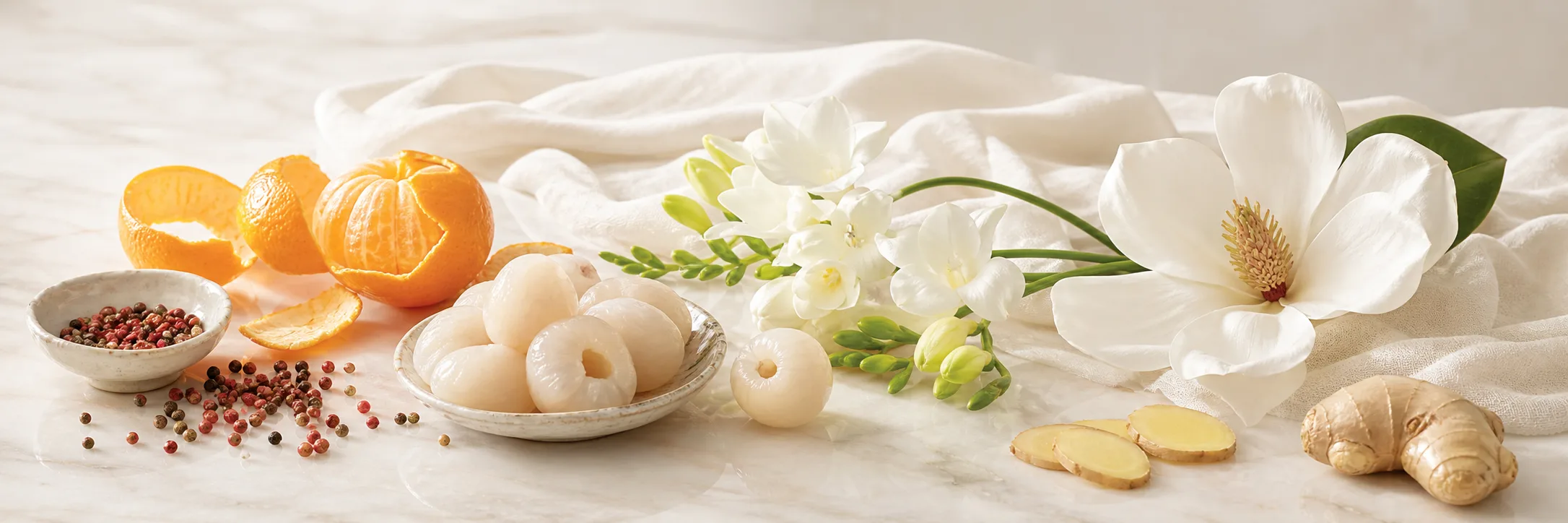
The opening is a sparkling, slightly tart burst — lychee and freesia with a peppery, gingery lift — that many describe as effervescent, “like a can of cold Diet Coke to the face,” or as “spicy orange juice.” The lychee is famously textural rather than fruity-sweet; as one detailed review put it, it carries “the texture, not the taste, of a lychee…the squeaky feeling when you bite into a lychee.” Magnolia is, to many noses, the dominant floral in the heart, surrounded by ginger, pink pepper, mandarin and jasmine. The florals are clean, non-indolic and seamless. But the early stages are short-lived, and the drydown is “entirely dominated by musky pepper” — what one reviewer called “the pepper-scented fingerprints of Alberto Morillas.” Detractors get a plasticky, shampoo-like or “ozonic plastic-y” facet, especially in current production.
Performance
The chronic weakness. Even devotees concede longevity is modest and projection light; the running joke is that “she ghosts.” Reapplication “between classes, caffeine hits, and questionable impulses” is the norm. Older/vintage batches are reported as warmer, more tropical and longer-lasting; current bottles read as lighter, sharper and more citrus-forward.
Wearing Context
A spring and warm-weather daytime scent: office-friendly, casual, uplifting, “fresh.” It is repeatedly framed as a mood-booster and a safe, versatile signature — the “clean girl aesthetic before anyone knew what that even was,” in one reviewer’s phrase. Several wearers describe it as a wedding-day or coming-of-age scent, often inherited from mothers, which is central to its emotional pull.
Comparisons & DNA
Within the spicy-fresh-floral family it is most often compared to Versace Bright Crystal (which one wearer says Miracle “smells much nicer” than), Chanel Chance Eau Tendre — for which Miracle is pitched as a cheaper alternative — and Ralph Lauren Romance. Olfactively it bears the Morillas pink-pepper signature also found in his other work of the era. Reviewers note that in 2000, building a fragrance on lychee, ginger and pepper was genuinely novel, which complicates the “generic” charge: it reads common now partly because it was widely imitated.
Reception
Among the most polarizing crowd-pleasers in mainstream perfumery. The defenders’ position is captured by the reviewer “mystified by the hate it receives,” who reads it as “PRETTY,” “bubbly, pink, suburban…in a comforting and nostalgic way - not bland.” Detractors call it “pleasantly bland,” “boring and insipid,” a “female office worker’s” scent, or — in the most colorful review — “a cold, prim, older woman…Professor Umbridge from the Harry Potter series wears this.” The polarization axes are clear: nostalgia versus novelty-seeking; tolerance for the plasticky/shampoo facet; and whether crowd-pleasing legibility is a virtue or a failing. Luca Turin and Tania Sanchez did not award it the kind of landmark review they gave Lancôme’s premium line in the 2018 Guide.
Versions & Reformulation
Reformulation is the dominant recent theme. Wearers with vintage (early-2000s) bottles describe the original as “sparkling, energetic, joyful,” with lychee and pepper “perfectly blended,” versus current production that has become “screechy and cloying,” with lychee and pepper “very sharp to the point they are overwhelming.” One reviewer specifically sought out a 2010 bottle (identifiable by a plastic collar) to recover “the warm tropical Miracle I remember.” A separate availability question has circulated: Lancôme has pulled back from mass-marketing Miracle in some Western markets (listing it as an online exclusive in the US, reportedly delisting in the UK) while it remains a top-5 bestseller in East Asian markets like Japan — so reports of “discontinuation” are better understood as regional retail withdrawal than global deletion.
Acquisition Notes
Mainstream pricing, widely discounted, and broadly available online even where pulled from physical counters (Notino, Origines and similar EU retailers are cited as continuing sources). Buyers who want the “real” Miracle should seek older batches; the warmer vintage formulation is specifically prized and traded. There is a robust ecosystem of “impression”/dupe oils (e.g., Oil Perfumery) and named soundalikes — wearers point to Zara pink-floral dupes and Avon U by Ungaro for Her as close, cheaper twins.
Notable Facts & Lore
- Uma Thurman was the face from launch in 2000, shot walking toward the dawn in a campaign by Paris agency Air, with the concept that each new day is a “miracle” one makes happen.
- The partnership later soured into litigation: Lancôme and Thurman signed a two-year contract in April 2000, with Lancôme agreeing to pay her $5.8 million for the first two years and $3.1 million for each additional year; Thurman subsequently sued Lancôme for $15 million in Manhattan federal court over continued use of her image after the contract expired (Europe in September 2004, the rest of the world that December).
- A men’s flanker, Miracle Homme, followed in October 2001, shot by Peter Lindbergh and positioned to echo Thurman’s campaign.
- The line later spawned flankers including Miracle So Magic! and the discontinued, much-mourned Miracle Forever (2006, by Dominique Ropion and Olivier Polge).