Parfums de Marly — Akaster
Essence
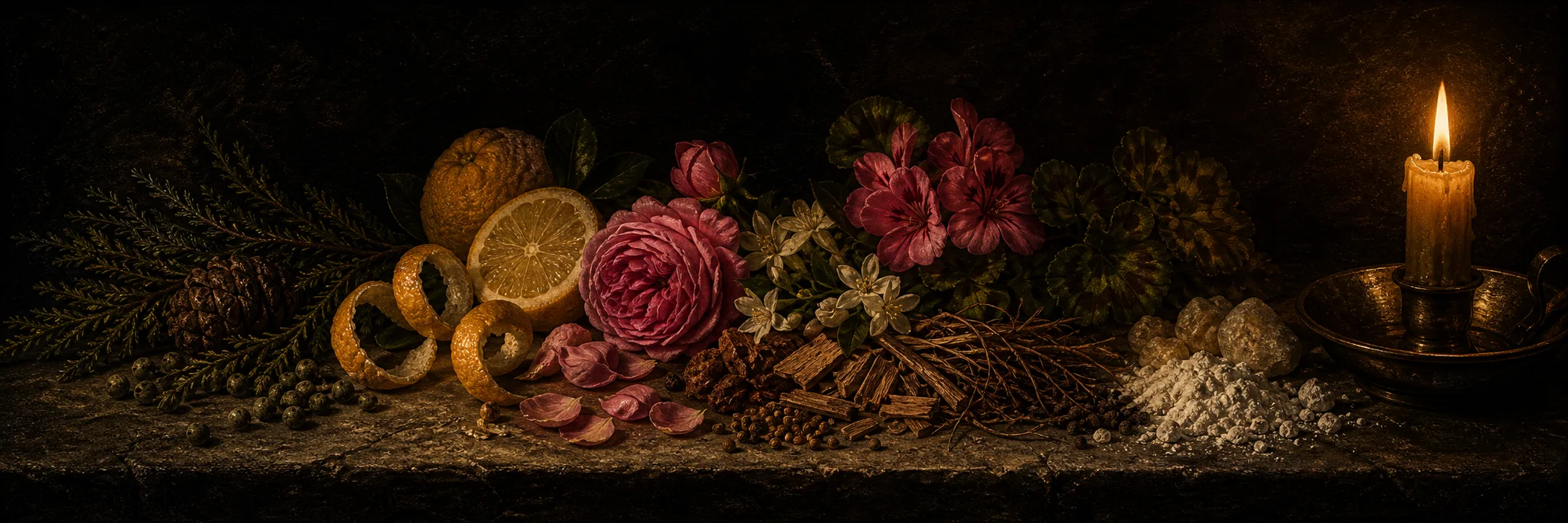
Akaster is a 2015 unisex oriental-woody EDP built around rose, oud, woods, spice, and musk. What makes it distinctive is not the idea of rose-oud itself, which everyone in perfume has done, but the way it is dried out and aerated: cypress and geranium give the floral core a green, tailored edge, while cardamom and musk keep the oud from turning into syrup or pure barnyard. The result is a mature, slightly austere, masculine-leaning rose-oud that reads more polished than plush.
Scent Profile
Akaster opens with a sharper, greener profile than its note list might suggest. On first spray, the loudest elements are usually cypress, cardamom, and a dry, already-present rose, with lemon acting more like tart lift than a full citrus front; several wearers call the opening fresh, sour, aromatic, or even minty, while others barely register the lemon at all. The heart arrives quickly rather than through a dramatic pivot. Between roughly the first hour and third hour, the rose becomes the centerpiece: broad, jammy to some noses, powder-dry to others, but consistently less syrupy than many rose-ouds. Geranium is usually not smelled as “geranium” outright; it shows up as greenness, tartness, and a slightly leafy freshness that keeps the rose from becoming plush. During this phase the oud often retreats into structure instead of spectacle, which is why people who expected a heavy Arabic-style blast sometimes find the mid more floral and gentler than advertised. In the drydown, the oud reasserts itself, though still in a polished Western register rather than full attar realism. Cardamom becomes easier to spot late, adding a dry warmth, while musk mostly acts as texture and lift rather than as a distinct note. The base can read smoky, slightly animalic, faintly “blue-cheesy,” or incense-tinged depending on skin, which explains both the praise and the pushback. Akaster is only moderately evolutionary: enough movement to stay interesting, but structurally semi-linear because the rose-oud accord is present from the start and remains the spine throughout. Its defining signature is a dry green rose over musky, slightly smoky oud, with cypress-cardamom providing the tailored aromatic twist.
Performance
Performance sits in the strong-to-very-good range rather than indisputable beast mode. Projection is usually moderate-strong at first spray, somewhere from beyond arm’s length to roughly six feet depending on skin and dose, with a clear aura for the first two to four hours before it settles closer. Sillage is noticeable and leaves a wake, but most wearers assessments stop short of calling it monstrous; “strong but not beastly” is a fair summary. On skin, most reports cluster around roughly 8 - 12 hours total wear, though there are clear outliers on both ends, including a minority who get weak performance. On clothing it lasts much longer, from several days to over a week. Temperature matters: warm weather can make the rose bloom beautifully at first, but perspiration also pushes the oud forward and can make it feel heavier or more overwhelming; cooler conditions generally extend longevity and keep the balance tidier. Application should be conservative.
Wearing Context
Akaster makes the most sense in fall, cool spring days, late winter, and evenings. It can work in daytime, but only if the setting can tolerate a composed, somewhat formal scent profile. What makes it shine is its balance of polish and edge: it feels dressed up without becoming velvet-curtain opulence. Where it falls flat is high heat, casual athletic settings, or any environment that rewards breezy friendliness. In hot weather the oud can swell and flatten the elegance that makes the scent interesting. Socially, the fragrance skews mature. Even people who like it often describe it as more masculine than the unisex label suggests, and a recurring wearers fault line is whether that maturity reads elegant or dated.
Comparisons & DNA
Akaster belongs to the modern Western rose-oud stream rather than the attar world, and wearers writers explicitly place it in the lineage that followed Armani Prive Oud Royal’s “modern oud” framing. Within that family, Dior Oud Ispahan is one of the clearest comparisons: both are rose-oud signatures, but Akaster is repeatedly described as less overwhelming, more office-friendly, and more toned down in projection and sillage, with cypress giving it a greener, more aromatic start. Initio Oud for Greatness is another common reference point, especially for the oud material itself. Guerlain Santal Royal also appears in similarity lists, though Akaster is the more clearly rose-oud-focused scent and less sandalwood-amber in feel. That is unusual for a Marly fragrance and likely owes to Akaster’s relative obscurity: it has neighbors, but no widely accepted cheap stand-in.
Reception
Reception is strong but niche within the niche. The criticisms are just as stable. A lot of people simply think the rose-oud genre is overcrowded and Akaster does not reinvent it. Others object to the oud material itself, which can read musky-animalic, cheesy, medicinal, or just too synthetic depending on expectation. There is also a real split over gender and age coding: some call it a masculine rose masterpiece, others call it dated, powdery, or old-fashioned. Performance is usually praised, but not universally; one of the recurring warnings is that it is emphatically not a blind buy, especially if you dislike formal rose, powdery nuances, or Western oud. The blind-buy verdict should therefore be no. Rose-oud enthusiasts and people who want a greener, more tailored take on the style will often love it; anyone hunting for mass-appeal Marly sweetness, or expecting either pure Arabic oud realism or plush MFK-style rose velvet, may bounce off it hard.
Versions & Reformulation
Single composition, no known reformulations.
Acquisition Notes
Wearer advice for the house overall is conservative: favor authorized dealers when possible, and if buying secondhand, trust smell and seller reputation over tiny packaging variances.
Notable Facts & Lore
- Akaster’s lore is less about blockbuster success than about misfit status inside the Marly range.
- That “overshadowed by Carlisle” story shows up everywhere else too.
- That backstory helps explain why Akaster feels somewhat separate from the crowd-pleasing part of the brand’s image.
- Just as important is what Akaster never became.
- It did not define the rose-oud market, did not generate a major clone economy, and did not turn into a TikTok-coded status bottle in the way later Marlys and adjacent niche hits did.
- Instead, its reputation hardened into something collectorish: the Marly for people who find Layton too obvious, Carlisle too plush, or mainstream rose-ouds too sugary.
- In wearer memory, Akaster is “the good overlooked one,” the bottle that surfaces when someone asks for masculine rose, aromatic rose-oud, or an underrated dark floral with Middle Eastern shading.