Hermès — Bel Ami
Essence
Bel Ami is the dry, citrus-fronted leather chypre that defined Hermes’s masculine voice for the late twentieth century-a confident, well-mannered cuir that opens with lemon-and-cardamom briskness and lands on warm saddle leather rather than tarry birch. Where most 1980s leathers swung toward smoke (Knize Ten) or animalic snarl (Aramis), Bel Ami chose tailored restraint: leather as a handbag’s interior, not a riding boot’s exterior. Heavily reformulated since 1986 and quietly re-orchestrated during the Jean-Claude Ellena era, it remains the touchstone “clean leather” reference, and the bottle that Roja Dove twice tried to recreate.
Scent Profile
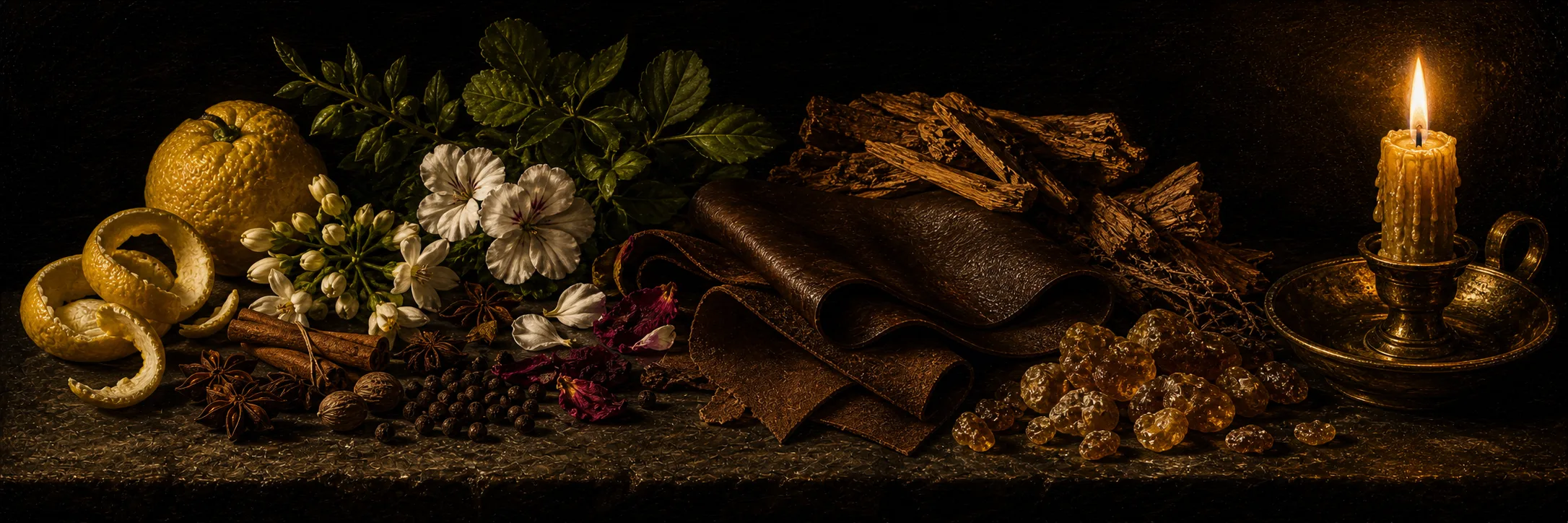
The first ten minutes are the most distinctive in the wear. A bright, slightly sour lemon-bergamot lifts off, immediately joined by green cardamom and dry sage-there is no sweetness, no aldehydic shimmer, no animalic warning shot. The citrus is not a flourish but a frame: it sits over an already-blooming isobutyl quinoline leather note, the sharp tan-leather chemical that signals you are in chypre-leather territory before the heart even arrives. Carnation does not read as flower so much as a peppery, clove-like spice nudging the leather from below; the listed basil and patchouli are submerged blending agents rather than legible notes. By the thirty-to-ninety minute mark the citrus has burned off and the carnation-leather axis takes the lead. This is where Bel Ami most resembles a chypre proper-a powdered, slightly dusty leather sitting on a faintly soapy bed of cedar and patchouli.
Performance
In current production, projection is moderate for the first hour-detectable at conversational distance but never room-filling-and tightens into close-skin behavior by hour three. Sillage in the first hour is the most generous phase, leaving a clear leather-citrus trail in an elevator or hallway; thereafter it becomes a personal scent. On skin, the modern formulation runs roughly six to eight hours with a discernible (if quiet) leather drydown at hour eight on most reports; on clothing-particularly cotton, wool, and scarves-twelve to twenty-four hours is normal, and Bel Ami is widely considered one of the better-projecting Hermes leathers from fabric. Heat hurts it.
Wearing Context
This is autumn-winter office wear, dinner wear, and any formal occasion that wants understated authority. Bel Ami is the Hermes equivalent of a charcoal flannel suit-not loud, not novel, not designed to flirt, but unmistakably expensive on close approach. It performs particularly well with leather goods (jackets, gloves, tailored shoes) because its leather accord reads as an extension of clothing rather than a perfume signature. Daytime business and evening tailoring are both natural homes; it falls flat in summer, in casual t-shirt-and-jeans contexts where its formality reads as overdressed, and at the club, where its restraint disappears against any noisy modern release.
Comparisons & DNA
The closest in-genre relatives are Aramis (Aramis, 1965) - louder, more herbal, more animalic, less polished; vintage Bel Ami in particular gets confused with Aramis on first sniff. Knize Ten (1925) is the patriarch of the citrus-leather axis Bel Ami inherits: smokier, drier, more uncompromising. Chanel Antaeus (1981) is often paired with Bel Ami in critical writing as the dry-woody-leather sibling; one prominent comparative read positions Bel Ami as the midpoint between Antaeus’s dry woods and Dior Fahrenheit’s “gasoline slap.” Moschino Pour Homme (1990, discontinued) was the long-running cheaper alternative-same base, brighter and more dandyish top with lavender and mace. In the high-end clone-or-homage category, Roja Dove paid Bel Ami direct tribute twice: Puredistance M (2010, his composition) and Roja Fetish Pour Homme (2012) both build on the citrus-leather-spice template at considerably higher prices and somewhat richer compositions.
Reception
Wearer consensus is broadly positive-a “modern classic” with a small but loud faction insisting the modern juice is a shadow of the original. Common praise: refinement, elegance, the citrus-leather opening, fabric performance, and Hermes quality. Common criticisms: weak skin projection in the modern formulation, “boring” or “old-man” associations from younger wearers, and the perennial complaint that the oakmoss has been gutted by IFRA restrictions. Polarization runs almost entirely along the vintage-vs-current axis.
Versions & Reformulation
Three production eras matter. The original 1986 Sieuzac formulation in the round “shaker” bottle is the vintage grail, characterized by louder oakmoss, more pronounced carnation, and a denser leather base. A subsequent reformulation through the late 1990s and 2000s gradually reduced oakmoss to comply with IFRA restrictions on atranol and chloroatranol. Around the time Jean-Claude Ellena became house perfumer, the composition was re-orchestrated (wear reports broadly attributes this to Ellena, though Hermes has not officially branded it as such), and the bottle changed from the cocktail-shaker shape to the current taller rectangular flacon.
Acquisition Notes
Designer-luxury Pricing bracket. Current retail in 2026 sits around $130 - $180 for 100 ml EDT from Hermes boutiques and authorized department stores; online discounters (discounters) routinely run $90 - $120 for grey-market 100 ml.
Notable Facts & Lore
- The name references Guy de Maupassant’s 1885 novel Bel-Ami, whose anti-hero Georges Duroy rises through Parisian society on charm and womanizing-a deliberately ambiguous choice for a fragrance, suggesting handsome surface over moral substance. Hermes’s own marketing copy describes Bel Ami as celebrating leather “in its most authentic expression,” which is the only documented house statement of consequence about the original composition. The reformulation history is the most-discussed aspect of Bel Ami in wear reports; the IFRA-driven attrition of oakmoss and certain leather aromachemicals is treated by vintage collectors as a case study in what has been lost from late-twentieth-century masculine perfumery. The Roja Dove tribute productions (Puredistance M, Fetish Pour Homme) are perhaps the highest form of flattery in the niche industry-explicit, expensive homages by a working perfumer to a fragrance still on shelves.