Hermès — Equipage
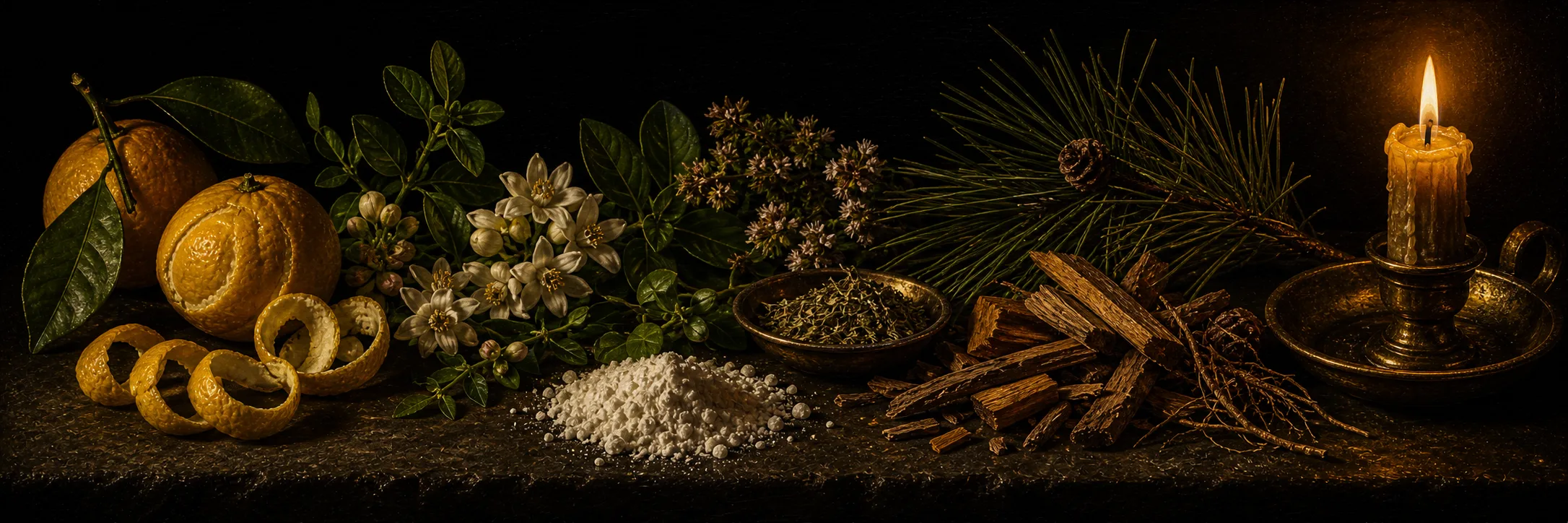
Essence
Equipage is the first Hermes masculine, a 1970 Guy Robert composition built to evoke the smell of a “cold pipe” and the equestrian world the house was then synonymous with-bergamot brightness over a powdered carnation-clove heart, suspended on a pine-and-oakmoss base. It is the carnation-spice masculine reference of late-twentieth-century French perfumery, restrained where its contemporaries were loud, and arguably the template for every Hermes masculine that followed. Reformulated repeatedly under IFRA pressure, it survives in the current lineup alongside its 2015 Ellena flanker Equipage Geranium.
Scent Profile
The first ten minutes open on a clean, slightly soapy bergamot lifted by clary sage and a small dose of aldehydes that gives the citrus a frosted edge rather than a juicy one. Orange and tarragon sit just beneath, contributing more to texture than to identifiable image. Within fifteen to twenty minutes the citrus burns off and the carnation steps forward-and this is the defining moment of the wear. Equipage’s carnation is not floral in the bouquet sense; it is the clove-eugenol facet of carnation extract, cool, dry, and slightly powdery, supported by a touch of cinnamon that the older formulations carry more visibly than the modern. Critical commentary’s Kevin Guyer described the resulting impression as “shredded, blond tobacco leaves dampened with mellow resins and smooth patchouli” - there is no tobacco in the pyramid, but the accord-effect of carnation + pine + patchouli reads tobacco-adjacent. The heart phase, hour one to three, is where pine is most prominent.
Performance
Projection is moderate in the first hour-clearly perceptible at conversational distance-and tapers to a close-skin character by hour three, with a soft persistent presence past hour six. Sillage is restrained throughout: this is a fragrance that maintains, in one widely-quoted wear reports paraphrase, “a low-key but detectable presence for a good six to eight hours, without fading.” On skin, current production runs six to eight hours on average; vintage bottles, when not turned, run slightly longer. On clothing-particularly cotton shirts, wool jackets, and scarves-Equipage performs notably well, often lasting overnight into the next morning and reading more clearly on fabric than on skin. Behavior favors cool weather.
Wearing Context
Formal daywear, office wear, dinner wear, autumn and winter-Equipage is the original “boardroom and library” Hermes masculine, and it still wears that way in 2026. It pairs naturally with tailoring, wool, and leather; it falls flat in casual streetwear contexts, at the gym, and in any setting where its restrained, slightly old-fashioned cast reads as out-of-step. The social-perception skew is older than the wearer-younger men in their twenties wearing Equipage will read as deliberately classical or as “old before their time”; men over forty wear it as a default of taste. The wearers frequently positions Equipage as a “gentleman’s scent” alongside Chanel Pour Monsieur and Givenchy Monsieur (vintage), and several long-time wearers describe it as a sartorial scent-to be worn the way one wears a tie.
Comparisons & DNA
The closest comparison within the same era is Chanel Pour Monsieur (1955, Henri Robert-father of Equipage’s Guy Robert) - a clear ancestor in the cool, restrained, citrus-aromatic mode, but Pour Monsieur is more nervous and herbal, less spicy and floral. Boucheron Pour Homme (1989) is the most commonly named modern descendant: cooler, less carnation-driven, but sharing the powdery-spicy-soapy DNA. Aramis (1965), often compared to Equipage in wear reports, is louder, more animalic, and more leather-forward-Equipage is the cleaner cousin. Eau Sauvage (1966) sits in the same conceptual neighborhood-French masculine restraint of the late 1960s-but is hesperidic and floral where Equipage is spicy and woody.
Reception
Critical reception has remained consistently positive across fifty-five years. Luca Turin’s Perfumes: The Guide treats Equipage as a canonical Hermes masculine; Turin reportedly remarked (and the comment is widely circulated in wear reports) that the current formulation is “the same as vintage” as of his 2007 evaluation, a position vintage collectors dispute but that has shaped the broader critical line. Critical commentary’s Kevin Guyer wrote a glowing review describing an “incense-ceremony” wood-warming character, and Perfume Shrine framed Equipage as Guy Robert’s masculine counterpart to his feminine masterpiece Caleche. Wearer consensus is broadly reverent.
Versions & Reformulation
Equipage has been reformulated multiple times across its history. The original 1970 Guy Robert composition (often in the cylindrical or “saddle-style” early bottle) is the vintage benchmark-louder carnation, denser oakmoss base, more legible cinnamon. Subsequent reformulations through the 1990s and 2000s gradually reduced oakmoss to IFRA-compliant levels, the most-discussed change in the wear reports vintage threads. The wearers generally regards the current production as a respectable shadow rather than a betrayal-Turin’s “same as vintage” remark notwithstanding, side-by-side comparisons reveal a quieter, slightly less moss-driven base in modern bottles.
Acquisition Notes
Designer-luxury bracket, and a notable bargain by Hermes pillar standards. Current retail 2026: approximately $120 - $160 for 100 ml EDT at Hermes boutiques; online discounters (discounters) regularly run $70 - $100.
Notable Facts & Lore
- The brief for Equipage came from the success of Guy Robert’s Monsieur Rochas (1969), composed the year prior; Hermes reportedly asked Robert to create something with the smell of “a cold pipe” - the dry, slightly ashy, slightly sweet character of pipe tobacco that has burnt out, rather than the smoky character of an active smoke. That brief produced the carnation-pine-moss skeleton, which evokes pipe-tobacco-adjacent imagery without containing tobacco in the formula. Perfume Shrine notes that there are persistent suggestions Jean-Louis Sieuzac (later the author of Bel Ami) also worked on the composition, which would give a direct in-house genealogical line between the two Hermes masculines. The name equipage refers in French equestrian usage to a hunt or carriage team-a deliberate evocation of the saddler heritage Hermes traded on.