Hermès — Eau des Merveilles
Essence
Eau des Merveilles is the salty, woody, abstract-amber composition that quietly redefined what a “feminine” fragrance could be in 2004-a perfume built around an imagined ambergris accord, with no jasmine, no rose, no tuberose, no conventional floral signal. Marketed feminine but worn unisex throughout its twenty-year life, it became the cornerstone of an extensive flanker family and the prototype for the dry-woody-amber school that Bois Imperial and others would later commercialize. The bottle, by Serge Mansau, is printed upside-down so the perfume reads correctly when held to the light.
Scent Profile
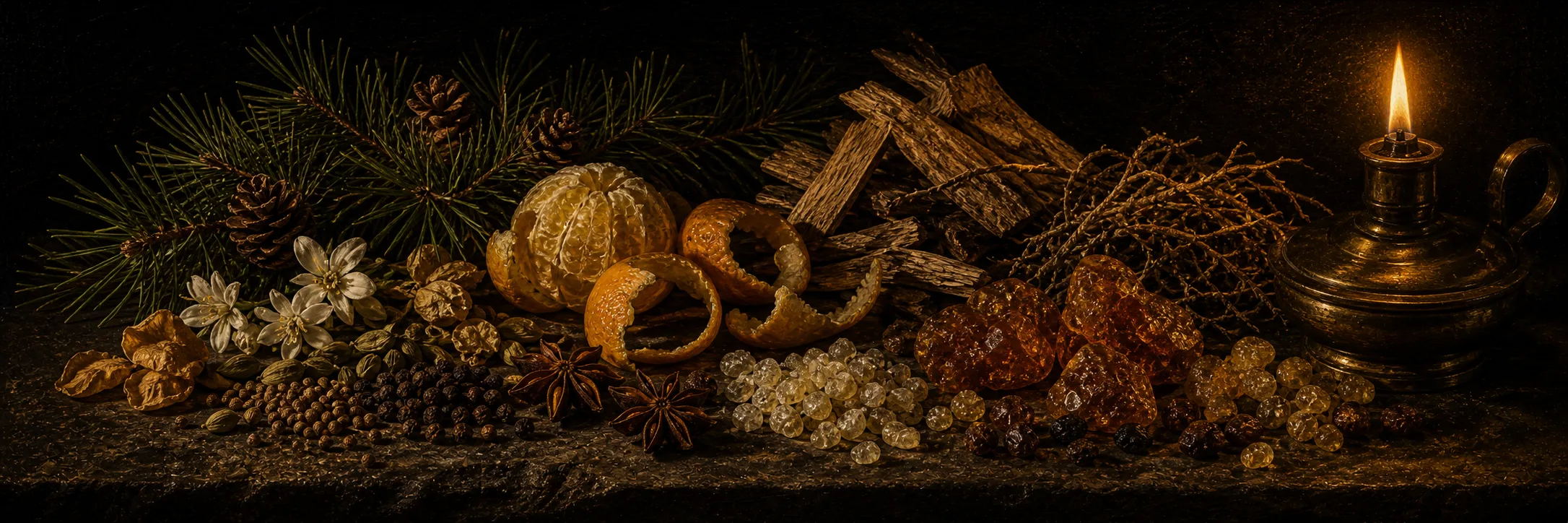
The opening is the cleverest part of the fragrance and the one most often misread on first sniff. Orange, bergamot, and lemon arrive together but the citrus is not the sparkly cocktail-grapefruit kind-it is a slightly dusty, woody-resinous citrus, anchored immediately by elemi, which contributes a piney, peppery, almost mineral edge. Within the first ten minutes pink pepper and black pepper are clearly perceptible, lending a dry crackle. The promised “amber” is not the vanillic-resinous amber of Ambre Sultan or Shalimar; it is a pale, salty, woody-ambergris reconstruction, more skin and driftwood than caramel and resin. The heart phase, roughly thirty minutes to three hours, is where the signature accord asserts itself. Violet is the only listed floral and it is not a violet bouquet-it provides a soft, slightly powdery, slightly metallic facet that supports rather than blooms.
Performance
Projection is light to moderate for the first hour-a discernible halo at arm’s length-then settles to a close-skin presence within ninety minutes. Sillage is restrained throughout; this is not a fragrance that announces itself across a room, and the Wearer consensus frequently flags this as a complaint from compliment-seeking wearers. Longevity on skin runs six to nine hours, with the ambergris-and-musk drydown clinging quietly past eight on most reports; on clothing-especially scarves and wool-it persists twelve to twenty-four hours and is notably more legible on fabric than on skin. Behavior in heat is its strength.
Wearing Context
Best worn in autumn and spring, daytime to early evening, on warm-weather days where its salty-citrus angle reads as sun-and-sea rather than as office cologne. It shines at the beach, on travel days, at outdoor lunches, on cotton shirts and linen scarves; it falls flat in formal evening settings where its airiness can seem under-dressed, and in cold dry indoor air where its restraint becomes invisible. Marketed feminine, it is genuinely unisex on skin-the Wearer consensus is that men wear it as a quirky alternative to Terre d’Hermes and women wear it as a non-floral, non-fruity alternative to mainstream feminine releases. Social-perception skew is “interesting, hard to place, slightly intellectual.” It does not signal seduction, professional authority, or trend-awareness; it signals taste and a willingness to wear something abstract.
Comparisons & DNA
Within Hermes’s own catalogue, Eau des Merveilles spawned one of the largest flanker families in modern perfumery. Elixir des Merveilles (2006, Jean-Claude Ellena) layered candied orange, vanilla biscuit, and patchouli over the same skeleton-sweeter, more gourmand, less salty; critical commentary called it “a bit of dessert” but found it lacked the original’s “understated elegance.” Eau Claire des Merveilles (2010, Ellena) is the citrus-soda-and-powder version-brighter, lighter, more conventional. L’Ambre des Merveilles (2012, Ellena) is the explicit amber reading-labdanum-vanilla-patchouli, much sweeter and more conventional than the original’s “amber without amber.” Eau des Merveilles Bleue (2015, Christine Nagel’s first Merveilles entry) is the marine-aquatic flanker-fresher, sportier, less interesting per critical commentary, which called it “very well done” but “a big old meh.” The Twilly d’Hermes line (2017+) drew partly on the Merveilles DNA in its woody-musk construction. The original remains, by wearer consensus, the best of the family.
Reception
Critical reception has been consistently strong from launch through 2026. Critical commentary’s Victoria Frolova called it “a perfect ambergris fragrance” and ranked the original above all its flankers, returning to it repeatedly in retrospective writing. Critical commentary treats it as a benchmark for the category and uses it as the reference point in reviewing every subsequent Merveilles flanker. Critical commentary described its central accord as “earthy barnacles, sun-lotion-soaked skin and salty sea air mixed with the scent of driftwood caught in the surf,” which is the most-quoted descriptive sentence in the secondary literature on this fragrance.
Versions & Reformulation
The original 2004 EDT remains the canonical version. Parfum des Merveilles (sometimes labeled Eau des Merveilles Pure Perfume) is the higher-concentration parfum, in a refillable metal flacon, with a richer, darker, woodier read-critical commentary describes it as “much richer, with darker wood notes” and recommends it to lovers of the EDT. The bath line that accompanied the launch has been largely discontinued. There have been no widely publicized reformulations of the EDT itself, though knowledgeable wearers note minor changes in the ambergris-accord brightness across production batches; nothing of the scale of Bel Ami or Equipage.
Acquisition Notes
Designer-luxury bracket, in the upper Hermes pillar pricing band. Current retail 2026: roughly $115 for 50 ml EDT, $150 for 100 ml EDT at Hermes boutiques and authorized retailers; online discounters routinely run 30 - 40% below retail.
Notable Facts & Lore
- The collaborative authorship between Ralf Schwieger and Nathalie Feisthauer is itself unusual-most major launches credit a single perfumer, and the pairing produced one of the most consequential entries in either of their catalogues. The bottle design by Serge Mansau, with the brand and notes printed upside down on the inner side so the design rights itself through the glass when held to light, is a small piece of perfume-design history that the wearers references frequently-the orange-tinted glass also functions as a magnifying lens when laid flat, a detail critical commentary pointed out in early coverage. Hermes’s own framing for the launch invoked “women who dream with their eyes wide open and see stars in daylight,” and the limited-edition collector bottles released over the years (most notably the 2009 constellation edition and various blue and gold variants) have become collector items in their own right, with full sealed examples trading at multiples of retail. The most consequential cultural fact about Eau des Merveilles is its structural influence: by building a feminine-marketed fragrance around imagined ambergris and an explicit refusal of floral signaling, Schwieger and Feisthauer opened the design space that the salty-woody-ambroxan school of the 2010s and 2020s-culminating in Dior Sauvage Eau de Parfum, Bois Imperial, and countless niche releases-would exploit at scale.