Hermès — Un Jardin en Méditerranée
Essence
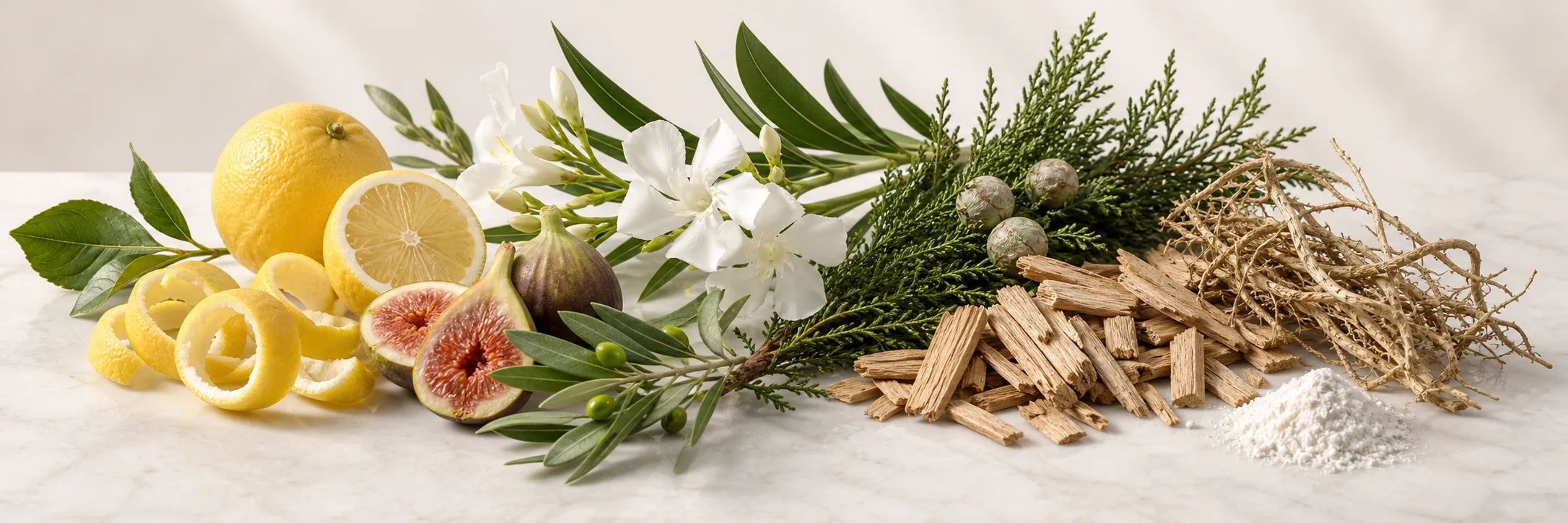
Un Jardin en Mediterranee is Jean-Claude Ellena’s 2003 fig landmark and the founding chapter of Hermes’s long-running “Un Jardin” travel series. It’s a transparent, watercolor-style fresh-green fragrance: a sharp citrus opening over a green, milky-but-not-sweet fig (leaf and tree more than fruit) wrapped in cool Mediterranean conifers-cypress, juniper, cedar-with a faint nutty pistachio and a whisper of white florals. Inspired by the Tunisian garden of Hermes display director Leila Menchari, it is widely regarded as one of the best fig fragrances ever made and a quiet masterpiece of Ellena’s minimalist, “less-is-more” style.
Scent Profile
The listed pyramid (bergamot/mandarin/lemon; fig-leaf/orange-blossom/oleander; fig-tree/cypress/cedar/musk) wears almost exactly as written, which is rare. The first 10 - 20 minutes hit with a vivid, sometimes sharp citrus blast-bergamot, lemon, mandarin-that several wearers find almost “too sharp” before it softens around the ten-minute mark. Riding underneath from the start are cool, piney aromatics: cypress and juniper (one one wearer specifically flags a berry-tinged Mexican-cypress quality) plus a green, slightly astringent, cologne-like freshness. The loudest opening element is citrus; the subtle ones are the early green fig-leaf and a faint salty-savory nuance. The heart (1 - 3 hours) shifts the green fig forward: a bright, watery, photorealistic fig-leaf-and-tree accord-not the creamy, coconut-milk fig of L’Artisan or the sweeter fruit of Acqua di Parma, but a dry, leafy, slightly bitter “whole fig tree in a garden” effect. A milky-sappy facet and nutty pistachio add gentle texture and a touch of sweetness, while orange blossom and a coarse, faintly “compost-y” oleander hover in the background (Olfactoria’s Travels memorably noted a divisive “compost note” reminding the wearer that decay is part of a living garden).
Performance
This is a deliberately soft, transparent composition, and performance reflects that. Projection is light-to-moderate-pleasant and detectable at conversational/arm’s-length range in the first hour, then hugging the skin; one fan summarizes “good projection in the first hour” with the rest intimate. Sillage is modest but, as several note, “prominent enough to garner compliments without becoming annoying.” Longevity on skin is the chief complaint: typically 4 - 6 hours, with generous estimates reaching 6 - 8; it fades noticeably around the four-hour mark for many. On clothing and hair it lasts considerably longer-a common tactic for this style.
Wearing Context
A quintessential spring/summer and hot-weather scent-built for warm afternoons, beach days, and Mediterranean-holiday moods; many call it a summer staple and “desert island” pick. Daytime is ideal, though its freshness works at any hour in heat. Perfectly unisex and office/work-appropriate (clean, refined, never loud). It shines outdoors in sun and as a hot-weather refresher; it falls flat in cold, dry conditions where it can reduce to “lemon-cypress bar soap” on some skins, and its light performance frustrates those wanting a statement scent.
Comparisons & DNA
The defining comparisons are the other great figs. Diptyque Philosykos (Olivia Giacobetti) is greener and figgier in a sharp, photorealistic fig-leaf way and lasts longer; L’Artisan Premier Figuier and Premier Figuier Extreme (also Giacobetti) are creamier, coconut-milky, sweeter and less green-Giacobetti’s figs predate and arguably set up the genre Mediterranee joined. Wearers consistently position Mediterranee as the drier, more citrus-forward, “garden” fig: “Eden before the fall” versus Giacobetti’s dustier, milkier work. Acqua di Parma Fico di Amalfi is sweeter and more fruity-beachy; Jo Malone Wild Fig & Cassis, Parfumerie Generale Jardins de Kerylos, and L’Occitane Feuille de Figuier are other genre neighbors.
Reception
Consensus in wear reports, and blogs is broadly admiring, often reverent-repeatedly called a “masterpiece,” a “summer classic,” and many people’s favorite of the entire Jardin line (rivaled mainly by Sur le Nil). Praise: the realism and elegance of the fig-garden accord, the perfect hot-weather wearability, the all-natural-feeling blend. Criticisms cluster on (1) weak longevity/projection and (2) a one-dimensional or “soapy” reading on some skins-even Victoria Frolova of critical commentary has said she finds it “too one-dimensional,” while still calling Ellena a master of salty perfumes; The Scentaur found it collapsed into “conifer-citrus hand soap” on their skin. The compost/oleander facet divides people (Olfactoria’s Travels became “fascinated” by it).
Versions & Reformulation
Single concentration: Eau de Toilette, in 50 ml and 100 ml (plus a 1.6 oz refillable and travel sprays). Treat the “ruined reformulation” claims as a real but not universal complaint-quality remains high by most accounts, with the main change being reduced strength. Mediterranee itself remains in production (Hermes confirmed it was not discontinued as of recent panic-rumors).
Acquisition Notes
Designer/luxury-house pricing but very accessible for Hermes-widely discounted at reputable online fragrance retailers, making it one of the better-value entries in the line. Sizes: 50 ml and 100 ml EDT, a 1.6 oz refillable, and 0.27 oz travel sprays.
Notable Facts & Lore
- Ellena’s documented inspiration: the perfume was conceived as a “watercolour” evoking the Tunisian seaside garden of Leila Menchari, Hermes’s legendary window-display director, built on “the theme of a fig tree in the morning and Mediterranean citrus.”