Hermès — Osmanthe Yunnan
Essence
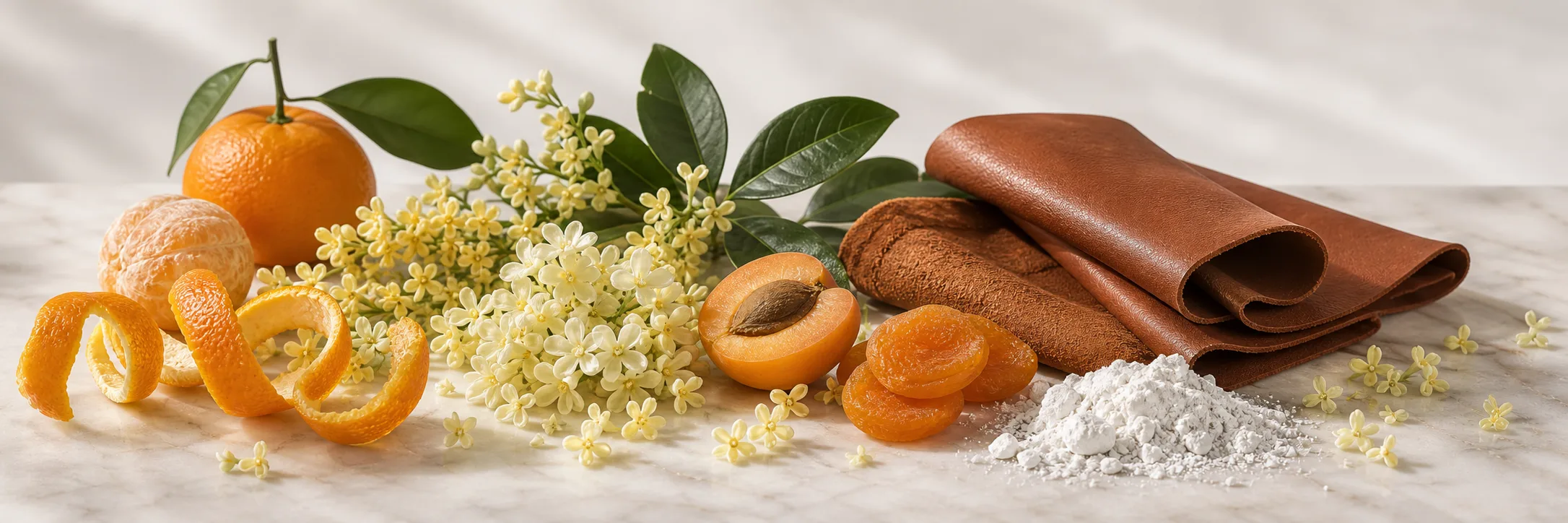
Osmanthe Yunnan is the canonical Western interpretation of the osmanthus flower: the apricot-tea-leather chord at the heart of the blossom, rendered in Jean-Claude Ellena’s signature watercolor minimalism. Released in 2005 as the fifth Hermessence, it pairs Yunnan-tea airiness with the soft chamois drydown of osmanthus absolute. It is not a perfume that performs; it is one that hovers-a brief, sunlit accord most enthusiasts treat as the reference point against which every other osmanthus soliflore is measured.
Scent Profile
The opening (first ten to twenty minutes) is the sharpest stretch: a dry, slightly tart citrus-listed as orange but reading more like a peeled-rind brightness-over an almost smoky black-tea infusion. This is the most assertive Osmanthe Yunnan ever gets. The tea is unmistakably the dried-leaf, lapsang-adjacent side of Yunnan rather than green tea, and it carries the composition’s “wet” axis while the orange does the “bright” work. Freesia is listed in the heart but reads almost entirely as ambient floral lift; it has no independent voice on skin. The heart (roughly one to three hours) is where the osmanthus accord assembles itself from the surrounding pieces. Ellena famously builds notes by adjacency rather than by ingredient-pairing apricot with floral and tea with leather to triangulate the osmanthus effect.
Performance
Light projection at a one-to-two-foot bubble for the first thirty minutes, then collapsing rapidly to skin scent. Sillage is essentially nil past the opening-companions in conversation will smell it; the next table will not. Longevity on skin: typically three to five hours of identifiable scent, fading to a ghost beyond six; on clothing (wool, cotton scarves) it punches well above its skin performance and can persist into the next day. This longevity gap is one of the most consistently noted features of the Hermessence line as a whole.
Wearing Context
Spring and early autumn are its natural homes-late March through May, then September through early October, when the air carries both warmth and a green-fresh edge. It works in summer if the air is dry, but high-humidity tropical heat saturates its delicacy. Winter is wrong: this scent does not survive being layered under wool, and it has no warmth-anchor to hold its own against cold-weather fragrances. Time of day skews toward daylight-morning through late afternoon.
Comparisons & DNA
The closest sibling is Jean-Claude Ellena’s own The Different Company Osmanthus (2001), which Ellena had created four years prior-critical commentary’s Victoria Frolova considers Osmanthe Yunnan the richer, sweeter, warmer evolution of that idea, where TDC’s version is sharper, soapier, and more citrus-led. Ormonde Jayne Osmanthus is markedly sharper and muskier. For a sweeter, more saturated osmanthus, see Parfums de Nicolai Eau de Pamplemousse Rose, which Frolova specifically called more grapefruit-driven, longer-lasting, and sharper than Osmanthe Yunnan; commenters in BdJ’s thread called the two “sisters.” Within Ellena’s own catalog, Osmanthe Yunnan sits in dialog with Bvlgari Eau Parfumee au The Vert (1993, also Ellena) - the same transparent-tea DNA, less floral-and with L’Artisan Parfumeur The Pour Un Ete (Olivia Giacobetti), which critical commentary explicitly cited as the same “add nothing that isn’t needed” school despite smelling nothing alike. Serge Lutens Nuit de Cellophane is louder and sweeter with a similar osmanthus-floral leaning.
Reception
Wearer consensus (very strong average sentiment), and wear reports treats Osmanthe Yunnan as the canonical osmanthus soliflore-usually mentioned in the same breath as TDC Osmanthus when serious osmanthus discussions arise. Polarization runs almost entirely along a single axis: longevity. Fans accept the four-hour ceiling as the cost of doing transparent business; detractors (especially blind buyers at the original $180+ price point) consider it indefensibly weak. wear reports regularly cite it as the case study for “is paying boutique-niche prices for a fragrance that lasts three hours rational?” The praise pattern is consistent: “natural,” “happy,” “the apricot-skin facet of osmanthus,” “Ellena at his most refined.” Criticism: weak, expensive, fails to deliver the osmanthus blast some users expect from the name.
Versions & Reformulation
Single concentration: eau de toilette, 100ml flacon (heavy glass with leather-stitched cap, color-tinted base) plus the 4x15ml travel set. No EDP, parfum, or extrait variant has ever been released. The Hermessence line was repackaged in stages from 2016 onward when Christine Nagel succeeded Ellena as in-house perfumer; the bottle silhouette and stitched-leather cap were retained while the outer packaging was updated. Wearer sentiment in wear reports indicates the juice itself has remained essentially unchanged across batches, with most wearers reporting older and newer bottles smell the same (a notable contrast to many other Hermes reformulations of the same era).
Acquisition Notes
Niche Pricing bracket: roughly $245 - $285 for 100ml at current Hermes boutique pricing, with the 4x15ml travel set around $180 - $210. Distribution is restricted to Hermes boutiques, the Hermes website, and a handful of authorized department-store Hermes counters (Selfridges, Bergdorf Goodman, select authorized department stores locations).
Notable Facts & Lore
- Instead, I think of them as little haiku.“