Zoologist — Bee
Essence
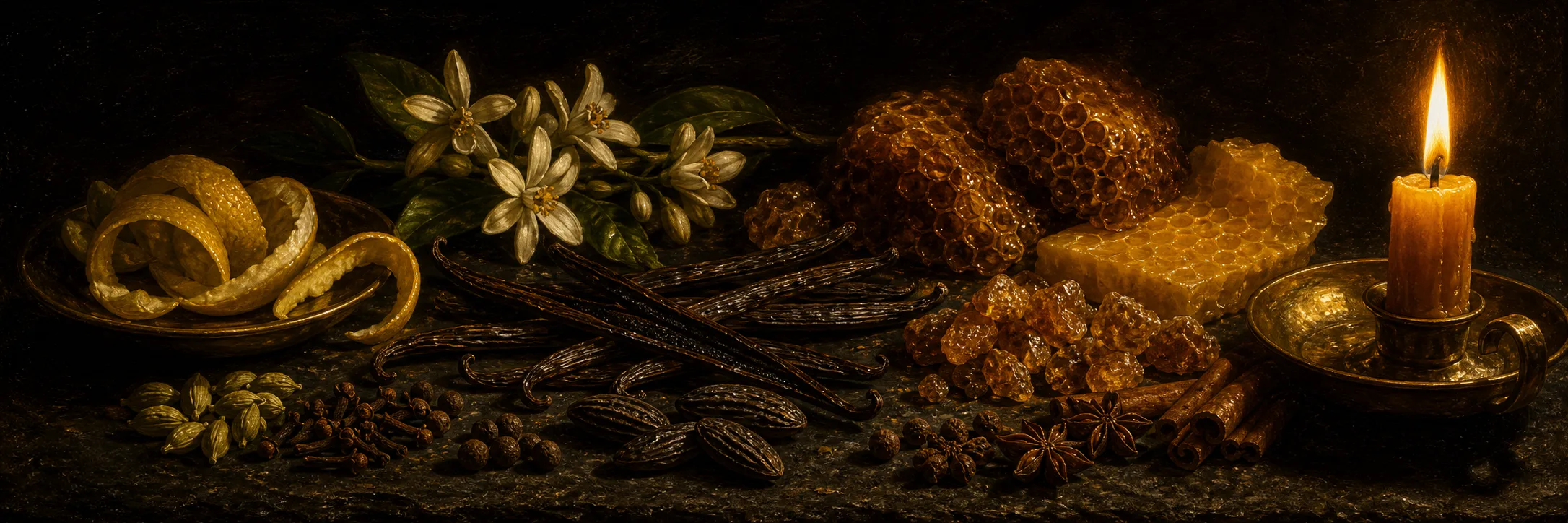
Bee is Zoologist’s 2019 honey landmark - a hyper-realistic beeswax-and-honey extrait by Cristiano Canali that became one of the most acclaimed honey fragrances in modern niche perfumery and a 2020 Art & Olfaction Awards Independent Category finalist. Cleverly, it contains no listed “honey” note: the honey illusion is built vertically from beeswax, a royal-jelly accord, and yellow florals, grounded in labdanum, benzoin and tonka. The result is a radiant, ambery floral-honey - sweet, waxy, pollen-dusty, faintly smoky - that reads as the inside of a sun-warmed hive rather than a honey jar. It is the house’s reference honey scent.
Scent Profile
Despite a long pyramid, Bee works one big idea hard: honey as texture and atmosphere. The opening (first 10 - 20 minutes) hits with gingery, marmalade-like brightness - orange and ginger syrup give a brief citric-spicy lift - over an immediately recognizable honeycomb sweetness. Reviewers describe the very first moments as the smoky, brown-sugar bitterness of molten honeycomb or cinder toffee just before the baking powder goes in, cut by a “jellied, clear coldness” that many attribute to the royal-jelly accord. That ginger-orange top is fleeting; it begins and ends quickly. The heart (1 - 3 hours) is the meat of the fragrance: a thick, white-ish beeswax note around which powdery-doughy florals cluster. Heliotrope is the dominant floral presence - fluffy, almond-vanilla, playdough-sweet (some compare the heliotropin dose to Dior Hypnotic Poison, though better blended) - supported by pollen-dusty mimosa and the maple-hay facet of broom. Orange blossom is listed but largely submerged; multiple critics report no detectable citrus or distinct orange flower at all, the florals being “muffled by the thick beeswax.” There’s a scratchy, dusty pollen quality that adds hive realism, and a faint smoky-incense thread. Crucially, Bee is only mildly animalic: it is not the urinous “pissy honey” of something like Absolue Pour Le Soir - the funk here reads as waxy/pollen-ish and musty rather than fecal or civet-like. The drydown (3+ hours) is where dismissive first impressions often reverse. The candied top calms, and the base of labdanum, benzoin, tonka, sandalwood and musk gives a velvety, resinous, ambery warmth - incense-tinged, slightly smoky, comfortably sweet. Several reviewers note a pattern of Bee being initially “crass and candied” then ending “velvety and nuanced,” rewarding patience. The far drydown is dense and rich rather than sheer, tilting more toward amber than floral. Evolution is real but compact: a subtle shift from bright/loud to modest/balanced rather than a dramatic transformation. The signature accord is realistic golden beeswax-honey suspended in powdery heliotrope and warm resins - an “atmospheric” honey that conjures the hive (wax, pollen, comb) more than a spoonful of honey. An authorized retailer’s own framing captures the appeal: “the honey accord is both extremely realistic and un-animalic - a rare feat that makes Bee a real contender for the title of the baby bear’s porridge of the honey fragrance genre.” Linearity-wise it sits in the middle: clearly honey from first spray to last, with meaningful textural development underneath.
Performance
Bee is a strong performer, consistent with its 18% extrait concentration (per Zoologist retailer listings). Projection is strong in the opening - a couple of sprays fill a room and draw comment - settling to moderate. Sillage is generous early; this is not a quiet scent and over-application is the most common regret. Longevity is excellent: Colognoisseur’s Mark Behnke pegged it at “12 - 14 hour longevity and average sillage,” and wearer accounts mention detecting it on the hand three-plus hours later “stronger than other fragrances after 30 minutes,” with one still smelling it three days later on the back of a hand. Both Now Smell This and Persolaise specifically praised its staying power. It performs best in cool-to-cold weather, where the waxy-resinous warmth feels cozy and rounded; in heat the sweetness can become cloying fast. Humidity amplifies the syrupy facet. Best application strategy is restraint - three sprays is plenty for all-day projection, and most wearers who found it “too much” simply over-sprayed. A single spray is enough to test the honey-tolerance question.
Wearing Context
Bee is a cool-weather, comfort-driven scent: best in autumn and winter, daytime or evening, in relaxed and intimate settings rather than tight professional ones. The honey-amber warmth shines on cold days, at home, on casual outings, and in any context where a rich, golden, slightly old-world “incense-and-honey” aura is welcome. It draws compliments when applied lightly in winter. Where it falls flat or feels wrong: hot, humid environments (it turns cloying), and conservative office or formal settings where its sweetness and volume can overwhelm. It’s a love-it-or-leave-it honey, so it suits the wearer who actively wants to smell of honey rather than someone seeking an abstract background sweetness. Social-perception skew: broadly unisex but reads sweet/feminine-leaning to many noses; some men find it too honey-forward to wear, while others wear it happily as a cold-weather signature. It is genuinely versatile within its sweet lane but not a crowd-neutral office scent.
Comparisons & DNA
Bee sits at the center of the modern honey-fragrance conversation. Its most-cited peer is Hiram Green Slowdive, the connoisseur’s honey reference: Slowdive is richer, thicker and more complex, with herbs, florals and tobacco as important as the honey, and an all-natural artisanal feel - but it’s heavier and harder to wear casually. Bee is simpler, more polished, more user-friendly and “big-boned” by comparison (Take One Thing Off frames Bee as “more niche than artisanal,” Slowdive as the hand-crafted one). Both belong to the indie/small-niche honey lineage alongside Olympic Orchids Golden Cattleya. Maison Francis Kurkdjian Absolue Pour Le Soir is the louder, smokier, far more animalic (“pissy”) honey-incense benchmark; Bee is the clean, non-urinous alternative for those who want honey without the skank. Serge Lutens Miel de Bois is the divisive woody-honey cousin (drier, more austere). L’Artisan Seville a l’Aube gets repeatedly compared by critics - one review’s verdict runs: “Seville a l’Aube is more feminine, stylish and ‘heady’; Bee is boyish and down to earth. I’m happy spending time with both.”; both are orange-blossom-and-incense adjacent. Within Zoologist, Hummingbird (Shelley Waddington) shares a honey-syrup-over-florals idea but is fruitier/cherry-floral and lighter; Moth has a powdered-honey facet. Designer/clone alternatives: there is no close drugstore dupe of Bee’s specific beeswax realism. Lattafa Atheeri (2025) is marketed around the bee/honey concept with a beehive bottle but contains no honey or beeswax note - it’s a sweet floral and not a true substitute, a point wearer discussions make repeatedly. Budget honey adjacents people mention include Kim Kardashian Pure Honey and L’Occitane Terre de Lumiere, but neither replicates Bee. The honest takeaway from wearer response is simple: if you want Bee specifically, nothing cheaper truly stands in for it.
Reception
Bee is one of Zoologist’s most celebrated and most argued-over releases. The Art & Olfaction finalist status and near-universal critical praise sit alongside a strikingly divided wearer response. Critics were enthusiastic: Colognoisseur’s Mark Behnke called it “a buzzy beautiful honey perfume” and praised Canali as a singular designer; Cafleurebon’s “It’s All The Buzz” review opened with “One spray brings a head-spinning amalgam of orange blossom, ginger syrup and royal jelly” and closed “I am in Grantchester again. And, yes, there is honey still for tea”; Persolaise - self-admittedly wary of Zoologist’s “gimmicky” concept - was won over, noting it smells exactly, delightfully, like honey; and the Take One Thing Off review put Bee on its “to-buy” list, calling it possibly the only beeswax-centric fragrance the writer could commit to. Now Smell This admired its smoky floral character and exceptional longevity. Common praise: photorealistic beeswax/honeycomb, well-balanced sweet-vs-waxy, excellent performance, and an emotionally “joyful” golden quality. Common criticism: too sweet/cloying for non-gourmand wearers; “just honey” and one-dimensional to detractors; and polarizing animalic/musty facets (“urinal cake,” “cat pee,” “church incense” all appear in negative reviews). The central axis of polarization is simply honey tolerance - those who want honey adore it, those who don’t bounce off hard. Even fans of the house split: some rank it a top-5 all-time, while Perfume Posse and other reviewers find it boring or merely “nice.” Blind-buy verdict: Sample first. It’s a reference-quality honey but a strongly polarizing one; nearly every positive reviewer adds the caveat to test before buying.
Versions & Reformulation
Single composition, no known reformulations. Bee launched in 2019 as an extrait de parfum (18%) and has remained consistent; it is offered in 1.5ml sample, 10 - 11ml travel spray, and 60ml Deluxe Bottle. It now ships in Zoologist’s post-2025 cylindrical bottle (earlier stock used the tapered design). No concentration variants or flankers exist.
Acquisition Notes
The cataloged full-bottle reference is 240 USD / 60 ml. Current Zoologist formats center on full bottles, with samples and travel sprays available for trial. Sampling is the sensible first step, especially for the house’s more animalic or conceptual entries. Buy through official or authorized channels and confirm the exact edition for similarly named releases.
Notable Facts & Lore
- Cristiano Canali of Argeville built the honey effect from beeswax absolute and a royal-jelly accord, while Victor Wong gave him a loose, habitat-driven brief.
- The headline accolade is being one of twelve Independent-category finalists (the field expanded from eight due to ties) at the 7th annual Art & Olfaction Awards, run by the Institute for Art and Olfaction and announced April 24, 2020 - Bee and the house’s Squid were both selected; it’s cited on virtually every retailer listing.
- A beekeeper reviewer on Persolaise’s site confirmed the realism, saying Bee smells exactly like empty honeycombs, even when they are being melted for further processing.
- Bee has become a default answer in “best honey fragrance” discussions, repeatedly surfacing when honey perfumes are debated.