Zoologist — Nightingale
Essence
Nightingale is the 2016 debut of Japanese perfumer and perfume writer Tomoo Inaba for Toronto niche house Zoologist, and one of the line’s high points: a modern floral chypre built around a Japanese plum-blossom (ume) accord, presented as a 20% extrait in a distinctive pink-tinted juice. Where most Zoologist scents tell an animal’s story, Nightingale instead evokes the onset of Japanese spring, when plum blossoms open and the nightingale sings. It is, in essence, a vintage rose-plum chypre reanimated with Japanese sensibility.
Scent Profile
Nightingale opens bright and tart, with saffron, bergamot and lemon over a rosy, powdery plum-blossom accord that Cafleurebon’s Gail Gross described as “a breath of spring cut with tart lemon, powdered with violet and spiced with the slightly bitter, dustiness of saffron.”
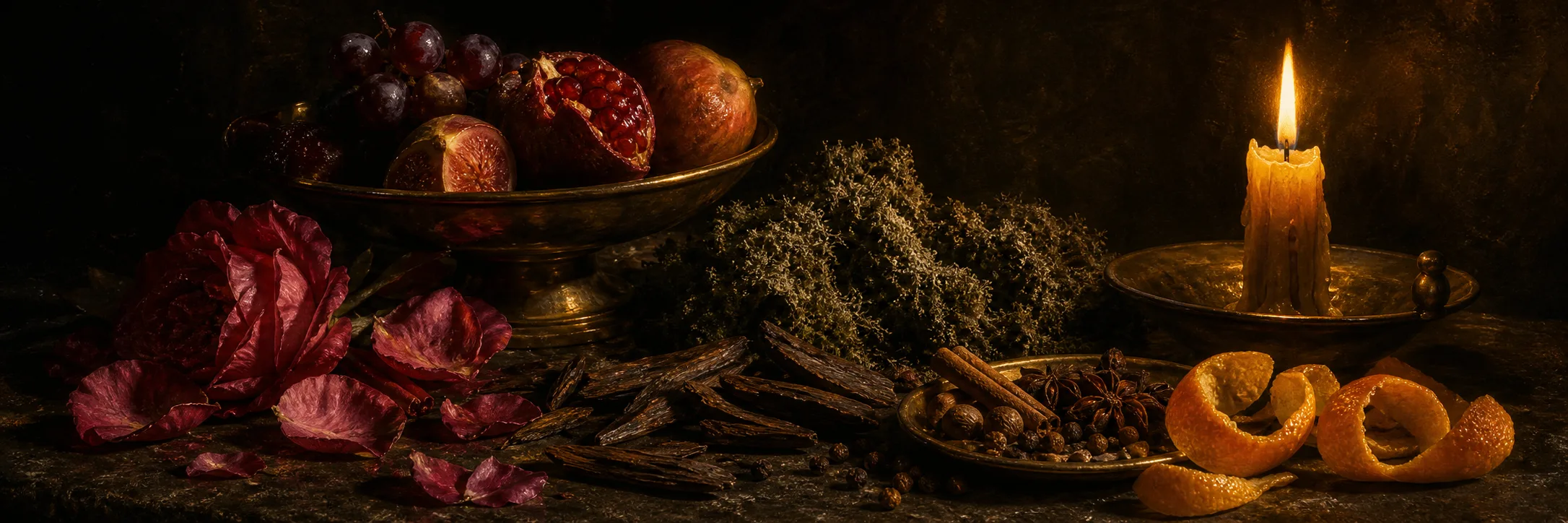
The heart is a powdery floral of red rose, plum blossom and violet, the violet lending a cosmetic, vintage-glamour effect that draws frequent comparison to Guerlain Météorites face powder and lipstick. It then sinks into the chypre and mukhallat base that gives the scent its depth and divides opinion: oakmoss, patchouli, oud, frankincense, labdanum, sandalwood, ambergris and white musk.
Gross noted that the spring-flower opening dries quickly into “an almost Middle Eastern style mukhallat of rose, ambergris, oud, saffron and a touch of smoke.” The overall arc runs from bright pink fruity-floral through dusky powder to a darker, resinous, mossy drydown. Many find it fairly linear and blanketed in soft powder once settled, while a minority find the drydown incoherent or too oud- and musk-forward. The signature is powdery plum-blossom-and-rose over a vintage mossy chypre base.
Performance
As a 20% extrait, Nightingale performs strongly. Gross reported “a pronounced sillage, reaching out to the edge of politeness,” with a rosy musk still detectable after 12 hours. Wearers commonly cite around 8 hours of longevity with moderate projection, and several describe it as quite strong and unwilling to hide, to the point that a few find it powdery enough to be headache-inducing. The practical guidance is to apply sparingly, since it is potent; this is not a quiet skin scent.
Wearing Context
Nightingale is best in spring and fall, where its plum-blossom freshness and chypre depth both register, with the herald-of-spring concept making spring especially fitting. It reads dressy, vintage and “old Hollywood,” evoking red lipstick, face powder and kimono elegance, so it suits refined, classic formality more than casual or sporty settings. Despite the feminine artwork, it is genuinely unisex, and Inaba himself called it a unisex perfume more catered toward mature perfume lovers. Several note it is an easy wear by Zoologist’s challenging standards. It is a poor fit only for those who dislike powdery florals or vintage-chypre moss and oud.
Comparisons & DNA
Nightingale’s DNA is the classic floral chypre, and it is repeatedly placed in vintage company. One wearer remarked that it could slot into Guerlain’s Les Légendaires lineup without a second glance, while its violet-powder facet specifically recalls Guerlain Météorites. Others liken its smooth powdery texture to Rochas Femme, and reference the 1980s and 90s Estée Lauder and Elizabeth Arden chypres. Within Zoologist, the natural comparison is Inaba’s other rose-forward work, Musk Deer, with Nightingale offering the more interesting feminine opening and Musk Deer the more pleasant musky drydown. The plum, rose and oud combination also brushes against Middle Eastern mukhallat territory.
Reception
Nightingale is unusually well-covered, with serious critical attention alongside deep affection from wearers. Luca Turin awarded it four stars in Perfumes: The Guide 2018, writing that “Tomoo Inaba is clearly a natural talent” and that the scent “belongs to that small band of perfumes that do something so interesting that you feel the need to rewind the video several times to understand what is going on.” Cafleurebon’s Gail Gross called herself addicted, and Miguel Matos named it “heaven for every vintage chypre lover” and proof “the art of perfumery is not dead.” Praise centers on its beauty, clarity, seamless blending and vintage class. Criticism clusters on powderiness, the oud and musk drydown that a few find underwhelming after the opening, and the perennial question of whether vintage chypre is to one’s taste. It is strongly recommended for chypre and powdery-floral lovers, with sampling advised for anyone wary of powder or oud.
Versions & Reformulation
Nightingale launched in 2016, originally as an Eau de Parfum and later offered and labeled as Extrait de Parfum at 20%, in 60 ml bottles plus 11 ml travel sprays; the catalog’s extrait designation matches the current listing. Zoologist has reformulated several fragrances over the years, including Beaver, Bat and Dragonfly, so buyers comparing older and newer bottles should stay alert to possible batch differences, though no reformulation of Nightingale specifically is documented. It is also notable as the only Zoologist whose juice is salmon-pink rather than the house’s standard pale yellow.
Acquisition Notes
Nightingale sits at niche extrait pricing, with the 60 ml retailing around $200, plus 11 ml travel sprays and inexpensive samples. The reliable channels are Zoologist’s own site and authorized stockists; the house publishes an authentication guide, so the brand or named stockists are preferable to open marketplaces. Sampling is strongly recommended before committing to the full bottle, and Zoologist sells samples directly. The house uses synthetic musks and ambergris with no animal products, relevant for ethically-minded buyers.
Notable Facts & Lore
- Inaba created the scent privately around 2013, one of more than 50 personal blends, before Victor Wong recruited him; it needed only minor tweaks to become the release.
- Its inspiration is a classical Japanese poem from the 1205 anthology Shin Kokin Wakashū, tied to a gift of an agarwood rosary in a plum-blossom box, which seeds the plum-and-oud reference points.
- Luca Turin awarded it four stars in Perfumes: The Guide 2018, a rare honor for an indie house’s debut.
- It is the only Zoologist fragrance whose juice is salmon-pink rather than the house’s pale yellow.
- Inaba describes it as opulent and deliberately strong, noting “it might be too strong for most Japanese tastes.”
- The kimono-clad bird artwork by Daisy Chan is frequently cited as among the line’s most beautiful.