Creed — Iris Tubéreuse
Essence
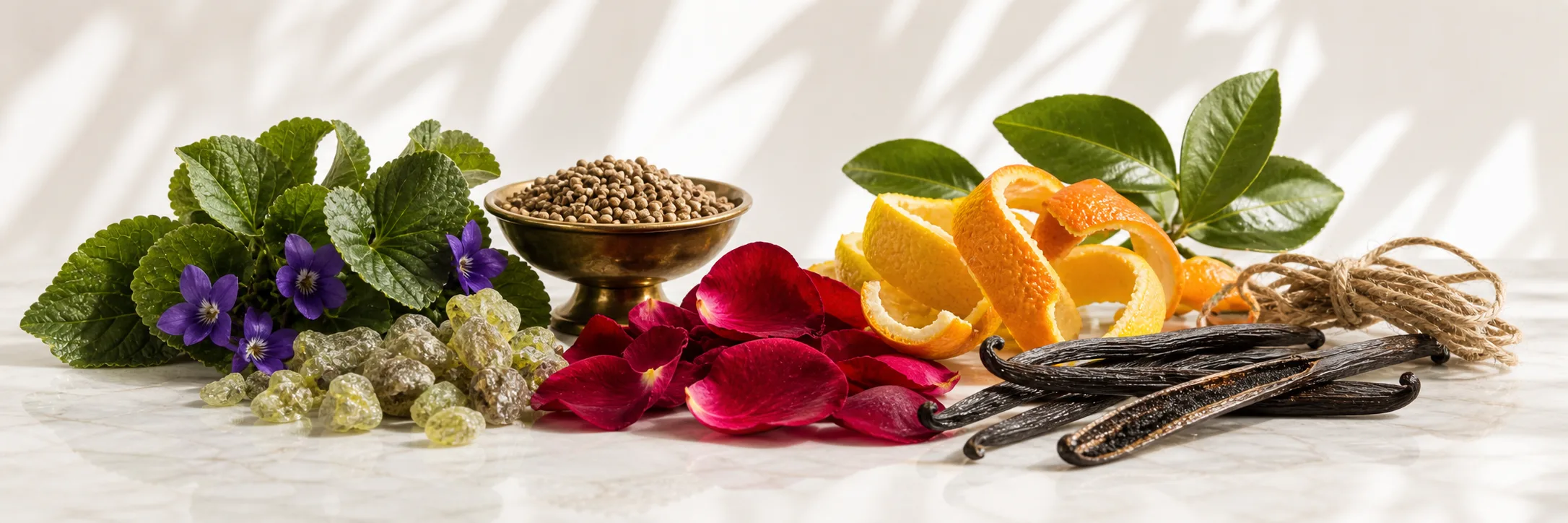
Iris Tubéreuse is Creed’s 2014 entry into the Acqua Originale collection, a boutique-experimental line meant to showcase singular materials. Despite its name, this is a green tuberose composition first and an iris fragrance only conceptually - perfumer Julien Rasquinet builds it from a fierce galbanum-violet-leaf opening into a cool, lily-modulated tuberose heart, finished with the salty-soft “Creedbergris” base familiar from the wider catalog. It is restrained where Fracas is operatic, fresh where Carnal Flower is carnal - a refined, unisex-leaning daytime floral often called the most underrated Creed.
Scent Profile
The opening (first ten to twenty minutes) is sharp and emphatically green. Galbanum - the bitter, resinous gum that anchors classics like Chanel No. 19 - comes through with full force, joined by violet leaf’s cool metallic-aqueous shimmer and a thin slice of orange providing the only citrus brightness. This is not the gourmand or honeyed opening that tuberose fragrances often deploy; it reads more like wet stems and crushed leaves than flowers. Several reviewers note the opening reminds them more of vintage L’Heure Bleue territory or Acqua di Parma Iris Nobile than of a modern tuberose. Neil Chapman, writing on The Black Narcissus (4 February 2015), captured the opening best: “a fierce galbanum and violet leaf head note… the rocket green illusion of hyacinthine fireworks - the most brilliantly self-conscious party entrance.” By the heart (one to three hours), the tuberose blooms - but quietly. This is a green, fresh, lily-tempered tuberose rather than the indolic, mentholated, slightly rubbery tuberose of Fracas or Carnal Flower. Several reviewers detect ylang-ylang here too, though it is not on the official note list (the Creed boutique page does list Indian tuberose with ylang-ylang, suggesting the omission is a oversight rather than an absence). Lily and lily-of-the-valley dilute and brighten the tuberose, producing a “soft rubber on dewy stems” effect - present but never overwhelming. The iris promised in the name is essentially invisible; multiple and reviewers note that there is no recognisable orris butter quality, no boiled-carrot-and-suede facet, and that the “iris” reads as a conceptual structural element rather than a perceptible note. One frequent interpretation is that Rasquinet built it as a composite from the supporting cast rather than dosing real iris absolute. The drydown (three-plus hours) settles into the unmistakable Creed base - that salty-mineralic-soft musk-vanilla accord nicknamed “Creedbergris” - overlaid with Sicilian orange blossom warmth and a discreet Mexican vanilla orchid powder. Neil Chapman calls the drydown the composition’s weak point: “more synthetic and confused (orange blossom, vanilla, musk).” Others find it the most pleasant phase, with the green sharpness gone and a clean, ambergris-tinged skin scent that develops into the next morning on clothing. The signature accord is green tuberose veiled by lily, anchored by the Creed-house base - a refined, almost reserved tuberose that reads less as a tropical white-floral bomb and more as a structured chypre-leaning floral. Evolution is real and stage-by-stage; linearity is moderate.
Performance
Performance is one of the most-debated aspects of Iris Tubéreuse. Despite being part of the Acqua Originale line (the name implies a lighter “eau” character), the EDP concentration delivers above-average longevity for a green floral - typically eight to ten hours on skin, with some users reporting twelve hours plus, and twenty-four-plus on clothing for those with skin chemistry that holds Creed’s musk base well. Projection is light-to-moderate: an arm’s-length cloud for the first hour, dropping to a close-skin scent thereafter. Sillage is intimate rather than diffusive - wearers-vote sillage score sits at 2.35/4. Several and users describe it as “appearing and disappearing” - periodically wafting up when the skin warms or the wearer moves - rather than projecting consistently. This is partly intentional; the composition is designed to read sheer rather than loud. Heat amplifies the tuberose and vanilla in the drydown but burns through the green opening faster. Cold weather dampens projection but extends longevity, and the green-galbanum opening lasts longer. Humid weather brings out the indolic facets of the tuberose more clearly; dry climates favour the iris-violet powdery character. Best application is two to three sprays to pulse points, avoiding fabric for the opening hour to let the galbanum-violet sharpness breathe.
Wearing Context
Spring and summer daytime are the natural home - galbanum’s bitter green wants warm air to bloom, and the tuberose-lily heart reads best against natural light. Several reviewers specifically cite humid summer evenings as when the fragrance becomes “surprisingly sexy, smooth, narcotic.” It can be worn in autumn comfortably; winter is its weakest season - the green opening reads thin and the drydown’s lightness fails to fill cold air. Occasions skew daytime: office wear, lunches, garden parties, outdoor weddings, daytime gallery openings. It performs well in professional settings precisely because it doesn’t shout. Less suitable: a formal black-tie evening (too understated), a winter night out (too sheer), heavy clubbing (the green-galbanum doesn’t survive crowds). Social-perception skew is feminine but not aggressively so. While marketed primarily to women, the Acqua Originale collection has always carried a unisex undertone, and several reviewers describe it as “an expertly made floral fragrance that seems more suitable for ladies, but any man can enjoy this well-made potion from afar.” The galbanum-violet-leaf opening gives men reasonable cover to wear it without obvious gendered signalling, particularly in European fragrance circles where green-floral chypres for men have a longer tradition.
Comparisons & DNA
The most consistent reference point is Robert Piguet Fracas - the 1948 tuberose benchmark. reviewers repeatedly frame Iris Tubéreuse as “a kinder, gentler Fracas” with iris-tempered restraint, lily-of-the-valley dilution, and an aquatic-fresh top that Fracas lacks. Where Fracas is operatic and indolic, Iris Tubéreuse is reserved and green. The second key comparison is Frédéric Malle Carnal Flower - Dominique Ropion’s gold-standard naturalistic tuberose. Iris Tubéreuse shares Carnal Flower’s earthy-menthol tuberose-leaf quality but dials back substantially on volume and weight; if Carnal Flower is a close-up of the flower, Iris Tubéreuse is the flower seen from a few feet away.
Reception
Iris Tubéreuse occupies a curious place in Creed reception: niche enough that it has avoided the polarising debates that surround Aventus, but well-regarded enough that the small wearers who knows it largely loves it. rates it a qualitative verdict across broad feedback - modest because the green-tuberose register is divisive among casual reviewers expecting iris-powder or a typical Creed citrus-musk profile. wearers ratings skew higher among those who specifically seek out tuberose compositions, with longevity scored at a qualitative verdict and sillage at 2.35/4. Common praise: the high-quality tuberose absolute (reviewers compare it favourably to natural Indian tuberose), the unexpected galbanum-violet opening, the underrated wearability, the surprisingly strong longevity for an “Acqua.” Common criticism: the absence of detectable iris despite the name; a drydown some find too generic-Creed-musk; a sense that the composition’s restraint reads as blandness in cold weather. The “where’s the iris?” complaint is the single most repeated note across, and. Polarisation axes split between green-tuberose enthusiasts (who love it) and powdery-iris seekers (who feel misled by the name). Among Creed enthusiasts who already wear Aventus or Green Irish Tweed, Iris Tubéreuse is often dismissed as too quiet; among floral specialists, it is frequently named as Creed’s most criminally overlooked release. critical coverage was thin at launch. Persolaise did not publish a dedicated review, despite the fragrance appearing in his Creed review index. Bois de Jasmin (Victoria Frolova) did not cover it. Olfactoria’s Travels archives lack a review (the blog went on hiatus in October 2015). Now Smell This published only Robin Krug’s 7 May 2014 launch announcement of the full Acqua Originale collection, listing the five-scent debut and a launch price of €149 / 100ml at Nose, Paris. The most substantive critical engagement came from Neil Chapman (The Black Narcissus, 4 February 2015), who praised the green-floral opening as “the most head-turning blue hyacinths” while finding the drydown lacking - a balanced but ultimately positive notice. Çafleurebon covered the broader Acqua Originale launch favourably, with the reviewer naming Iris Tubéreuse her favourite of the line: “a sharply green, lush tuberose opening, surrounded but not destroyed by a magnificent earthy iris.” Blind buy verdict: yes, with caveat. If you already love green tuberose and accept that the iris-in-name is conceptual, it is safe. If you are hoping for a Prada Infusion d’Iris - style powdery iris, look elsewhere.
Versions & Reformulation
Single composition, no documented reformulations. The fragrance has remained in production continuously since 2014 and is still listed on the Creed Boutique site in 2025-26 - surviving the broader Acqua Originale reorganisation. According to reporting (Eddie Bulliqi, “Creed Reorganizes the Acqua Originale Collection”), Aberdeen Lavender, Asian Green Tea, and Cedre Blanc were discontinued and replaced with Green Neroli, Citrus Bigarade, and Zeste Mandarine. Iris Tubéreuse and Vetiver Geranium are the two original 2014 releases that have remained in active production. Older packaging featured the original Acqua Originale facetted bottle with a white cap; the current packaging conforms to the unified Creed bottle style. No concentration variants exist - it has only ever been released as EDP. Anecdotal comments suggest some batch-to-batch drift in the strength of the green opening, but no formal reformulation has been confirmed.
Acquisition Notes
Pricing tier: luxury, in line with Creed’s mainline. MSRP is approximately $360 USD for 100ml at Creed boutiques (it launched at €149 / 100ml in 2014 per the Now Smell This launch announcement, so pricing has roughly doubled in twelve years). Bottle sizes: 30ml, 75ml, and 100ml have all been produced; 100ml is currently most available. Decant ecosystem is sparse compared to the Aventus line.
Notable Facts & Lore
- Creed’s official marketing frames Iris Tubéreuse as “a marriage of two of Olivier’s favourite places” - Tuscany (orange, violet) and India (the tuberose, “the finest in the world, harvested by moonlight”).