Creed — Erolfa
Essence
Erolfa is Creed’s 1992 entry into the early-1990s aquatic genre - a salty, citrus-and-herb-forward marine fragrance built on the house’s signature woody-ambergris base, composed jointly by Olivier Creed and Pierre Bourdon. It is a niche-tier aquatic of unusual subtlety: drier, more bitter, and more herbal than mass-market Calone-driven aquatics of the period, and named for an acronym of Olivier Creed’s children (Erwin, Olivia) and wife (Fabienne). Cult-followed rather than widely known, it is the Creed aquatic most associated with the Mediterranean-sailing imagery the house has used to position the bottle.
Scent Profile
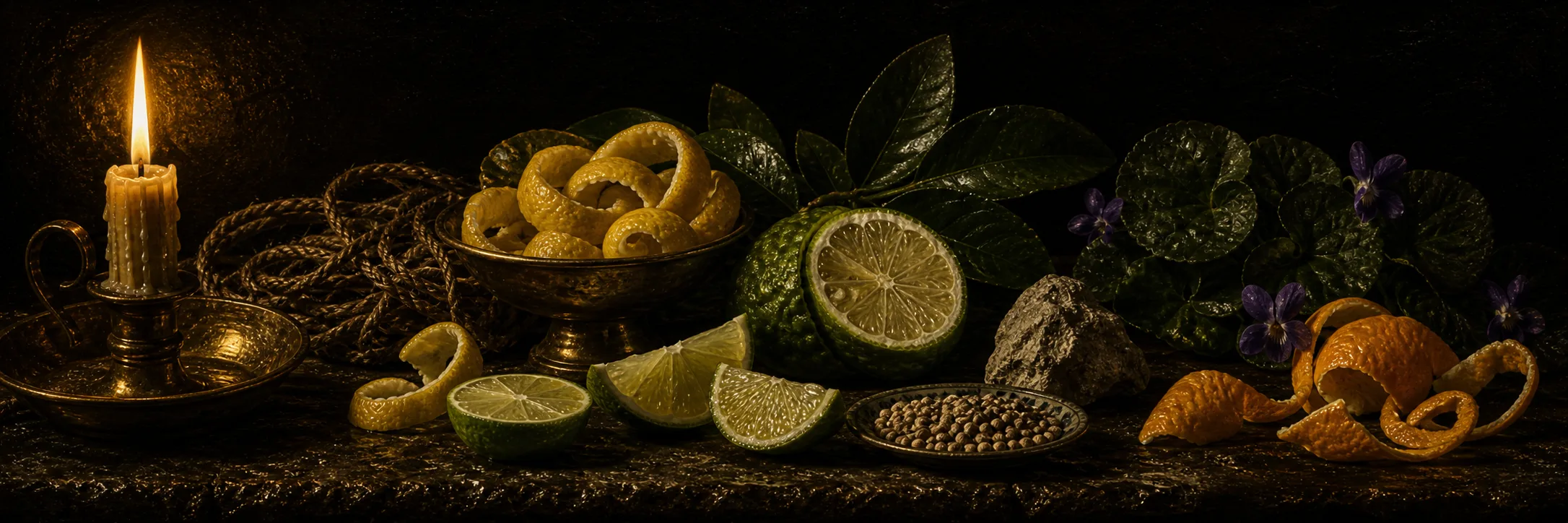
The opening is aggressively citrus. Lime cuts hardest, supported by bergamot and lemon - three citruses at once produces a bitter-rind freshness that registers more as cologne-classical than as fruit. Melon enters within the first minute as the Calone signature watermelon-cucumber-marine accord, and it is here that Erolfa identifies itself as an aquatic rather than a citrus cologne. Green notes and violet add a leafy, slightly powdery dimension underneath, and a sharp caraway-and-pepper spice complicates the freshness with a savory bite. Some wearers detect a brief cumin-adjacent dryness in the open that is not always officially listed; this is the kitchen-spice character that the editorial coverage has flagged as a distinguishing feature versus other 1990s aquatics. The opening is bright, salty, and intentionally a bit bitter. The heart, from roughly thirty minutes to two hours, is where Erolfa becomes most itself. Pine and herbal notes assert themselves, giving the composition a needle-and-sap quality that no other major aquatic of the era achieves. Ginger reads as a dry warming spice, jasmine as a clean white-floral counterweight, cyclamen as a green watery floral, and nutmeg-flower as a faintly powdery spice. This combination produces what Eddie Bulliqi described in “Aquatic Creeds for Summer” feature as “the torrid burn of sulphuric algae and whipping cold of starboard spray that fizzes up a ship’s sides and slaps you in the cheek at high speed.” The pine and herbs are the key - they distinguish Erolfa from the cleaner laundry-Calone aquatics that dominated 1990s mainstream perfumery. The drydown, from three hours onward, is the house base: ambergris (today predominantly ambroxan with supporting woody-amber materials), white musk, sandalwood, cedar, and oakmoss. This is the same salty-mineral-musky base that anchors Millesime Imperial and the original Aventus, and longtime Creed wearers will recognize it immediately. The base in Erolfa is drier and less sweet than in Millesime Imperial, with oakmoss adding a chypre-ish bitterness that distinguishes the two. It settles into a soft skin scent that holds for hours but is not loud. The signature accord is the lime-melon-pine-salt opening folding into the ambergris-musk-oakmoss Creed base. Evolution is moderate; the fragrance shifts but does not transform. Long-form commentary has identified the structural tension as the key feature - that there is “a bit of a disjoint between the base and the rest; almost like they are two different scents” - a perception that other reviewers experience as sophistication rather than failure.
Performance
Projection is light to moderate - roughly an arm’s length for the first ninety minutes, then closer. Sillage is consistently rated as the weak point. On skin, longevity averages four to seven hours, with the persistent woody-musky base extending to eight in cooler conditions but the salty-marine character itself fading by hour three. On clothing, eight to twelve hours is realistic. This is one of the shorter-lasting Creeds, even by the house’s own modest performance standards, and a frequent wearers complaint. Heat amplifies the citrus and melon and is the natural home for the fragrance; it was composed for warm-weather wear. Humidity flatters it. Cold weather flattens the top end and exposes the woody base sooner than is ideal. Dry climates lengthen its performance window slightly. Best application strategy is generous: five to seven sprays minimum, distributed across chest, neck, and forearms, with reapplication at the four-hour mark a common practice. Spraying onto a shirt collar substantially extends the marine character.
Wearing Context
Best in late spring through summer, with daytime wear strongly preferred. The fragrance is built for sun, salt, and warm air. Time of day: morning through late afternoon - Erolfa is too quiet and too aquatic for evening. Occasions: casual daytime, weekend outdoor activities, sailing (the brand’s own framing), business-casual settings, summer travel. Settings where it shines: anywhere with sun and skin; the fragrance projects best off warm skin in moving air. Settings where it falls flat: indoor evening, cold weather, formal dinners, anywhere requiring presence or weight. Social-perception skew: Erolfa reads as quiet, polished, and adult - neither youthful nor old-fashioned. It does not advertise itself, which is part of its niche appeal and part of why some wearers find it underwhelming for the price. The wearers discussion repeatedly describes it as “elegant aquatic for those who wear suit and tie” - a positioning that distinguishes it from the gym-and-club register of mainstream aquatics.
Comparisons & DNA
Within Creed, the natural comparisons are Millesime Imperial (saltier, more melon-forward, brighter) and Silver Mountain Water (greener, with a tea-blackcurrant facet, more verdant than marine). Erolfa is the most herbal of the three. Royal Water sits in adjacent territory but is more bitter-citrus driven. Green Irish Tweed shares the underlying dihydromyrcenol family but is dryer and more fougère-aquatic. Outside the house, the obvious comparisons are the early-1990s aquatic cohort: Davidoff Cool Water (1988, also by Pierre Bourdon, with which Erolfa shares clear DNA but to which it is more sophisticated and more expensive), Nautica (1992, considerably cheaper and more synthetic), Giorgio Armani Acqua di Giò (1996, sweeter and more melon-driven), Issey Miyake L’Eau d’Issey Pour Homme (1994, lighter and more yuzu-forward), and Ralph Lauren Polo Blue (2002, sweeter and broader).
Reception
Consensus is split into two persistent factions. The defenders consider Erolfa an underrated, sophisticated aquatic that rewards patience and warm weather; this group includes long-form reviewers who rate it among their top-tier Creeds and the enthusiasts who praise its naturalness and salt-pine character. The skeptics consider it a competent but unremarkable aquatic at an unjustifiable price, indistinguishable in its base from cheaper Creeds and in its top from designer alternatives. Common praise: the unusual herbal-pine character, the salty Creed base, the naturalness of materials, the wearability for office-appropriate summer. Common criticisms: weak performance (the most-cited issue), the disjointed top-to-base transition, and the price-to-distinctiveness ratio. Axes of polarization: aquatic-genre lovers vs. Creed-base lovers (the two camps experience the fragrance differently); summer-signature seekers vs. wearers expecting niche-grade presence; those who hear the salty pine and those who experience it as “drug store marine deodorant,” as one reviewer described it. coverage is light. editorial “Aquatic Creeds for Summer” article (Eddie Bulliqi) is the most positive critical assessment, characterizing Erolfa as having “herbal dynamism” with “an effervescent, carbonated jet of spiky ferns and churning an undercurrent of sand.” Colognoisseur has not produced a dedicated Erolfa entry. Bois de Jasmin, Now Smell This, and Persolaise have not reviewed Erolfa at length. Luca Turin and Tania Sanchez’s Perfumes: The Guide (2008) rated most Creeds harshly; specific star coverage of Erolfa is in the one-to-dismissive range consistent with their broader assessment of the line. No major reappraisal exists. Blind-buy verdict: not recommended at retail. Sample first via Surrender to Chance or MicroPerfumes; Erolfa is exactly the kind of fragrance where individual response is unpredictable and the price-performance ratio rewards sampling.
Versions & Reformulation
Sold only in EDP concentration. Bottle sizes commonly available: 50ml, 100ml, 250ml, and larger 500ml flacons. The fragrance has remained in continuous production since 1992. Reformulation discourse is moderate. Long-time Creed wearers have noted that the ambergris-base materials in current production lean more heavily on ambroxan and synthetic woody-amber chemicals than the earlier batches, which used more natural ambergris-style materials. The change has been gradual rather than a single sharp reformulation; current production remains broadly consistent with the original character but is perceived by some as less rich.
Acquisition Notes
Pricing tier: luxury. Creed boutique retail in 2025 is approximately $345 for 50ml and $470 for 100ml. The decant ecosystem is solid: Surrender to Chance, MicroPerfumes, and Scent Split all carry Erolfa in 1ml-and-up sizes, and Erolfa is a frequently sampled Creed precisely because of its polarizing nature. Counterfeit prevalence: low.
Notable Facts & Lore
- The name “Erolfa” is documented by Creed as an acronym of three family members: ER for Erwin (Olivier Creed’s son and now the seventh generation of the house), OL for Olivia (Olivier’s daughter and a visual artist at the company), and FA for Fabienne (their mother and Olivier’s wife).