Creed — Vanisia
Essence
Vanisia is a 1987 oriental eau de parfum attributed to Olivier Creed, and one of the most quietly revered “hidden gems” in the Creed catalogue - a fragrance whose reputation runs almost entirely opposite to the house’s modern image of hyped aquatics and YouTube fanboy “freshies.” Despite the name, it is not a vanilla soliflore. It is a rich, powdery, ambery oriental in the classic French tradition, marketed (per Creed’s own house lore) as having been created for a Spanish queen who wished to make a “style statement” like her relative Marie Antoinette, commissioning something “rich, sensual and mysterious, with undertones of Spanish woods and rich vanilla.” Now discontinued/vaulted, it survives as a connoisseur’s fragrance prized for the quality of its materials and its old-world, vintage-Guerlain character.
Scent Profile
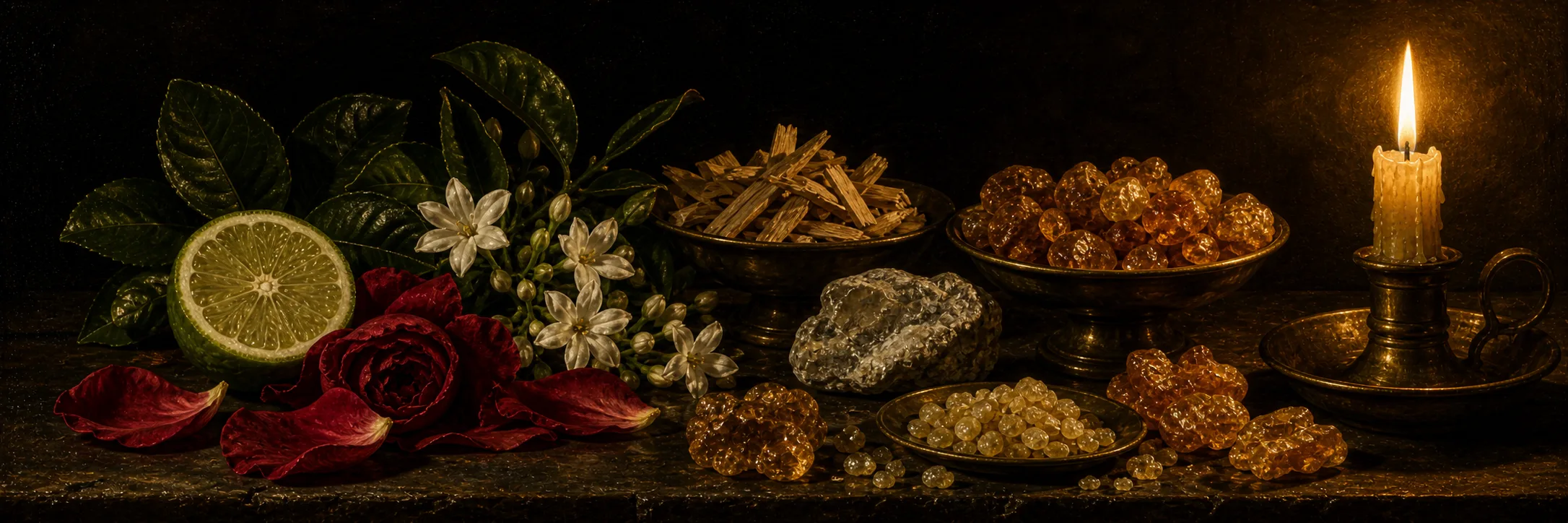
The fragrance opens with a bright bergamot - though several wearers report something brighter and harder to pin down, occasionally a spicy-aromatic, even faintly anisic or “barbershop” lavender-and-cedar facet, that can read briefly masculine. The heart is a well-contained jasmine-and-Bulgarian-rose dyad, the jasmine slightly indolic, the rose subdued rather than dominant - this is emphatically “not a rose fragrance,” as multiple reviewers insist. The real story is the base: a powdery, golden amber laced with Creed’s signature ambergris, a discreet but persistent unsweetened vanilla, and a dry sandalwood. The amber is frequently described as “rose-dusted” and 1950s/60s-style “butterscotch,” with a faint animalic, powdery undertone that invites comparisons to Bal à Versailles, Tabu and Jicky. Critically, the vanilla here is restrained: as one reviewer put it, “this is a vanilla for people who dislike its intrusive and cloying versions; it is never overly sweet here.” The whole is “subtle to the extreme” and notably reactive to skin chemistry - some find it blooms only on warm flesh.
Performance
Performance reports vary with formulation age and storage, but the consensus on well-preserved vintage bottles is strong. The fragrance is described as billowing “powdery sillage” that one must be “comfortable” wearing, with longevity “verging on pure perfume strength” on some skins. Others, particularly on drier or male skin, report a more moderate showing - one detailed review logged “moderate sillage, adequate projection and four hours of longevity,” calling it “not great but acceptable.” aggregated wearers scores place longevity at a qualitative verdict and sillage at 2.66/4 - i.e., above-average lasting power with moderate projection. The high-quality naturals are credited with the fragrance “smelling better and better” as it heats on skin.
Wearing Context
Vanisia is an autumn/winter fragrance par excellence - warm, resinous, cosseting. Reviewers repeatedly tie it to cold-weather and evening wear: “an absolutely amazing fragrance for a cold winter night,” even “Christmas in a bottle.” It reads sophisticated and “mature,” and is often flagged as best suited to wearers with some confidence and other “youth-ammunition under their belt,” as Perfume Shrine’s Elena Vosnaki framed it. Though marketed feminine, it is widely worn and recommended as effectively unisex; the wearers splits roughly 50/50 on whether a man can pull it off, with many men wearing it happily. available data skews it toward evening wear and the 26 - 55 age group.
Comparisons & DNA
Vanisia’s DNA is consistently triangulated against a handful of classics. The single most common comparison is Guerlain Shalimar - “smells like vintage Shalimar, a bit more citrus on top,” though Vanisia is described as more floral, more powdery and less vanillic in the drydown. Guerlain Samsara comes up for the sandalwood-vanilla axis, and Chanel Égoïste is repeatedly cited - Perfume Shrine’s Elena Vosnaki likened it to “a lighter Égoïste. if that one put the sandalwood into the boudoir.” One detailed reviewer placed it as a blend of “Bois des Îles, Égoïste, and Samsara, without any of the neon-lit syntheticness of Samsara, or the sweaty cinnamon of Égoïste.”
Reception
Among classic-perfume enthusiasts, Vanisia is a critical darling and a recurring “best-kept secret” recommendation, precisely because it confounds expectations of the Creed brand. Perfume Shrine’s Elena Vosnaki, taking “the scalpel” to the fragrance’s under-the-radar status, blamed its obscurity on “the double whammy of a misleading name and the wrong company (few houses are more derisive!)” while praising “a complex and satisfyingly rich amber accord” recalling “the play between light and darkness in the paintings of the Spanish masters.” On, one perfumista lamented that fellow enthusiasts “have completely ignored Creed, largely because they associate it with aquatics and hype… That’s sad because… their classic women’s perfumes are often amazing and widely unknown, Vanisia being a perfect example.” Dissent exists - a vocal minority on find an animalic, “cat pee”/urinous facet in the amber-jasmine accord - but the dominant sentiment is admiration for an “expensive”-smelling, beautifully blended classic. The Perfume Magazine’s Raphaella Barkley called it “rich and warm, decidedly sexy and very feminine and… beautifully executed,” rejecting the “smells like my grandmother” stereotype.
Versions & Reformulation
Vanisia was launched in 1987 as part of Creed’s Millésime line and classified by Michael Edwards as an Oriental/Classic. It is now discontinued/vaulted: Creed’s vice president Adam Brecht told The Perfume Magazine (2012) that “over the long term, this fragrance will be added to the vault under the Creed boutique” in Paris, “whereupon the Creed family and company will no longer send Vanisia to the United States… edits must be made to the collection to make room for new creations.” Within Creed’s terminology, “vaulted” means out of current production but not necessarily permanently deleted - though wearers understanding is that vaulted scents are effectively discontinued indefinitely, typically due to low sales. There is some discrepancy across databases ( at one point listed it as “still in production”), but the practical reality by the mid-2010s onward is that Vanisia left active distribution. Vintage discussion is notable: collectors report bottles 15+ years old “smell exactly the same as the day I purchased them,” and some suspect older bottles contained real Mysore sandalwood and genuine ambergris. Wearers have also reported encountering “off,” metallic, or more masculine-skewing bottles, raising the possibility of either an undocumented reformulation or - given Creed’s well-known counterfeit problem - fake stock in circulation.
Acquisition Notes
Because it was marketed female-centric and remained “mostly unknown,” its prices have not exploded the way other vintage Creeds have - a point reviewers raise as making it a relative value among collectible Creeds. Buyers should prioritize well-stored bottles and be alert to (a) the genuine risk of counterfeits, which are widespread for Creed, and (b) reports of variable/degraded bottles. Sampling before committing is strongly advised given how reactive the fragrance is to individual skin chemistry.
Notable Facts & Lore
- House lore holds that Vanisia was created for a Spanish queen described as a great-niece of Marie Antoinette; the story is Creed marketing rather than independently documented history, and one commenter even cited an alternative (unverified) 1948 origin and a connection to Queen María Cristina of Spain.