Creed — Aventus
Essence
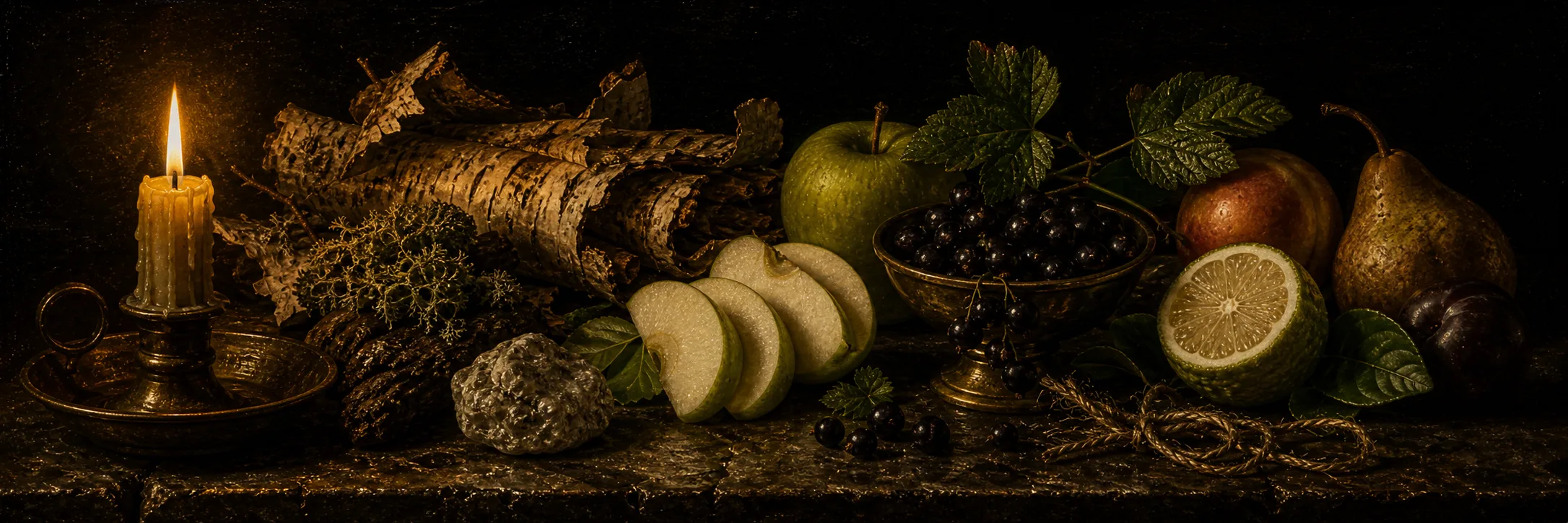
Aventus is the most influential masculine niche fragrance of the 2010s - full stop. Released in 2010 to mark Creed’s claimed 250th anniversary, composed by Jean-Christophe Hérault with Olivier Creed credited as co-author, it built a smoky-fruity chypre architecture (pineapple-blackcurrant-bergamot over birch-jasmine-patchouli into oakmoss-ambergris-musk-vanilla) that single-handedly created a new template. The “smoky pineapple” signature became shorthand for modern success-fragrance. Its near-mythical batch variation, generation-defining counterfeit ecosystem, and the unprecedented clone industry it spawned have made Aventus less a perfume than a cultural object - the Supreme of niche fragrance.
Scent Profile
The opening (first ten to twenty minutes) is the most famous opening in modern masculine perfumery: a juicy pineapple-blackcurrant burst lifted by Calabrian bergamot and lemon, with pink pepper providing a sharp aromatic prickle. The “Aventus pineapple” - slightly metallic, never tropical, never cloying - is the defining note. Apple sits behind it as a tart-green secondary fruit. In good batches, this opening reads bright, fizzy, and unmistakably high-quality; in weaker batches, the synthetic edge becomes audible and the pineapple thins. The transition into the heart (one to three hours) is where the fragrance’s defining accord crystallises: the smoky-fruity contrast that became Aventus’s calling card. Birch (in earlier batches, with explicit birch-tar character; reduced or removed in later batches) layers a dry, smouldering wood-smoke through the pineapple, creating the signature “grilled fruit” or “smoky pineapple” impression. Patchouli and Moroccan jasmine add weight; rose is theoretically present but rarely perceptible. This middle phase, especially in 2010-2014 batches, is what cemented Aventus’s reputation - a structural contradiction (fresh fruit + woodsmoke) that should not work but does. The drydown (three-plus hours) settles into Creed’s signature base: oakmoss providing chypre minerality, musk warming, ambergris (or its ambroxan synthetic stand-in) giving the salty-skin radiance, and vanilla softening the edges. Cedarwood and ambroxan provide modern lift. In peak batches - the legendary 2012 F-series, 14-batches, certain 16/17 batches - the base reads creamy, layered, three-dimensional. In contested newer batches, particularly 2021-2025 production, multiple reviewers describe the base as “thin, airy, almost cologne-like” with weakened oakmoss and a more synthetic ambergris signature. The signature accord is unmistakably smoky pineapple with chypre base - the architecture that hundreds of clones have tried to replicate. Evolution is real but compressed into the first three hours; from hour four onward Aventus becomes increasingly linear, a soft skin scent of musk-vanilla-faint-smoke. Mark Behnke, reviewing for ÇaFleureBon at launch, described the top notes as charging “off my skin like a cavalry charge” and called the overall impression “a wood-paneled man cave with roses in vases” - an evocative shorthand for the unusual juxtaposition.
Performance
Performance varies more by batch than for almost any other fragrance on the market. In good batches (the 2012-2014 F-series, 14L, 16H, 17M, 18B, 19D, the much-coveted 19Z01): projection is strong, throwing an arm’s length to two for the first two-three hours; sillage fills rooms; longevity runs eight to twelve hours on skin and detectable on fabric the next morning. In weaker batches (a recurring complaint targets 2020-2022 production, especially 20A01, 21T01, and 2025 F-batches): projection is moderate at best, longevity drops to four to six hours, and the base feels stripped. The most-upvoted 2025 comment compares the current batch to “smoky alcohol water… no pineapple, no citrus.” Heat amplifies the pineapple-citrus opening dramatically and can muddy the patchouli-birch middle. Cold weather mutes projection but preserves the smoky-fruity contrast. Humidity intensifies the fruity character. Dry climates favour the smoky-mossy base. Best application strategy: two to three sprays maximum, applied to chest and inner forearm - Aventus rewards restraint, and overspraying tips it into nausea-inducing territory in some batches. Many long-term wearers report macerating new bottles for four to eight weeks before first use, claiming it improves performance; this is folklore but extremely common. A note on nose-blindness: Aventus is one of the worst offenders. Multiple critical reviews and wearer accounts describe wearing it and being unable to smell it within an hour while others can still perceive it from across a room. The ambroxan and ambergris-mimic synthetics drive this effect.
Wearing Context
Aventus’s defining trait is versatility. Year-round wearable: spring and summer favor the fruity-citrus opening; autumn and winter foreground the smoky-mossy base. Daytime office, business meetings, first dates, weddings, weekend drinks, even gym (in moderation) - it works across nearly every social context, which is precisely what made it the default “important meeting” scent for a decade. Where it shines: business-formal settings, evening dinners, networking events, daytime weddings. Where it falls flat: settings where its ubiquity becomes a liability - fragrance-aware crowds will identify it instantly, and at this point a portion of the wearers considers it overexposed. In hot tropical climates, the smoky-mossy backbone can read out of context. Social-perception skew is the most studied of any fragrance. For ten years, Aventus signalled “established success” - the boardroom default. Around 2020-2022, as the Lattafa CDNIM and other clones flooded TikTok, the cultural valence of Aventus began to shift: now it can read as either “old-money confident” or “trying too hard,” depending on context and audience. Bois de Jasmin’s Victoria Frolova called it “the perfume of choice for soulless climbers of the career ladder” in an early review, then softened her view in a later post, ultimately giving Aventus a a strongly positive rating while acknowledging the cultural baggage. Persolaise dismissed it at launch as “a niche version of Bleu De Chanel: fairly competently put together, but overly reliant on thin synthetics” - a verdict he has never publicly walked back.
Comparisons & DNA
The clone economy Aventus spawned is unprecedented in fragrance history. The single most-recommended designer-tier alternative is Armaf Club de Nuit Intense Man (CDNIM), widely considered 85-90% accurate to peak-batch Aventus DNA - pineapple-birch-ambergris architecture executed with surprising fidelity at roughly one-tenth the price. CDNIM’s parfum version is the current gold standard. Lattafa Asad is the next-tier budget interpretation; Afnan 9PM is less close (more sweet-amber than smoky-fruity); Khadlaj Hawas and Mancera Cedrat Boise sit in the same DNA family, with Cedrat Boise often called “smokier and creamier than current Aventus.” Parfums Vintage Pineapple Vintage Intense (Damien Stammers, 2017) is a respected high-end clone that captures the pineapple-musk opening accurately.
Reception
Consensus on Aventus is, after fifteen years, fragmenting. overall rating remains high (positive range) on tens of thousands of votes. holds it in the positive range. online discussion has shifted from worship (2015-2019) to a more cynical “yes it’s great but you’re paying for hype, and the clones are 90% as good” consensus (2020-2025)., with its more vintage-oriented wearers, has always been the most critical - many longtime longtime reviewers never warmed to it and consider Persolaise’s “thin synthetics” dismissal accurate. Common praise: the unique smoky-fruity contrast, the unmatched compliment-getting reputation, the versatility, the high-quality natural-feeling pineapple. Common criticism: the price (currently $270 starting for 30ml, scaling to a 980ml flacon at the top end), the batch inconsistency, the apparent quality drop in 2020-2025 production, the cultural overexposure. Polarisation axes: vintage-batch enthusiasts vs. current-batch buyers; clone-acceptors vs. authenticity-purists; Creed-loyalists vs. Bourdon-attribution skeptics. Critical reception: Persolaise (Dariush Alavi) was openly dismissive in his March 2011 FiFi UK Best Niche Perfume shortlist commentary: “Aventus is what I’d call a niche version of Bleu De Chanel: fairly competently put together, but overly reliant on thin synthetics.” Now Smell This (Robin Krug) covered the 2010 launch with cautious wearers-interest framing, never publishing a full critical pan. ÇaFleureBon (Mark Behnke, FiFi 2011-finalist for his Aventus review) was much more positive, framing the composition as a successful Olivier Creed work that “celebrates all that makes a man successful” with note-by-note Napoleonic symbolism. Bois de Jasmin (Victoria Frolova) ultimately gave Aventus 5 stars while explicitly flagging her cultural reservations. Colognoisseur (Mark Behnke, after his ÇaFleureBon tenure) has continued to engage with the Aventus story. Blind buy verdict: no, sample first. Given batch variation, the price tier, and the genuine possibility that a current bottle will not perform like the legend suggests, sampling - ideally across two or three different recent batches - is essential. The CDNIM clone exists as a low-risk way to verify if you even like the DNA before committing.
Versions & Reformulation
Aventus has never been formally “reformulated” in the IFRA sense, but batch variation across fifteen years of production has been so significant that the wearers treats different batches as effectively different fragrances. The original 2010 formula included a substantial birch-tar note; consensus is that the birch-tar was reduced or removed around 2014, producing the famous “fruitier batches” of 2014-2018. Subsequent batches have drifted further - widely tracked changes include reduced oakmoss (likely IFRA-driven), shifts in ambergris-mimic synthetics, and apparent musk swaps. Key batch lore: F12, A4218, 12D01, 12F01, 13Q01 (an outlier, widely reviewed as the worst batch - user sweetstentch408 calls it “the worst batch of Aventus bar none”), 14L01, 14M01, 16H01, 17M01, 17P01, 18B01, 19D01, 19Z01 (a favorite), 20A01, 21T01 (widely criticised as weak). The 2025 F-batches have received vicious reviews on. Concentration variants and flankers: Aventus Cologne (2019) - a brighter, more aromatic-fougère take with ginger-mandarin opening, sandalwood-vetiver heart, styrax-tonka base, generally considered the most polarising flanker. Aventus for Her (2016) - apple-rose-musk feminine interpretation. Aventus 10th Anniversary (2020) - a special-edition bottle that Creed claims is identical to standard Aventus, packaged in dark glass for slower oxidation; opinion is divided on whether it actually smells the same. Absolu Aventus (2023 LE, 2025 permanent) - covered separately. Sizes: 30ml, 50ml, 100ml, 240ml, 490ml, and 980ml flacons.
Acquisition Notes
Creed Boutique US currently lists Aventus from $270 (30ml) with 100ml at approximately $475-$525 and the 240ml, 490ml, and 980ml flacons scaling steeply (the 980ml flacon trades above $2,000). Decant ecosystem is the most developed of any niche fragrance. Surrender to Chance carries multiple batches with year-attribution; Scent Split carries Aventus across batches and at multiple decant sizes; MicroPerfumes stocks it consistently; DecantPlanet and dedicated Aventus-specialists like Vintage Decants offer batch-specific decants (a 2016 batch can run substantially more than a 2024 batch). Expect $4-$12 for 1ml samples, $20-$45 for 5ml decants, with vintage batches commanding 2-4x premiums.
Notable Facts & Lore
- Aventus’s stated inspiration is Napoleon Bonaparte - Olivier Creed’s marketing positions the fragrance as a tribute to “the dramatic life of war, peace and romance” of the emperor, with each note allegedly representing a phase of Napoleon’s life.