Creed — Spice and Wood
Essence
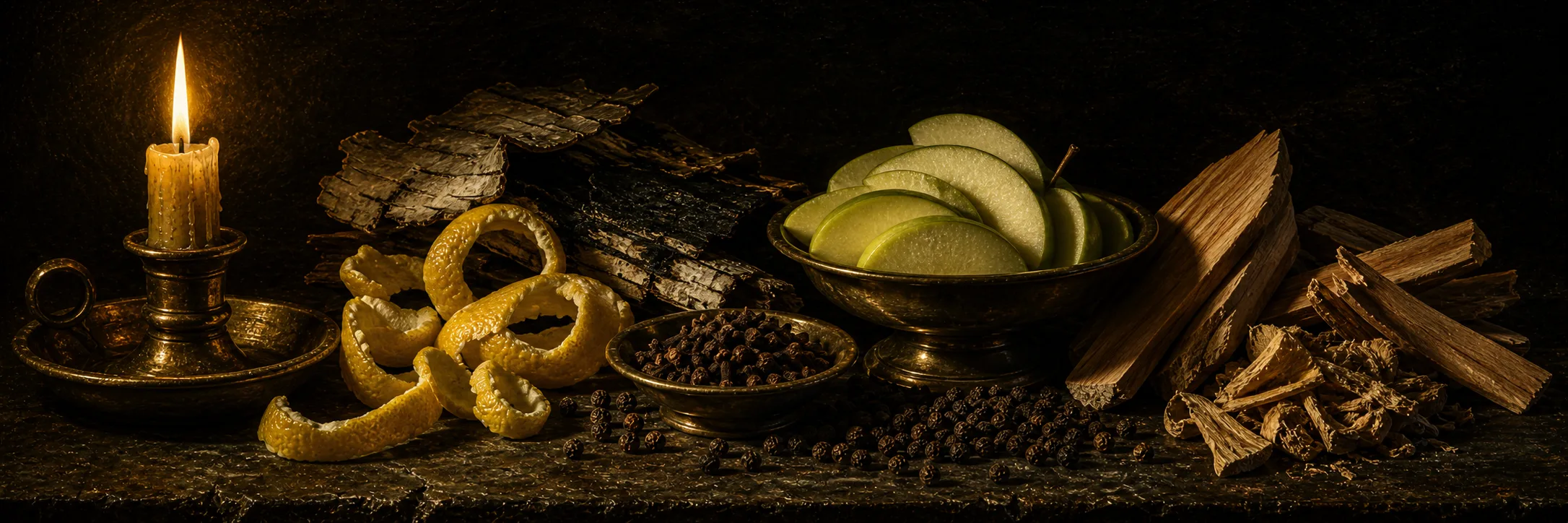
Spice and Wood is Creed’s 2010 Royal Exclusives play at a dry, transparent woody-spicy - a peppery cedar-and-birch chypre lit from above by green apple and lemon. Think Aventus’s smoky-fruit DNA stripped of the pineapple and sweetness, rebuilt around cracked black pepper, clove, and dry blond woods, with an angelica-root pungency doing most of the spicy lifting. It is the quietest, most “tasteful” expression of the Creed house signature: an apple-citrus-and-cedar accord that wears like a well-pressed white poplin shirt rather than a statement coat.
Scent Profile
The first ten minutes are the loudest the fragrance ever gets. Bergamot and Egyptian lemon arrive sharp and natural - not a candied citrus, more like zest from a Sicilian peel - laced with a juicy green-apple note unmistakably cousin to Aventus’s apple, only cooler and less sweet. A gin-like aromatic snap (the angelica root telegraphing its arrival) cuts through almost immediately, and within minutes black pepper and clove crowd the citrus. One commenter compares the first spray to “a peppery forest.” From roughly the 30-minute mark into hour two, the heart shifts to a dry, slightly resinous wood-and-spice core. Clove dominates the spice line - warm rather than dental - and the “desert pepper” reads as pimento/Jamaican pepper, supplying a dusty heat. White birch is conspicuous: not the leathery birch-tar of a Russian leather, but a clean, pencil-shaving birch interlocking with cedar. The listed rose is barely perceptible; patchouli is present but stripped of its earthy facets, functioning as a dry-woody fixative rather than a star. Angelica continues to lend a green, almost camphorous edge that prevents the spices from going gourmand. By hour three the composition flattens into a calm chypre skeleton: cedar dominant, clean musk underneath, a wisp of oakmoss, and the Creed-house ambergris-adjacent base note you also recognize from French Lover and Original Vetiver. The Egyptian iris is more textural than floral - a powdery sheen rather than a recognizable orris. Long-time wearers on describe a baked-apple-over-smoldering-campfire impression that emerges late, which is really birch and clove playing off residual apple. Development is essentially linear with subtle phasing rather than dramatic transformation. The signature accord is dry peppery cedar over green apple - that is the calling card, and what separates it from every other Creed.
Performance
Performance is the single most consistent complaint across every wearers surveyed. Projection is light-to-moderate for the first 60 - 90 minutes (an arm’s-length bubble at best), then collapses to a skin scent. Sillage barely exists past the first hour; this is not a fragrance that leaves a wake across a room. Longevity on skin ranges from 3 - 4 hours for those who run dry to 6 - 8 hours for those who detect the late cedar/musk drydown - long-form reviewers cluster around 6 - 8 hours; commenters routinely report 30 minutes to a skin-scent within the hour. On clothing - wool, cotton, scarves - it can be smelled the next day, which is the workaround experienced owners explicitly recommend. It blooms in warm, dry weather (citrus and pepper lift cleanly) and goes thin and ghostly in cold. Humidity flatters the apple-cedar accord slightly but does not extend longevity. Best application strategy: generous - 4 - 6 sprays minimum, with at least one to fabric, and avoid rubbing, as the top notes flash off fast enough already. Multiple owners explicitly say this is a fragrance worth owning as a decant, not a 75 ml bottle, purely on a cost-per-projected-hour basis.
Wearing Context
This is a daytime fragrance and an office fragrance - discreet, “expensive-smelling” in a way that signals taste rather than presence. It is most at home in spring, early summer, and especially autumn, when the apple-clove-cedar idea reads as seasonal without becoming a pumpkin-spice cliché. Multiple long-form reviewers single it out as the perfect October-November fragrance: crisp, dry-leaf, peppery without being heavy. Where it shines: business casual, client meetings, dinner with people who get close enough to smell it, weddings (a recurring “this is my wedding scent” sentiment on ), and warm-weather travel where you do not want to telegraph a heavy oriental. It layers beautifully under Aventus (apple compatibility) or Royal Oud (spice extension). Where it falls flat: clubs, nightlife, cold-weather statement scenarios, and any context that expects a Creed to perform like Aventus or Green Irish Tweed. It is unsuitable as a compliment-magnet - it almost never gets noticed by strangers. Social-perception skew is decidedly mature-masculine despite the unisex framing: wearers reads it as 30+, white-collar, “smells like someone who pays millionaires’ salaries” (a recurring trope on the entry). Women can wear it, but the / vote leans heavily male in practice.
Comparisons & DNA
The closest DNA match in the broader market is Frédéric Malle French Lover / Bois d’Orage (Pierre Bourdon, 2007) - both lean on angelica, cedar, and a dry incense-like backbone. French Lover is denser, more saturated, and substantially longer-lasting; Spice and Wood is the airier, fruitier, more citrus-led variant. Many regulars treat them as siblings, with French Lover the better value by a wide margin. Within Creed itself: Aventus (2010) shares the apple-and-birch axis but is sweeter, smokier, and far louder; Royal Oud (2011) is its Royal Exclusives line-mate and the maximalist cousin - pink pepper, oud, cedar, dramatically more projection; Original Santal is in spicy-woody territory but sweeter and creamier (sandalwood-cinnamon-tonka rather than cedar-pepper-clove); Bois du Portugal is the older, darker, more old-world cedar; Sublime Vanille (the 2009 Royal Exclusives debut) is its tonal opposite - gourmand vanilla; Original Vetiver shares a similar dry, transparent house texture. Outside Creed: Hermès Terre d’Hermès is structurally the closest mainstream comparison - pepper, cedar, citrus - cheaper, longer-lasting, and louder; L’Artisan Timbuktu (Bertrand Duchaufour, 2004) shares the airy, peppery-woody chypre architecture and likely informed it; Loewe 7 lands in the same green-apple-and-woods territory at a fraction of the price (and was released the same year, fuelling a long-running “who copied whom” thread); Tom Ford Oud Wood is darker, smokier, creamier; Serge Lutens Bois et Musc denser and more skin-like; Frédéric Malle Musc Ravageur is the warmer, animalic alternate-universe answer to the same brief; Dior Eau Noire sweeter and more lavender-led.
Reception
Consensus is sharply bifurcated along a single axis: scent quality versus price/performance. On scent, sentiment is genuinely warm - accord voting tilts heavily woody, fresh-spicy, and citrus; long-form reviewers regularly call it among Creed’s most refined compositions. The frequently quoted line - “one of Creed’s best smelling fragrances, also their worst performing” - captures the consensus exactly. Praise centers on: natural-smelling raw materials (especially the lemon and apple), a “smells expensive” texture, the rare-for-Creed sense of complexity-without-loudness, and the dry-down’s understated elegance. Criticism centers on three things: (1) projection and longevity universally described as below the niche-luxury benchmark, (2) a price-to-performance ratio even fans concede is hard to defend, and (3) a perceived lack of distinctiveness - the recurring “me-too” charge that the woody-spicy genre has been done as well or better by Terre d’Hermès, Timbuktu, and French Lover for less money. The Loewe 7 comparison comes up often and not flatteringly to Creed. Blind-buy verdict: No. Not at this price tier. Performance variance and documented reformulation drift make a sample or decant essential. It is, however, an almost universal “glad I tried it” - sentiment toward the juice itself is overwhelmingly positive when the price question is bracketed. - 2 critic coverage is unusually thin and worth flagging: Luca Turin and Tania Sanchez’s Perfumes: The Guide (2008) and The A - Z Guide (2009) both pre-date the 2010 launch and contain no entry. Persolaise’s blog tags Creed extensively but did not surface a Spice and Wood - specific review; Bois de Jasmin, Now Smell This, Çafleurebon, and Colognoisseur similarly produced no dedicated long-form review I could locate. The reception record is essentially a wearers record - itself revealing: this is a collector’s Royal Exclusive that flew under the formal critical radar even as it accumulated a devoted enthusiast following.
Versions & Reformulation
Spice and Wood launched in 2010 as the second release in the Royal Exclusives (Les Royales Exclusives) collection, following Sublime Vanille (2009) and preceding the 2011 trio of Original Cologne (Pure White Cologne), Jardin d’Amalfi, and White Flowers - the broader range coinciding with Creed’s 250th-anniversary year. The launch press described it as initially a limited edition of fewer than 500 bottles. It has been continuously produced since, in two presentations: the 75 ml flacon and the 250 ml carafe, both in the hand-finished Pochet du Courval glass bottle with the gilded Creed family crest. Reformulation is real and reported by multiple long-tenured owners on both and. The consensus pattern: bottles from roughly 2011 - 2013 are remembered as more saturated, with deeper birch, clove, and angelica, and a more pronounced smoky-fruit through-line. A noticeable thinning is reported between 2014 and 2017 - paralleling Aventus’s same-era drift - with later batches (notably 2018-onward F-series) described as more transparent, more aromachemical-forward, and lighter on the spice-and-wood core. One detailed account specifically fingers an Alpha Damascone - type aroma chemical as making the newer opening harsher and more synthetic. Creed officially declines to authenticate by batch number, complicating verification, but the olfactory difference between early-decade and late-decade bottles is widely accepted within the wearers.
Acquisition Notes
Pricing places Spice and Wood at the top of Creed’s tier, alongside Royal Oud and Sublime Vanille. Current retail (May 2026) sits around $575 - $610 USD for 75 ml at U. S. boutiques and department stores; the 250 ml carafe lists at €895 on Creed’s European site.
Notable Facts & Lore
- The originally documented inspiration - repeated in Creed’s own launch press and reproduced verbatim on entry - is the love story of Cleopatra and Marc Antony, framed as “the treasures of Europe and the Orient.”