Creed — Fleurissimo
Essence
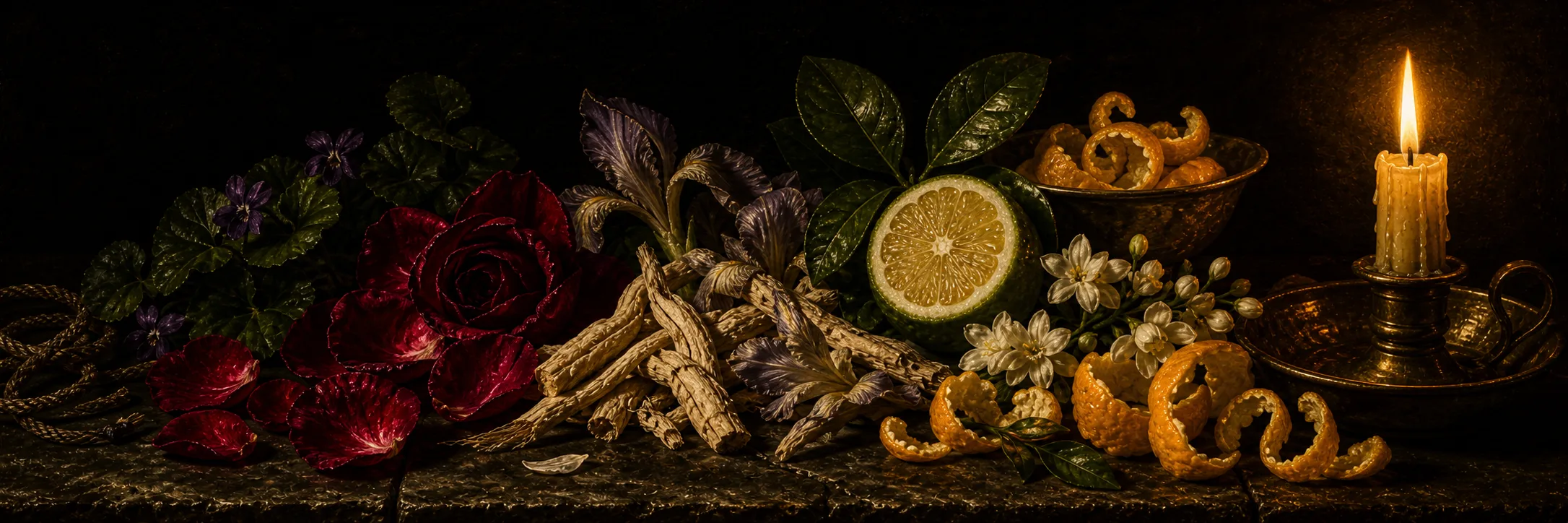
Fleurissimo is Creed’s mid-century floral landmark - a luminous bouquet of tuberose, rose, jasmine, ylang-ylang, and neroli arranged over a violet-leaf and bergamot top and a quiet orris-and-sandalwood base, attributed to James Henry Creed and dated by the house to 1956. Its identity is inseparable from the story (variously substantiated and disputed) that it was commissioned by Prince Rainier III of Monaco as a wedding gift for Grace Kelly. The composition itself is a literal, almost technicolor white-floral bouquet - not abstract, not subverted, not modernized - and reads as a vintage bridal floral executed with niche-grade materials.
Scent Profile
The opening is bergamot lifted by mandarin, with violet leaves adding a cool, green, wet-stem dimension that prevents the citrus from reading sweet. The mandarin sweetens the bergamot and the violet leaves bitter it - three notes braided into a single bright-green-citrus accord that resolves within ten minutes. This is a classical opening, deliberately uncomplicated, and its function is to clear the palate before the heart arrives. The heart is the entire fragrance. Tuberose is the dominant note: creamy, slightly indolic, waxen-petaled, less rubbery than Fracas and less screechy than Carnal Flower, but unmistakably tuberose in full bloom. Rose (Bulgarian, by Creed’s specification) sits next to it as a warm, slightly soapy counterweight rather than as a competing star. Jasmine adds an animalic-honeyed depth that prevents the tuberose from reading purely waxy. Ylang-ylang amplifies the creamy-banana-floral quality and ties the bouquet together. Neroli adds a green-orange-flower brightness near the top of the heart. This is not a tuberose soliflore - it is a literal floral bouquet, with all five flowers identifiable to a trained nose and the tuberose simply primus inter pares. The base, from roughly three hours onward, is unusually quiet for a fragrance built around such loud florals. Orris (iris root) adds a powdery, slightly carrot-cool earthiness; cedar provides a dry woody scaffolding; sandalwood adds creamy softness. This is not the salty-ambergris Creed base of the male woody fragrances - Fleurissimo’s drydown is a clean powdery-floral wind-down rather than a musky-marine landing. Some reviewers report a brief ambergris glimmer in the late drydown; this is consistent with the house’s broader use of ambergris-style materials but is not formally listed in the catalog notes. The signature accord is the tuberose-rose-jasmine-ylang heart over the violet-leaf-bergamot top - a literal bridal-bouquet rendering that Eddie Bulliqi at described as “a thick blend of bouquet florals arranged for maximum frill and thrill, heaving in the bulk of its own petals.” Linearity is low in the sense that the fragrance evolves clearly from green-citrus open to white-floral heart to powdery base, but linearity is high in the sense that the heart dominates so completely that one accord defines the wearing experience.
Performance
Projection is moderate to strong in the first two hours - three to four feet at peak - and settles into close wear thereafter. Sillage is generous for a vintage-style floral; this is not a quiet fragrance in the early going. On skin, longevity is good: six to ten hours is typical, with the powdery base persisting longest, and some wearers report longevity into a second day on cooler skin types. On clothing, twelve to twenty-four hours is realistic, with the white florals clinging to silk and wool particularly. Heat amplifies the indolic-tuberose facet and can push the fragrance into headache territory if overapplied; humid heat is the most flattering condition. Cold weather flattens the top end and exposes the powdery iris base sooner. Best application strategy is restrained: two to three sprays maximum, placed on chest and one wrist, avoiding the neck where the tuberose can become overwhelming. This is a fragrance where less is decisively more; the bouquet is loud enough on its own.
Wearing Context
Best in spring and early summer, with a long-debated tertiary case for autumn evening wear (some wearers members specifically argue it reads as autumn-winter rather than as a warm-weather scent - both readings have defenders). Time of day favors mid-morning through afternoon; for evening wear, restraint on application is essential. Occasions: weddings (its native habitat), bridal showers, formal daytime events, opera, garden parties. Settings where it shines: dressed-up daytime, anywhere requiring a vintage-feminine register, contexts where a classical white floral is read as appropriate. Settings where it falls flat: office in dense indoor environments (the tuberose travels and can overwhelm), gym, casual daytime, anywhere modern minimalism is expected. Social-perception skew: Fleurissimo reads as old-Hollywood feminine - distinctly vintage in style. The Eddie Bulliqi feature framed it explicitly as having an “1980s style despite being composed in 1956,” with “weight, less air,” closer to Opium than to L’Air du Temps. Younger wearers and those expecting modern florals frequently find it loud and dated; classical-floral enthusiasts find it transcendent. There is essentially no middle ground.
Comparisons & DNA
The unavoidable comparison is Robert Piguet Fracas (1948) - the tuberose soliflore standard. Fracas is louder, more singular, and more rubbery-waxen; Fleurissimo is softer, more bouquet-like, and more refined. Many wearers own both and consider them complementary. Other natural comparisons: Estée Lauder Tuberose Gardenia (sweeter, more vanillic), Frédéric Malle Carnal Flower (greener, more camphorous), Serge Lutens Tubéreuse Criminelle (denser, more medicinal). For the bridal-floral genre specifically, Jean Patou Joy (rose-jasmine soliflore in the same era), Christian Dior Diorissimo (lily-of-the-valley, also 1956), and Caron Fleurs de Rocaille sit in the broader vintage-floral neighborhood.
Reception
Consensus is sharply divided along a vintage-vs-modern axis. Defenders consider Fleurissimo a transcendent classical floral that no contemporary house executes at the same level of material weight; critics consider it dated, loud, soapy, or simply unremarkable for its price. Common praise: the literal bouquet quality, the naturalness of the florals, the tuberose’s restraint relative to Fracas, the Grace Kelly mystique, longevity and projection. Common criticisms: the dated character, the soap-floral quality some perceive (multiple reviewers describe a “creamy soapy tuberose” reading), the price relative to alternatives, the lack of modernization. Axes of polarization: vintage-floral lovers vs. modernists; tuberose lovers vs. tuberose skeptics; those who buy the Grace Kelly mythology vs. those who find the Creed origin story dubious. coverage is uneven. Bois de Jasmin (Victoria Frolova) has not produced a dedicated Fleurissimo review but has discussed Creed broadly and her commenters reference the bottle (including one specific wearers description of mixing “Spring Fling - 50/50 Spring Flowers and Fleurissimo” as a layering experiment). Now Smell This (Robin Krug) has not reviewed Fleurissimo specifically. Persolaise (Dariush Alavi) has covered Creed in his general blog work but not Fleurissimo at length. The most substantial critical engagement is therefore the feature by Eddie Bulliqi titled “Creed’s Fleurissimo: A Sleeper Floral Waiting to Be Discovered by Gen Z,” which describes the composition as “a thick blend of bouquet florals arranged for maximum frill and thrill” and predicts a possible Gen-Z revival on the strength of its “cottage-core” register: “despite angrily conveying flowers breaking free from their vase, most passers-by will likely think you smell of soap, hair spray, nostalgia, and family money.” coverage: Luca Turin and Tania Sanchez’s Perfumes: The Guide (2008) rated most Creeds in the one-to-dismissive range with skepticism toward the house’s marketing claims. Their treatment of Fleurissimo specifically falls within that pattern, and no celebratory critical reassessment has emerged. Chandler Burr has not produced significant Fleurissimo coverage in his column or books. Blind-buy verdict: recommended only for committed white-floral enthusiasts who can verify authentic supply. Strongly sample first via Surrender to Chance, MicroPerfumes, or a Creed counter - this is a fragrance whose response varies dramatically by skin chemistry and stylistic preference.
Versions & Reformulation
Fleurissimo is sold in EDP concentration. Bottle sizes commonly available: 75ml, 250ml, and larger flacons; a Millesime designation appears on certain bottles, denoting (per Creed’s framing) the use of best-harvest-year materials. Reformulation discourse is moderate. Vintage Fleurissimo (pre-2000s production) is reported by some longtime wearers to be richer in tuberose and more naturalistic in its florals; current production is competent but slightly more synthetic-tinged. Surrender to Chance has at times stocked a specifically labeled “Fleurissimo Millesime” sample, suggesting the house has at points marketed the bottle in differentiated form. Batch-to-batch variation, while less famous than Aventus’s, exists here too - Creed’s standard statement that natural-material formulations vary by harvest applies. A separate piece of complexity: certain perfume historians and commentators have suggested that the fragrance’s first commercial release was 1972 rather than 1956, with the 1956 date reflecting only the original commissioned wedding-day formula. Surrender to Chance’s reference page repeats the 1972 public-release claim. The catalog-fact 1956 date used here reflects the house’s official launch date, with the understanding that the bottle’s first widely available commercial form likely arrived later.
Acquisition Notes
Pricing tier: luxury. Creed boutique retail in 2025 is approximately $345 - 390 for 75ml and scales upward for the larger flacons. The decant ecosystem is good: Surrender to Chance, MicroPerfumes, and Scent Split all carry Fleurissimo in small sample sizes, and given the polarizing vintage-floral character, sampling is strongly the wearers-recommended path. Counterfeit prevalence: low to moderate.
Notable Facts & Lore
- The defining piece of Fleurissimo lore is the story that the fragrance was commissioned by Prince Rainier III of Monaco from James Henry Creed (the fifth generation of the house) as a wedding gift for Grace Kelly, designed to complement her wedding bouquet for the April 18, 1956 ceremony.