Creed — Feuille Verte
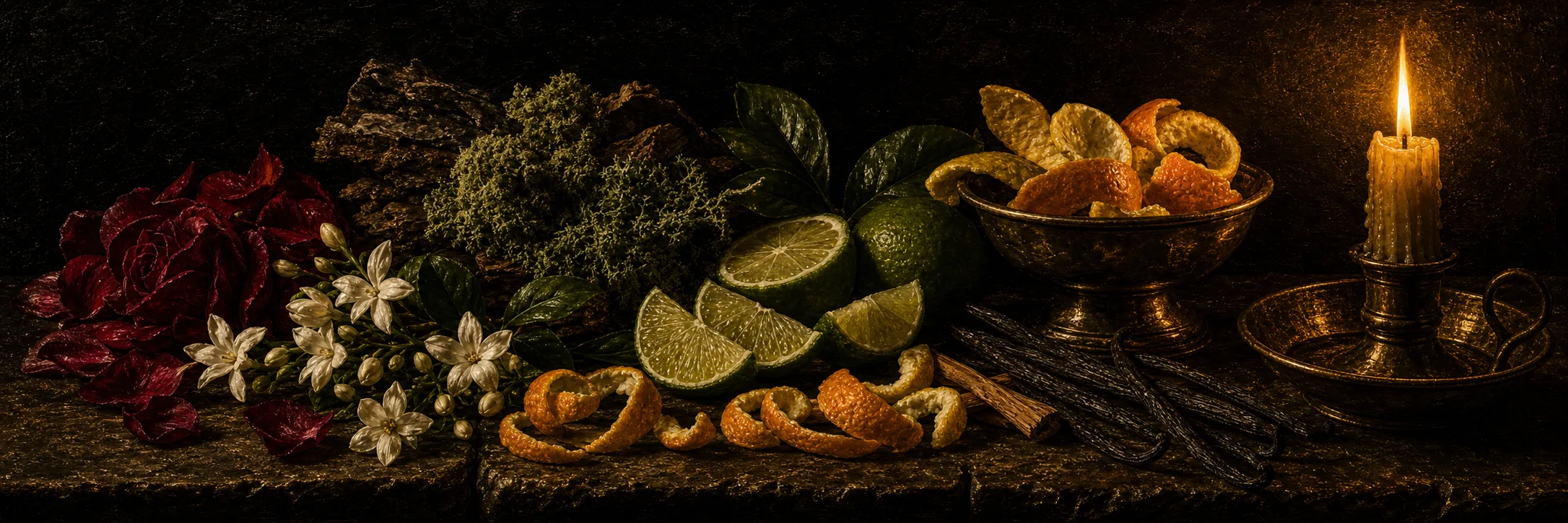
Essence
Feuille Verte (often pluralized in Creed’s own materials as “Feuilles Vertes,” “green leaves”) is one of the most quietly mythologized fragrances in the modern Creed canon - less because of what it smells like than because of how rarely anyone has been able to smell it. Released in 2006 as an ultra-limited release and given a small US re-release in 2011, it never entered the permanent line, which is precisely why it occupies the status it does among Creed obsessives. Despite the name promising leafy greenery, the consensus among those who have actually worn it is that this is not a “green” fragrance in the dihydromyrcenol/Green-Irish-Tweed sense at all. It is a citrus-topped floral chypre built on a now-near-extinct material: real, heavy oakmoss. The catalog classifies it as chypre-floral and unisex, and that is the more honest description than the marketing’s pastoral “green leaves after the rain” framing. It reads as a deliberate throwback even at the time of its release - an old-world construction issued into a market that Creed itself was busy reorienting toward brighter, more transparent aquatics.
Scent Profile
The opening is the most universally praised passage: a sharp, juicy citrus accord of lime and mandarin that reviewers repeatedly single out for its naturalism, with the lime in particular described as pristine and attention-commanding. This phase is short-lived - multiple wearers note it lasts only 10 - 15 minutes before collapsing into the heart. What follows is the fragrance’s defining feature: a dry, golden-brown oakmoss that is unsweetened and earthy, flanked by Bulgarian rose and a restrained vanilla bean. The rose/oakmoss pairing is what gives Feuille Verte its heft; it feels more robust, denser, and less transparent than the typical Creed “freshie,” and several reviewers reach for the word “savory” or even “soapy” to describe its refined, almost vinegary-herbal character. The drydown departs from Creed’s habitual ambergris-musk-vanilla landing and instead resolves into a high-quality jasmine absolute, which the more enthusiastic reviewers treat as the payoff of the whole composition. It is worth flagging the dissent honestly. A meaningful minority of wearers do not experience harmony here. One detailed reviewer compared it to “Original Vetiver on steroids,” finding the green note dry and disagreeable, possibly synthetic, and producing a “bugspray” effect on paper; another reviewer registered “a strong vinegar smell with some rather dark herbs and just a pinch of sawdust,” comparing it to Diptyque’s scented vinegar, and explicitly warned that anyone “expecting happy green leaves in the bright citrusy style of new Creeds” should skip it. So the fragrance is polarizing in an interesting way: the people who love it love it as a classical chypre; the people who dislike it dislike it because the name set up an expectation the juice does not meet.
Performance
Performance is the recurring weakness, and it is one that even devotees concede. Longevity is frequently described as average-to-poor - roughly three to four hours on skin is the most commonly cited figure, with sillage moderate for the first ninety minutes or so before it becomes a skin scent. One reviewer of the 2011 batch lamented that “after less than two hours the scent is gone,” calling it “a wonderful albeit ephemeral experience.” This is partly the nature of a citrus-chypre built on natural materials, and partly a consequence of reformulation pressure on oakmoss (see Versions). It is not a projection monster and was never intended to be; the framing among fans is that you wear it for yourself and for the close-range refinement, not to fill a room.
Wearing Context
This is a daytime, cooler-weather-to-spring fragrance by near-universal agreement. Reviewers recommend spring and summer “as long as the weather isn’t sweltering,” and note its flexibility across casual daytime outdoor wear through to formal indoor occasions, day or night. Its soft, mature, slightly old-fashioned character means it does not announce itself; it is positioned by fans as a connoisseur’s wear rather than a compliment-getter or a club scent. The chypre structure and oakmoss give it a “grown-up,” classical register that pairs naturally with the idea of it as a special-occasion bottle to be rationed - a sentiment reinforced by its scarcity.
Comparisons & DNA
The most useful internal Creed comparisons are to the house’s other green and classical compositions. Reviewers place it in the lineage of Creed’s green output - Original Vetiver, Selection Verte, Green Irish Tweed - but stress that it is structurally different from all of them, being a citrus-floral chypre rather than an aromatic fougère or a vetiver scent. The most cited internal cousins for the oakmoss character are the discontinued classical Creeds: Vintage Tabarome and Cyprès-Musc, with one reviewer adding Angélique Encens as a kindred “old-school” Creed. The contrarian who likened it to “Original Vetiver on steroids” did so critically. Outside the house, Caron’s Eau de Caron and Alpona are offered as comparable old-world citrus-chypre vibes, and one reviewer pointed fans of vintage Tabarome toward it as a more floral, less overtly masculine sibling.
Reception
Critical and wearers reception is high but caveated. Within enthusiast circles it has long carried “one of the best Creeds” reputation, and on it was repeatedly hailed as the finest release of 2006 and proof that Creed could still make a genuinely classical fragrance. The recurring praise centers on material quality, the lime opening, and the jasmine drydown. The recurring criticisms are twofold: poor longevity, and the gap between the “green leaf” name and the actual chypre experience. There is also a documented skeptical strand - at least one reviewer who sampled the expensive 2006 limited edition concluded the hype outstripped the juice. The net picture is a beloved but genuinely divisive scent whose reputation is amplified by rarity.
Versions & Reformulation
This is central to the Feuille Verte story. The original was a 2006 limited edition; according to documentation it was sold as one hundred 250 ml flacons at Neiman Marcus for Father’s Day 2006 at $375, each hand-signed by Olivier Creed, with an optional green leather-wrapped atomizer at $100. A gala US re-release followed in 2011, with a commonly cited figure of only 350 of the 250 ml decanters made available, plus subsequent very limited boutique availability and promotional appearances. The 2006-versus-2011 batch question is genuinely contested among owners. The dominant view, articulated by a owner who ran a 2008 decant against 2011 flacons, is that they are essentially the same fragrance with the oakmoss slightly toned down due to IFRA restrictions - making the already-ephemeral scent a touch more so. A dissenting owner who wore 2006 and 2011 side by side declared the 2011 “a shadow of the former.” The practical takeaway: oakmoss regulation is the reformulation pressure point, and later batches are widely believed to be somewhat lighter and shorter-lived than the original. The catalog lists the concentration as EDP; note that some Creed and retailer materials describe it as a men’s cologne, though it is best understood as unisex.
Acquisition Notes
Feuille Verte is discontinued and was never a standard-line product, so acquisition is a collector’s exercise rather than a purchase. It surfaces on the secondary market and through decant services, and historically was split into small decants by services that obtained the limited flacons. Because authenticity and batch matter so much here - and because oakmoss-heavy juice degrades and the top notes evaporate from atomizers over time (one reviewer speculated the florals had partly evaporated from a leather-wrapped atomizer they bought) - buyers should prioritize provenance and, where possible, sample before committing to a full flacon at the elevated prices the rarity commands. Given the modest longevity, a decant is arguably the rational way to experience it.
Notable Facts & Lore
- The fragrance is explicitly framed by Creed as a tribute to Olivier Creed’s country life in Fontainebleau - green leaves after rain, newly mown grass, freshly turned earth - where, the house copy notes, he rode, walked his terriers, and made fragrance with his son Erwin in a workshop down a hidden country lane.