Creed — Fleur de Thé Rose Bulgare
Essence
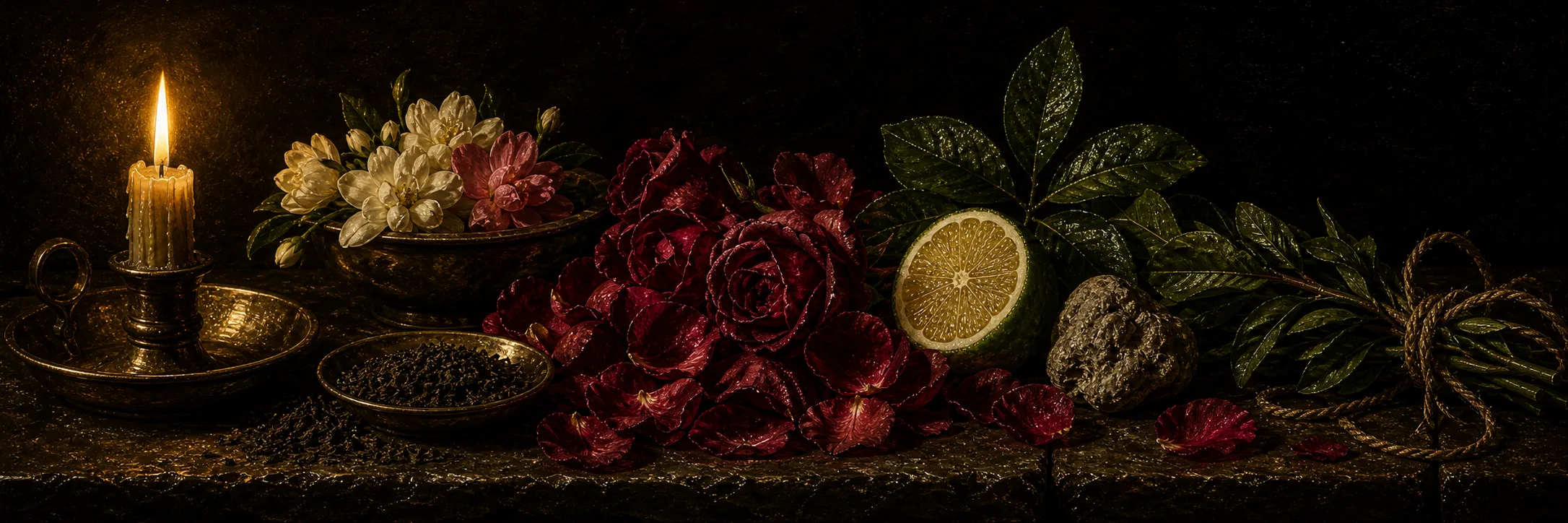
Fleur de Thé Rose Bulgare is Creed’s most unapologetic rose soliflore - a naked, dry, old-fashioned Bulgarian rose lifted by citrus and a literal green-tea-flower note, sitting on a strong, earthy ambergris base. Officially dated to 1890 and attributed to Henry Creed (third generation), it is in practice a circa-2000 release marketed as a historical recreation, and it has become Creed’s best-selling Private Collection fragrance. Its distinction is purity and directness: where most rose fragrances soften into powder, candy, or potpourri, this one stays a “powerhouse rose” - bright, true, and slightly austere.
Scent Profile
The opening is an explosion of soliflore rose “swimming in green tea,” with a brief, fast-passing alcohol hit some reviewers dislike at the price point. The citrus trio - bergamot, lemon, mandarin - keeps the rose buoyant and unsweetened rather than adding much character of its own. The green tea here is a deliberate literal tea note (the flower of the tea plant, not the leaf), reading as a delicate botanical/garden facet rather than the galbanum-green sharpness of its sibling Fleurs de Bulgarie. Some experienced noses (notably Zealot Crusader on ) also detect a touch of jasmine/hedione brightening the heart. The base is the defining and most divisive element: pure, unfettered Creed-style ambergris, “massive lumps” of it - earthy, slightly animalic, and so prominent that it becomes “the most challenging aspect.” The composition is essentially linear - a rose that stays a rose - and reviewers split between calling it “transparent”/translucent and “powerhouse”/projective. The signature accord is dry tea-rose over earthy ambergris, a combination one critic flatly called “a weird combo when you think about it” yet one that works.
Performance
Performance reports are polarized, likely reflecting batch and skin variance. Several rose lovers report excellent results: “good lasting power, good projection,” and one Badger & Blade reviewer got “a solid 12 hours” from just five sprays of a sample, “never overbearing or cloying.” reviewers, conversely, find it “translucent,” “fragile,” and forgettable, laying close to the skin with little sillage. The consensus middle ground: a true rose with respectable-to-strong projection that some skins amplify and others mute. It is generally framed as a warm-weather, daytime rose - “perfect for a summer day,” a clear morning rose-garden impression - though its richness lets it cross seasons.
Wearing Context
Daytime, spring and summer, casual-to-elegant. The marketing and framing skew strongly feminine (“a true feminine fragrance,” “all woman, powerful and authentic”), but multiple male reviewers note it is wearable by men comfortable with rose - /Badger & Blade reviewers compare it to Penhaligon’s Hammam Bouquet and say “a man could pull this off.” Social perception skews classic, confident, and rose-forward; one reviewer warned it is so directly rosy that “people who hate rose will subsequently hate you on days you wear this around them.” It is a signature-scent candidate for dedicated rose people rather than a crowd-pleasing safe blind buy.
Comparisons & DNA
Pure rose-soliflore DNA with an ambergris base. The most-cited comparison is Penhaligon’s Hammam Bouquet, which shares a “powdery, dusty rose” - but where Hammam’s rose “turns flat and synthetic,” Creed’s “progresses into a ripe, pink fullness.” The crucial in-house comparison is Creed Fleurs de Bulgarie (the Damask/galbanum-green, sharper rose); Fleur de Thé Rose Bulgare is the more old-fashioned, tea-rose-and-ambergris counterpart. The single most important value comparison from the wearers is Perfumer’s Workshop Tea Rose (1973): a reviewer directly preferred the far cheaper PWTR as a rose soliflore and questioned paying “exponentially pricier” Creed money. Diptyque L’Ombre dans l’Eau is named (by Zealot Crusader) among comparably pure rose treatments.
Reception
Reception is genuinely polarized along a rose-purity axis. Praise: rose collectors call it their favorite true rose, “fresh, youthful, exhilarating,” “off the charts.” Criticism clusters on three points: (1) the prominent, almost feral ambergris base; (2) for some, it reads as just “soap, soap, soap” or a “fragile”/transparent rose not worth the money; and (3) value - the 250ml-only format and price are recurring complaints. The most analytically useful critique comes from Zealot Crusader, who flagged the 1890 dating as essentially marketing fiction - green tea was not a perfumery material in 1890, and the presence of hedione argues for a much later (2000) actual composition. He concludes that even “as a rose nut myself, I cannot say this is anywhere near a Holy Grail for the genre,” while still rating the quality highly. Blind-buy verdict per wearers: not recommended unsniffed given price, polarizing ambergris, and the bulk-bottle format - sample first.
Versions & Reformulation
The core “version” issue is historical framing: Creed dates it to 1890 and attributes it to Henry Creed, but the consensus among knowledgeable reviewers (Zealot Crusader most explicitly) is that the modern product is a 2000 recreation/realization, with the 1890 backstory being one of Creed’s well-documented “historical re-writes.” Creed’s own retail copy states it was “introduced to the public in 2000, just over one hundred years after its original creation.” Reviewers note green-glass vs. clear-glass bottle versions and debate whether the juice changed; the more credible view attributes batch differences to natural-ingredient variation rather than deliberate reformulation. Vaulted/discontinued by Creed around March 2020.
Acquisition Notes
Sold by Creed only in large 250ml splash flacons (no pre-filled atomizers, unlike Creed’s mainstream lines), which shaped its acquisition pattern. Boutique pricing before vaulting ran roughly $475 for 250ml, rising to about $565 in the clear-bottle era, per a collector on. g., The Perfumed Court) are a documented channel.
Notable Facts & Lore
- The official origin story: created for the wife of a historically famous U.