Fragonard — Baroque
Essence
Baroque is a discontinued spicy floral-woody rose from Fragonard, the historic Grasse house, and it is exactly what its name promises: an ornate, lush, slightly old-fashioned rose built on a spine of ginger and saffron and grounded in guaiac wood, vanilla, and musk. Sold largely as a boutique-and-museum souvenir in Grasse, Eze, Nice, and Paris, it quietly accrued a devoted following and is now among the more fondly mourned Fragonard discontinuations. The house’s own museum framing calls it a soft blend of rose and carnation, though wearers consistently report something richer and spicier than soft.
Scent Profile
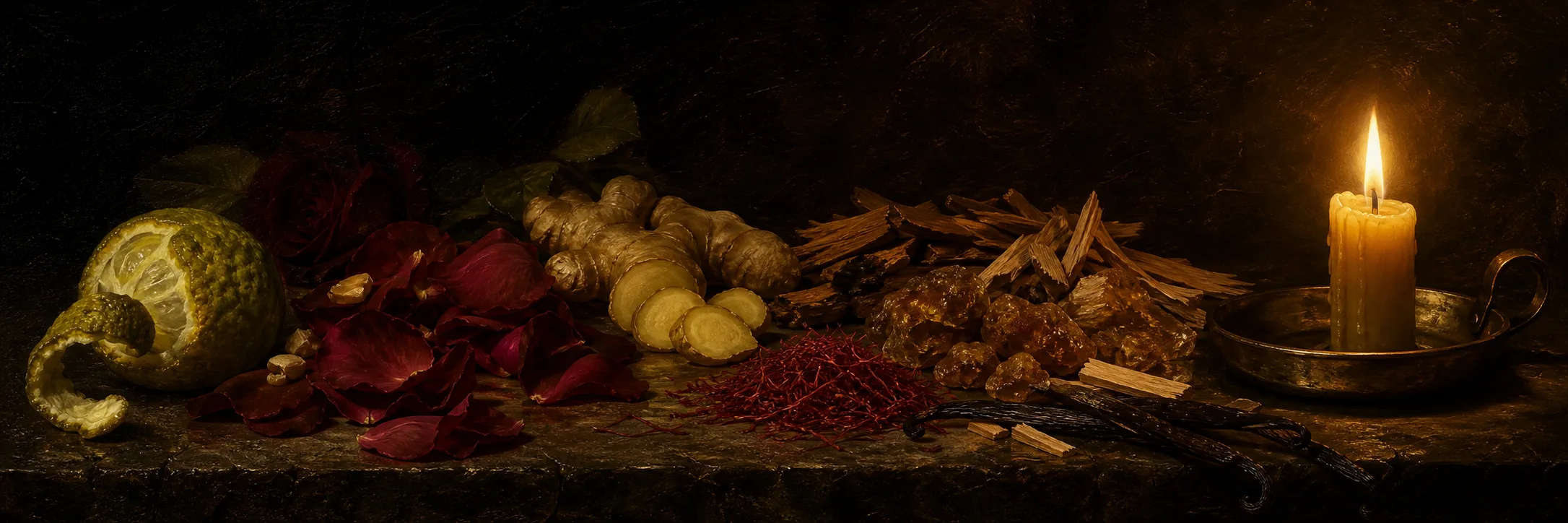
The construction is a rose duet — tea rose and Bulgarian rose — lifted by a bright bergamot top and given its signature edge by ginger and saffron.
As it develops, the rose warms and deepens. Wearers describe gigantic red roses with a clear taste of saffron and a warm, light ginger note, the spice giving the flower a dark, edgy character that several call nothing for the weak-hearted. Skin chemistry tips the balance: on some wearers the rose recedes almost entirely, leaving carnation and vanilla or a spicy amber instead.
The base of guaiac wood, which itself carries a tea-rose-like facet and acts as a fixative, joins vanilla and musk to pull everything into a warm, satiny drydown. The most common arc runs from ginger and bergamot at the top, through a rose-vanilla blend, into a powdery, silky musk-vanilla close.
Performance
Performance is strong in the classic European mold. Wearers report that it lasts forever in the Eau de Toilette and projects vividly, with one describing a single drop scenting an entire room and beyond. This is not a quiet skin scent but a room-filling rose with real tenacity. The parfum concentration, sold in Fragonard’s gold aluminum estagnon flacons, is correspondingly intense — potent enough that at least one wearer found it almost too strong to apply freely. A light hand is the sensible default.
Wearing Context
Baroque reads as a cool-weather, evening, special-occasion rose — a queenly scent for days that call for feeling a bit more special. It skews mature and formal, and wearers repeatedly contrast it with girly or modern fruity-florals, describing its flowers as dark and mature. A sunny winter day suits its lush opulence especially well. It is not an everyday office scent for most, sitting more comfortably in dressed-up and ceremonial settings.
Comparisons & DNA
The most frequent reference point is Jean Desprez Bal à Versailles, with Baroque described as reminiscent of it but spicier and more modern, placing it in the lineage of opulent, slightly animalic-vanillic French rose-orientals. One wearer offered the more unexpected pairing of a cross between Bal à Versailles and Bvlgari BLV. Within its genre it belongs to the spicy-rose-with-warm-woods family, and the ginger-saffron lift over guaiac and vanilla is its distinguishing fingerprint. Many wearers insist nothing else smells quite like it, a verdict that is partly genuine character and partly the scarcity speaking.
Reception
Reception among those who found it is warm and frequently elegiac, with a recurring chorus of devotion mixed with grief at its discontinuation. Admirers call it beautiful and wish the house would relaunch it; one memorable account framed it as a baroque rose cloud you sink into or even drown in, an acquired taste that ultimately won the writer over. There are dissenters: on some skins it turned plasticky or sickly sweet, and to some noses it read as old-fashioned. The split is chemistry- and generation-dependent, but the dominant sentiment is affection for a discontinued favorite, which keeps secondary-market demand high.
Versions & Reformulation
Baroque was produced both as an Eau de Toilette, in 100 and 200 ml bottles with a 600 ml refill, and as a parfum in Fragonard’s signature gold aluminum flacons. Its release year is not formally recorded, but it appears in 1990s Fragonard mini-sets, placing it in the house’s late-twentieth-century lineup. No formal reformulation is documented, though wearers note batch variation as with most older Fragonard scents. It is now discontinued; third-party “type” recreations exist but are not the original.
Acquisition Notes
Baroque is acquired today almost exclusively secondhand and is frequently described as rare and no longer produced. Because it was a boutique and museum exclusive sold mainly in person in France, supply is scattered and condition variable. Buyers should prioritize well-preserved bottles, since the top notes degrade with age, and the gold parfum flacons, which protect against light, keep best. Sealed vintage commands collector prices, and a sample or swap is the safest first step given the per-skin variability.
Notable Facts & Lore
- Baroque was sold largely as a boutique-and-museum souvenir, encountered by many admirers at Fragonard’s Grasse factory, in Eze, Nice, or the Paris boutique.
- Many wearers note that no one else they meet ever has the same fragrance on, a mark of its scattered, in-person distribution.
- The base uses guaiac wood, which carries its own tea-rose-like facet and acts as a natural fixative.
- The house museum situates Baroque within Fragonard’s mid-century floral heyday, calling it a rose-and-carnation expression of the era’s taste for heady florals.
- One fan invented an elaborate court backstory for it set in the era of Louis XV — confabulation rather than house history, but a measure of its period-costume aura.
- It was offered both as an Eau de Toilette and as a parfum in Fragonard’s signature gold aluminum estagnon flacons.