Fragonard — Fleur d'Oranger Parfum
Essence
Fleur d’Oranger Parfum (2023) is the most concentrated and most recent expression of Fragonard’s long-running orange-blossom soliflore line, presented in the house’s signature golden “Estagnon” bottle. It is a clean, sunny, naturalistic orange-blossom-and-neroli scent built on the Grasse maison’s defining value proposition: high-quality traditional French floral perfumery at a fraction of niche prices. Despite the “Parfum” label implying greater richness, the consensus is that this version reads greener, more neroli and orange-leaf-leaning, and less honeyed than the beloved EDT — and weaker in performance than expected. It sits in a confusing family of Fragonard orange blossoms, and the real question for buyers is which of the three to choose.
Scent Profile
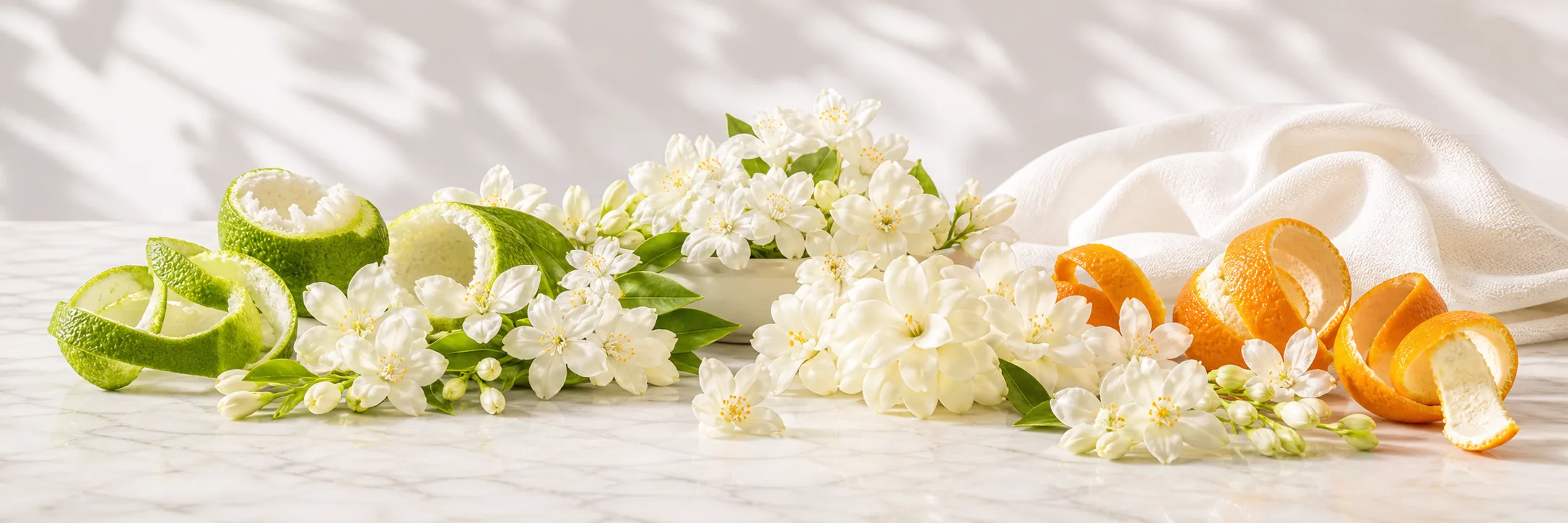
The opening is a bright, slightly green neroli-and-bergamot accord — citrusy and fresh, described by one wearer as “more of an orange leaf scent” that recalls the twig and leaf of the tree rather than the indolic flower. This is a transparent, daylight orange blossom from the very first spray.
The heart is the orange-blossom and jasmine pairing, but rendered clean rather than narcotic: “a clean, sunny, natural floral, a dive into the blossoms of a tree in warm weather.” A recurring observation is that, compared with the EDT, the Parfum drops the “sweeter, vaguely honeyed note in the base” and stays on green and white tones instead.
The drydown is a clean, soft musk, with ylang-ylang in the notes that several wearers find barely perceptible. Linearity is high — this is a soliflore that opens, states its orange-blossom theme, and holds it with little development. The signature is a clean, woody-green orange blossom with a soap-effect base in the house’s broader soliflore style.
Performance
Performance is the fragrance’s most-criticized axis, which is striking for a “Parfum.” Many wearers report disappointing tenacity and projection: one found the projection “is quickly suffocated, that it quickly runs out of steam,” with “pretty good [hold] on fabric and barely decent on skin.” Another, comparing concentrations, noted “longevity is somewhat improved, but [the] EDT has better sillage,” and concluded the Parfum’s best use “would be for traveling, or for handbag and touch-ups during the day.” Expect modest projection, short-to-moderate longevity on skin and better persistence on clothing. Spray generously, favor fabric and pulse points, and treat it as an intimate, frequently refreshed scent rather than a projector.
Wearing Context
This is a daytime, warm-weather, spring-and-summer fragrance par excellence: clean, sunny and uplifting, suited to office, casual and daily wear where an understated natural floral is wanted. It is genuinely unisex in the manner of neroli colognes, though it skews feminine-neutral in perception. The clean soap effect and low projection make it well-suited to scent-sensitive environments and close quarters. It is not an evening, seductive or cold-weather scent; its register is fresh grooming rather than statement — the olfactory equivalent of clean linen in sunshine.
Comparisons & DNA
- Fleur d’Oranger EDT, from within the house, is warmer, honeyed and arguably better-loved, with better sillage; many wearers prefer it to this Parfum.
- Fleur d’Oranger Intense (2016) is the louder, sweeter, more white-floral and “babyish” of the family — the heaviest of the three.
- Serge Lutens Fleurs d’Oranger is the instructive opposite: a heady, indolic, cumin-spiked tuberose-jasmine bomb, where the Fragonard is clean, green and sunlit, with no cumin, indole or narcotic weight.
- Jo Malone Orange Blossom is the closest external neighbor — another clean, bright, non-indolic reading; the Fragonard offers far better value but weaker performance.
Reception
Reception is warm toward the scent quality but pointed about value-versus-redundancy and performance. There is no dedicated critic review of this 2023 release, though the broader Fragonard orange-blossom line is much-loved. The recurring praise is the natural, elegant “characteristic delicacy” of Fragonard’s house style and the unbeatable price-to-quality ratio. The dominant criticism is twofold: weak performance for a “Parfum,” and the maison’s confusing proliferation of near-identical orange blossoms — one wearer’s exasperation is representative: “I don’t understand the point of bringing out so many perfumes with the same scent.” The polarization runs along concentration preference: devotees of the honeyed EDT or the bold Intense find the Parfum redundant or even a downgrade, while a minority appreciate its greener, drier clarity. As a blind buy it is low-risk on scent, but most should try the EDT or Intense first.
Versions & Reformulation
This is itself the newest concentration in a multi-version line rather than a reformulation. The family context is what matters: the Fleur d’Oranger EDT (the original honeyed signature), the Fleur d’Oranger Intense EDP (2016, richer and sweeter), and this 2023 Parfum. One caution attaches to the Intense, not the Parfum — a single wearer alleged the recipe had been thinned and reported skin irritation, a claim the company denied; it is unverified, but it signals that batch and formula sensitivity exists across the line.
Acquisition Notes
Fragonard’s defining feature is affordability and direct sourcing from Grasse. Per the official US site, the Parfum retails at $89.00 for 30 ml and $115.00 for 60 ml, while the same site lists the EDT at $70.00 (100 ml) and $95.00 (200 ml) and the Intense EDP at $99.00 (50 ml) — so the concentrations are priced closely, which sharpens the “which one” question. Counterfeiting is minimal, and the main friction is simply buying from Fragonard boutiques (concentrated in France and the Grasse, Èze and Paris factory-shops) or the official site. The full allergen ingredient list is printed on the box, and because the three orange blossoms look alike in their golden bottles, it is worth confirming the exact concentration on the label before purchase.
Notable Facts & Lore
- The Parfumerie Fragonard opened in 1926, when founder Eugène Fuchs named it after the Grasse-born painter Jean-Honoré Fragonard (1732-1806).
- The house built its identity on traditional Grasse floral perfumery sold at accessible prices.
- Orange blossom is a historic Grasse crop, making it a fitting house signature.
- Fragonard frames Fleur d’Oranger as one of its “iconic” signatures.
- The 2023 Parfum’s marketing leans on its golden “Estagnon” bottle as the upscale expression of that icon.
- No perfumer is publicly credited for this release.