Fragonard — Capucine
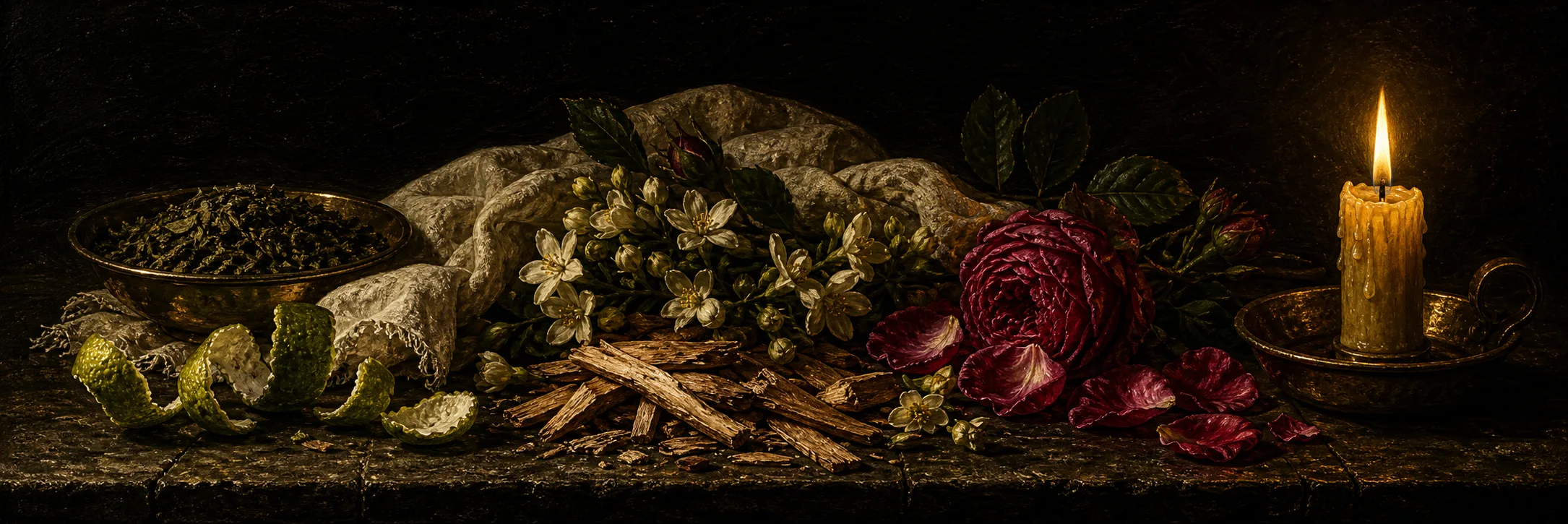
Essence
Capucine is a soft, powdery floral from Fragonard, the Grasse perfume-tourism institution, launched in 2005 and now apparently discontinued. Its pyramid promises a green-tea soliflore over jasmine and rose, but the fragrance that reaches the skin is a creamy, sweet, powdery floral built on an unlisted vanillic sweetness and a soft musk drydown. It is pretty, affordable, and distinctly French — an easy everyday scent rather than a complex or original one.
Scent Profile
The opening is the most tea-legible phase: a soft green-tea-and-bergamot accord, slightly creamy from what reads as an unlisted vanillin, that one wearer summed up as “totally tea for days.” It is bright and transparent rather than herbal or bitter.
From there the fragrance turns powdery. Jasmine and rose arrive “creamy, slightly powdered,” softened rather than indolic, and the tea recedes into the background as a conceit rather than a sustained accord. The true backbone of the heart-to-base transition is vanilla and musk, not tea.
The drydown settles into a soft, sweet, musky-vanillic powder that many liken to face powder or talc — “Powder & cotton… my mother’s perfumed powder” is a representative impression. It is fairly linear once it sets, with a stable powdery-musky base. Skin chemistry matters: a vocal minority gets little tea, reading sharp green notes, soapiness, or even a plasticky sweetness instead. The pure parfum is richer and creamier than the EDT, described by one wearer as “a cloud of musky, woody, powdery, sweet jasmine and rose.”
Performance
Longevity is good for an inexpensive, relatively delicate floral, with moderate sillage. The parfum clearly outperforms the lighter, more common EDT — one parfum wearer reports a shopkeeper noticing it “from the other side of the counter 6 hours after I had put it on,” and another warns it “could be quite strong” and should be applied “really sparingly” in close quarters. For projection, reach for the parfum; for an easy daily wear, the EDT is enough.
Wearing Context
Capucine reads as a feminine, comforting, everyday-to-cozy fragrance. It suits the office (applied sparingly), a classy evening event, or simple comfort wear — one wearer notes it works “in the office… on a classy evening event or in bed according to your mood.” The powdery-sweet character is soft and inoffensive, soothing rather than attention-seeking. It is at its best in cooler and transitional weather and in intimate settings, where the powder reads as cozy rather than dated. Younger or powder-averse wearers may find it old-fashioned.
Comparisons & DNA
- Kenzo Flower by Kenzo is the recurring anchor: wearers repeatedly note Capucine “reminds me of Flower by Kenzo,” sharing a powdery-floral-over-vanilla-musk DNA, and Flower by Kenzo EDP is the most-cited point of reference.
- Kenzo Flower Le Parfum (the warmer, rosier red version) is named as the closest match by one wearer who finds Capucine’s rose more pronounced.
- Elizabeth Arden Green Tea, crossed conceptually with Kenzo Flower, captures the green-tea-meets-powder idea for anyone trying to triangulate the structure.
- Chloé Capucine is a name-clash to avoid: that fragrance is green and piquant, where the Fragonard is sweet and powdery — they should not be confused.
Reception
Consensus is mildly-to-warmly positive: wearers find it a comforting, elegant, “very French” powdery floral with a lovely musky-vanillic drydown and strong value for the price. The most common criticism is a lack of originality — one wearer says it recalls “a lot of Fragonards fragrances I have smelled before” — alongside the divisive baby-powder facet and disagreement over whether any tea is truly perceptible. The axis of polarization is skin chemistry: the same juice reads as “refined, finely chiseled, creamy” to some and “sickly sweet, artificial, plasticky” to others. Several wearers describe it, like much of the Fragonard line, as a high-quality “base” that mass designers might build upon. As a blind buy it is low-risk for fans of powdery Kenzo-Flower-style florals, riskier for anyone who dislikes powder or sweet musk.
Versions & Reformulation
Capucine appeared in several formats: parfum in Fragonard’s signature gold and aluminum estagnon flacons, 100 ml and 200 ml Eau de Toilette, and a 600 ml refill. The parfum is consistently reported as the richer, creamier, longer-lasting version; the EDT is lighter. The fragrance is now apparently discontinued and no longer appears in Fragonard’s current catalogue. No distinct reformulations are documented beyond the concentration variants.
Acquisition Notes
Fragonard is a deliberately inexpensive, factory-priced house, and Capucine sat in that low tier — broadly the $20–$60 range depending on size and concentration. No Capucine-specific original price survives from a neutral source, since it is discontinued. Original product was historically sold almost exclusively through Fragonard boutiques in France, the brand website, and the Grasse factory; today it surfaces only on the secondhand market, where pricing is inflated and inconsistent. No counterfeit or batch-code concerns are documented for this fragrance.
Notable Facts & Lore
- Fragonard was founded in 1926 in Grasse and named for the painter Jean-Honoré Fragonard.
- The house is famous as much for its factory-museum perfume tourism as for its scents.
- “Capucine” is the French word for the nasturtium, a tangy, peppery edible flower — though the fragrance smells nothing like the herb.
- The name follows Fragonard’s convention of naming scents after flowers and plants.
- A persistent piece of trivia speculates the name honors the 1960s French actress Capucine (Germaine Lefebvre), but no authoritative source supports this; treat it as unconfirmed.
- Wearers frequently describe the Fragonard line as well-made, affordable “base” compositions.