Fragonard — Vetiver
Essence
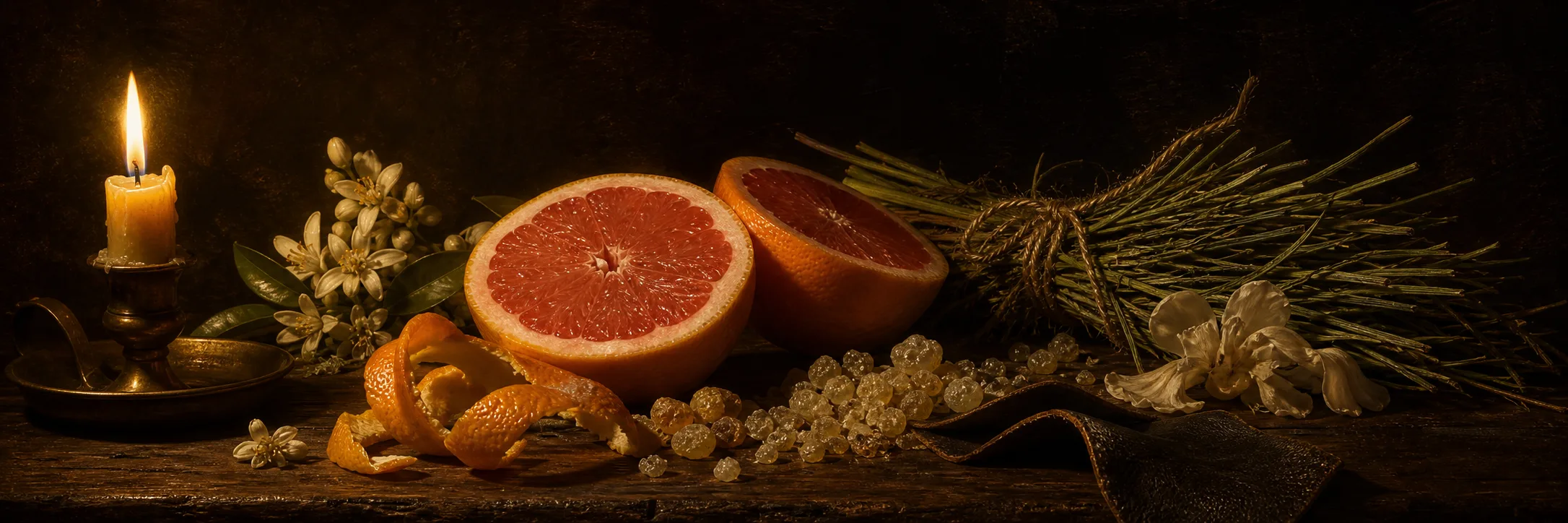
Fragonard Vetiver is an affordable, bright take on vetiver from the Grasse house Fragonard, and a quietly unusual one: its published pyramid foregrounds grapefruit, neroli, incense, balsam fir, leather and peony rather than vetiver itself. In practice vetiver is the spine of the scent, but it is wrapped in citrus, soft incense and balsamic woods instead of presented as a dark, earthy soliflore. Its real distinction is value — an easygoing, summer-friendly vetiver widely treated as a low-cost relative of pricier ones.
Scent Profile
The opening is bright and fresh: grapefruit, sometimes a touch loud but not sour, with neroli and a sharp, resinous elemi over a soft incense that many wearers single out as a highlight.
The heart brings the vetiver forward — clean, green, and slightly damp, read by some as grassy and almost aquatic without earthiness and by others as rootier and more substantial. Balsam fir supports it with a balmy, true-fir, pine-needle facet, joined by cedar. The catalog’s leather and peony notes stay largely submerged, with fir, incense, cedar and grapefruit doing most of the talking.
The base is a light benzoin-and-musk drydown with more cedar. Development is fairly linear, and the overall effect is clean, bright, and unisex.
Performance
Performance sits on the lighter side, as expected from an inexpensive fresh eau de toilette. Wearers consistently describe it as fresh and bright but modest in longevity, with light sillage that leaves a subtle close cloud, and noticeably better staying power on clothing than on skin. Realistic expectations run to roughly seven to eight hours of wear with moderate-to-soft projection. The practical approach is to apply generously, spray onto fabric, and treat it as a frequent-reapplication summer scent rather than a long-haul performer.
Wearing Context
This is a spring and summer daytime casual fragrance — fresh, green, and citrusy. It reads unisex with a slight masculine lean, the balsam fir and faint leather nudging it that way before it settles neutral. Wearers reach for it as an everyday energy boost on warm, even humid days, and it suits the office, errands, and hot-weather casual wear. It is not an evening or cold-season statement scent, given its brightness and light performance.
Comparisons & DNA
The dominant comparison is Hermès Terre d’Hermès in its eau de toilette form, which many wearers treat Fragonard Vetiver as a budget stand-in for — one describing it as Terre d’Hermès “without the citrus, only the vetiver.” The shared DNA is the grapefruit-over-mineral-woody-vetiver structure; the difference is Fragonard’s lighter weight, lower price, and weaker performance. Guerlain Vétiver and Tom Ford’s vetivers come up as the more grown-up, earthier benchmarks against which this reads youthful. One wearer likened its old-school woody opening to the original Gucci Pour Homme with vetiver added.
Reception
Reception is positive within its value framing. Praise centers on freshness, the soft incense and balsam fir, easy wearability, the eco-friendly refillable bottle, and above all price-to-quality, with wearers widely recommending it as an inexpensive, pleasant vetiver. The consistent criticism is performance, both longevity and sillage running light, along with a sense among vetiver purists that it is thin, old-school, and less earthy than premium vetivers. There is mild disagreement over whether it is a “real” vetiver or a citrus-woody fresh scent that happens to contain it. The verdict is a low-risk, low-cost blind buy for anyone wanting a fresh summer vetiver on a budget, provided they accept modest performance.
Versions & Reformulation
Some care is needed on identity. The catalog facts match Fragonard’s current Vetiver EDT. The house also has a separate, older men’s Vetyver that shares much of the same pyramid and is believed by some to have been repackaged as “Les Naturelles: Vetiver,” so the naming and bottle history is somewhat tangled across releases. The catalog’s omission of vetiver from the visible notes, and its inclusion of peony and leather, appears to be a database quirk rather than a different juice. The original year is not reliably documented, and no formal reformulation is recorded, though packaging and line changes over time are evident.
Acquisition Notes
This sits firmly in the budget tier, which is a core part of its appeal. It is sold in Fragonard’s refillable 100 ml glass spray, around $49 at the house, with a 50 ml option and an unusually economical large refill canister that reinforces the value positioning. Distribution runs through Fragonard’s own boutiques, including the Grasse museum shop, the brand website, and a few outside retailers, so availability outside France can be patchy. Counterfeiting is not a notable concern at this price, and the low full-bottle cost softens any blind-buy risk.
Notable Facts & Lore
- Fragonard is a Grasse perfume house founded in 1926 by Eugène Fuchs.
- It is named after the Grasse-born 18th-century painter Jean-Honoré Fragonard.
- Many wearers bought this scent at the Fragonard museum in Grasse, part of its word-of-mouth lore.
- The house frames the scent around vetiver’s Indian origin.
- Its published pyramid famously omits vetiver from the visible notes even though the material is structurally central.