Fragonard — Soleil
Essence
Soleil is Fragonard’s flagship floral, framed by the house as its great classic: a sun-warmed white-floral bouquet built to evoke noontime light over the gardens of Grasse. Composed by Jean Guichard in 1997, it is an orange-blossom-forward floral with a powdery iris-and-musk backbone, sold mainly through the house’s own boutiques and museum shops in France. Its appeal is execution rather than novelty - a natural, soapy-floral bouquet style that reads deliberately old-fashioned - all wrapped in a collectible hammered-gold sun stopper that is half the reason people buy it. It anchors Fragonard’s sun trilogy alongside Grain de Soleil (1999) and Coeur de Soleil (2018).
Scent Profile
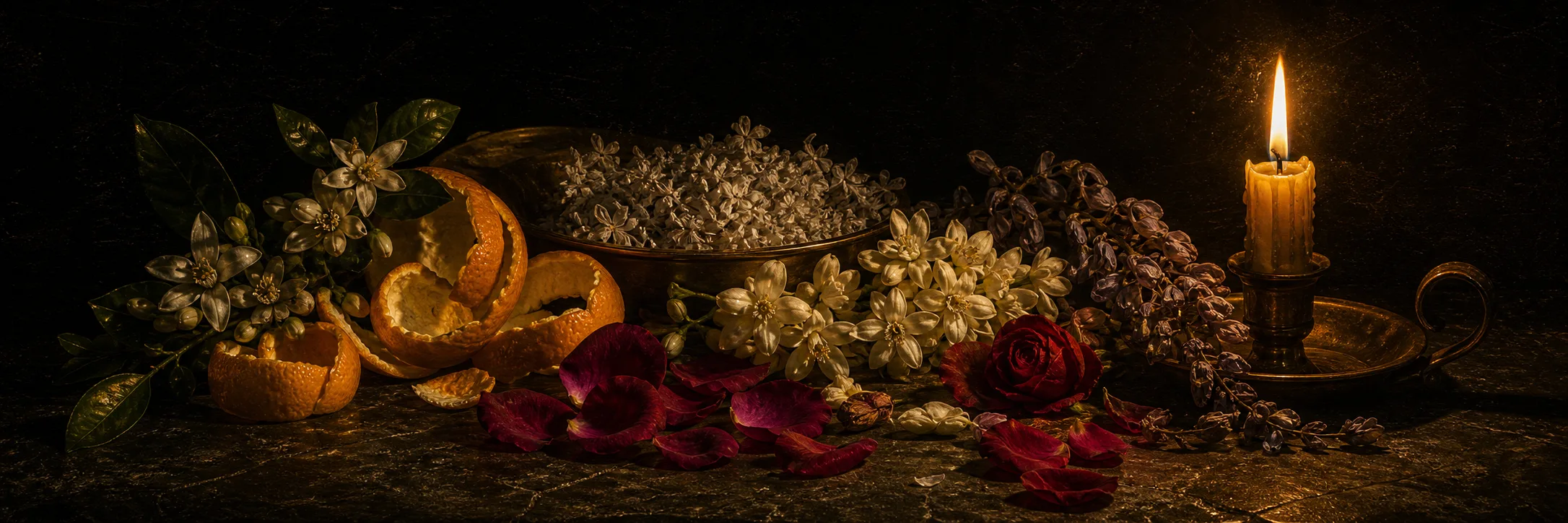
The orange-blossom top is the dominant signature throughout, with an opening many call total orange blossom: strong and immediately flowery, the orange reading as the blossom’s natural citrus facet rather than a juicy fruit.
The blossom then ushers in a heart bouquet of jasmine, lily, rose, iris and wisteria, and opinion splits on which way it leans. One camp reads a blooming, indolic jasmine that can briefly overwhelm if you put your nose right on skin; another reads a softer, starchy-powdery mode driven by the iris. Wisteria is the surprise, often singled out as the showstopper for a lightly sweet, spicy, dewy facet between lilac and tuberose that is unusual in a mainstream floral.
The sandalwood, amber and musk base stays largely submerged, with rose, musk and iris emerging late to lend a creamy, lotion-like softness rather than a distinct woody drydown. Linearity is moderate: it opens loud and floral, then settles into a soft clean-floral skin scent within a few hours. Perception varies sharply by batch and skin - heady-violet for some, clean-floral or distinctly old-school for others.
Performance
Soleil is heat-activated. In warm weather it really projects, with one wearer in roughly 80 F reporting tremendous sillage and persistence, while in the cold it does much less. Longevity clusters around four to five hours of meaningful wear, and several note it fades faster than other scents from the brand. Sillage stays soft and close to the skin in cool or office settings. The practical strategy is to spray generously and reserve it for warm, sunny days where the florals bloom, and the affordable price makes respraying low-stakes.
Wearing Context
This is the textbook sunny floral for warm weather: a bright, happy daytime scent that evokes a French provincial garden, best in spring and summer and outdoors in heat and sun. It feels muted in cold weather, though some owners wear it indoors in winter to dream of nicer days. Occasion-wise it is casual-to-polished daywear rather than a night-out or seductive scent. It skews feminine and reads mature and classic rather than youthful, and a few note it suits men comfortable with soft florals - feminine but not rigidly so. Anyone after a modern, sweet, gourmand or fruity-floral profile will find it dated and soapy.
Comparisons & DNA
- Grain de Soleil (Fragonard, 1999) is the natural in-house contrast, framed as the “Moon” to Soleil’s “Sun”: a darker, warm-spicy amber-gourmand for autumn and winter, sharing the rose-jasmine-iris DNA but opposite in mood.
- Vintage Chanel No. 5 is the genre touchstone wearers reach for - the same powdery, soapy white-floral elegance, though Soleil is no dupe.
- Fragonard’s own Fleur d’Oranger (2005) is the cleaner, more linear orange-blossom alternative for anyone wanting a soliflore rather than a full bouquet. There is no widely cited designer clone of Soleil; it is itself the affordable option in its lane, which makes clone-hunting largely moot.
Reception
Reception is warm but not uncritical. Praise centers on a natural, non-synthetic quality attributed to Fragonard’s Grasse sourcing, a genuine sunny-garden effect, an excellent price-to-quality ratio, and the collectible sun bottle, and it earns repeat signature-scent and favorite-ever declarations. Three axes divide opinion: whether the soapy, old-fashioned character reads as dated and mass-market or as natural and exquisite; an occasional synthetic aquatic note some find intrusive on an otherwise natural floral; and batch inconsistency, with the indole and base reading very differently bottle to bottle. The blind-buy verdict is broadly favorable for orange-blossom and classic-floral lovers but firmly not for anyone wanting modern, sweet or long-projecting fragrances.
Versions & Reformulation
Soleil has been in continuous production since 1997, offered as 50 ml and 100 ml EDP plus matching scented soap, bath and body products. It is part of the sun line: the original Soleil (1997), the warm-spicy Grain de Soleil (1999) and the later Coeur de Soleil (2018). No formal reformulation is documented, though multiple long-term owners report meaningful batch-to-batch variation in the base and floral balance - best treated as anecdotal batch variance rather than a confirmed reformulation. The ingredient list shows a conventional allergen profile consistent with a classic-style floral.
Acquisition Notes
Pricing is firmly affordable for the quality: Fragonard’s own site lists the 100 ml EDP at $106 and the 50 ml at $74, with European figures around 55 euros for 100 ml, and a recurring theme is that it punches above its weight class. The authentic channels are Fragonard’s boutiques and museums across France and the official website. One logistics quirk is that the house restricts shipping of alcohol-based fragrance to some countries and charges heavy dangerous-goods fees on international orders. Counterfeiting is not a prominent concern at this price, but buying from Fragonard directly or a reputable seller helps avoid old or heat-damaged stock given the reported batch variability.
Notable Facts & Lore
- The sun is Fragonard’s house symbol and appears in its logo, which is why Soleil - literally “sun” - is treated as the brand’s signature statement.
- The bottle wears a hammered-gold sun-shaped stopper that collectors prize as an objet d’art.
- The house opened in Grasse in 1926, is still family-run, and is named after the Grasse-born Rococo painter Jean-Honore Fragonard (1732-1806).
- The house describes Soleil as inspired by the glimmering light and warmth of the sun in the South of France - “sunshine in a bottle.”
- A recurring origin story is the boutique discovery: many owners recount buying it on trips to Grasse or the Paris museum after sampling the whole line.