Fragonard — Emilie Parfum
Essence
Emilie Parfum is the higher-concentration version of Fragonard’s long-running feminine floral Émilie, from the historical Grasse house known for its factory boutiques and factory-direct pricing. It is a classic, somewhat retro French rose-violet bouquet — a powdery, slightly soapy floral that wearers consistently call “vintage-like” and “ladylike” rather than modern. The parfum is denser and softer than the EDT, trading the EDT’s loud, alcoholic opening burst for a more velvety presentation of the same composition. As of November 2023 the Émilie range has been discontinued and is being sold off.
Scent Profile
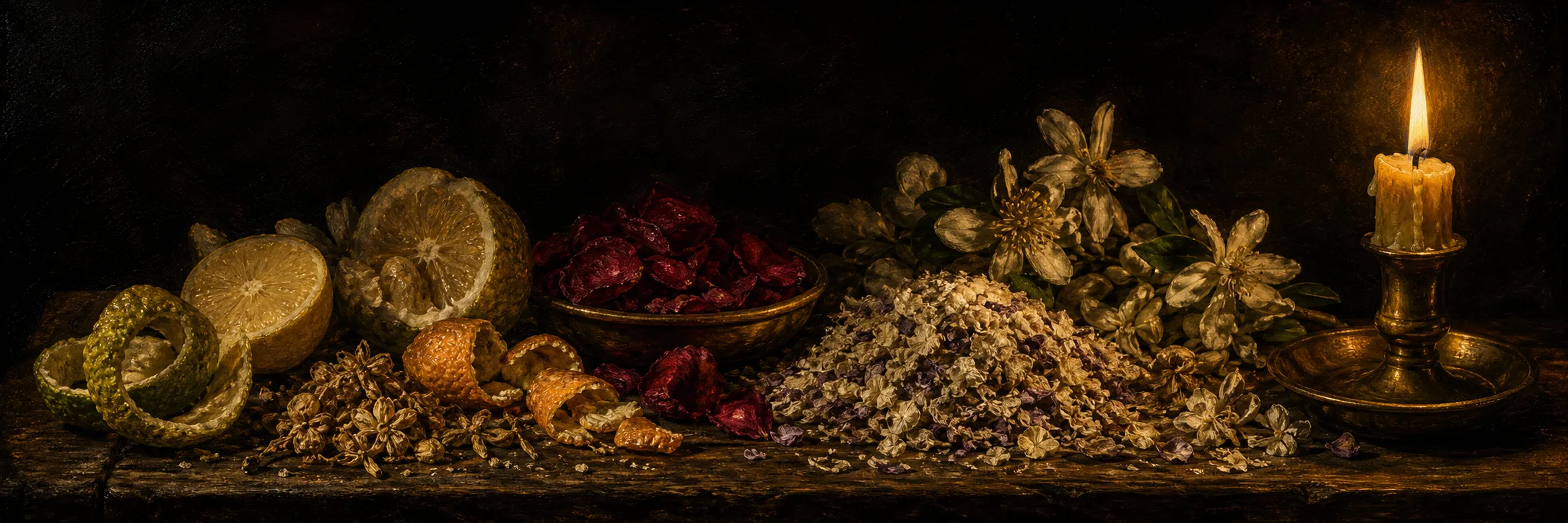
The citrus top of bergamot, lemon and orange is fleeting — one wearer noted it “seem to disappear within a minute or two” — and quickly gives way to the real subject of the fragrance: a powdery rose-violet duet.
What dominates is that violet-rose accord, described variously as “a green powdery rose,” “sugar dusted rose petals,” and a “rose tinted violet with a powdery sophisticated woody base.” In the parfum, rose is less forward than expected; one wearer found “the violet, non-indolic clean jasmine and lily of the valley are most present… I’m not reading rose strongly.” Lily-of-the-valley adds a soapy, dewy greenness through the heart.
The drydown turns ambery, faintly incense-like and softly woody from the sandalwood and amber, which act as a well-blended anchor. The fragrance is close to linear once the heart settles, and its signature effect is “fine milled soap, fresh cut flowers” — a clean, powdery, old-school floral.
Performance
Performance is strong, especially for the parfum. Wearers report longevity around 8 hours, often describing it as “bold” and “long lasting,” with one outlier claiming far longer wear but also growing tired of the base after many hours. Sillage is close-to-moderate (“the sillage is close”), while the EDT specifically is flagged as projecting very strongly and “alcoholic” on application. The recurring advice is to spray with caution: several wearers warn it is “incredibly strong” and potentially “headache inducing” if over-applied. The parfum applies softer than the EDT but lasts longer.
Wearing Context
This skews classic and mature, but reads as versatile within that: “perfect for the office and anytime, any season” to one wearer, best “suited to the warmer months… spring and early summer” to another. The powdery-floral character is elegant, romantic and “very french-like.” It draws compliments, but also the recurring “old lady” tag from those who dislike vintage florals, so its perception skews generational. It is at its best as a daytime, office, or romantic special-occasion floral; the heavy powder can feel wrong in very hot, humid conditions or for anyone expecting a modern fruity-floral.
Comparisons & DNA
- YSL Paris is the most-cited reference: “its interpretation of rose does remind me of Paris,” for the wine-like, spicy rose-violet character.
- Jacomo Silence overlaps heavily — one wearer says “they share 8 of the same notes” — with Silence the greener of the two.
- Frédéric Malle Lipstick Rose is the upscale rose-violet cousin; against it, Emilie reads “more voluptuously floral when it dries down, less powdery,” with more lily-of-the-valley and a more incense-like quality.
- Fragonard Baroque, from within the house, is described as Emilie’s near “twin-sister.”
Reception
Reception is broadly affectionate. Wearers call it “gloriously pretty,” “extremely likable” and romantic, and praise what reads as high-quality natural floral material (“real floral essences were used and the high quality is apparent”); it is frequently singled out as a Fragonard standout after factory visits. The criticisms are consistent: it can read “too perfumey and a little too loud,” its clean, aldehydic facet puts some off (“I can smell only clean note”), and the “old lady” and headache complaints recur. Polarization runs squarely along the vintage-versus-modern axis. As a blind buy it is reasonable for fans of classic powdery florals given Fragonard’s affordability, but vintage-averse buyers should sample first.
Versions & Reformulation
Émilie exists in multiple concentrations: this Parfum (in gilded aluminium canisters, commonly 30 and 60 ml) plus an EDT (100 and 200 ml, with a 600 ml refill). The parfum is the softer, longer-lasting form; the EDT is the louder, more alcoholic opener that fades faster on some skins. The whole Émilie range was reported discontinued as of late 2023, with boutiques clearing remaining stock. No major reformulation of the juice itself is documented beyond the concentration differences.
Acquisition Notes
Fragonard’s model is factory-direct boutique pricing, and Emilie sat at an affordable tier — roughly $89 for the parfum and around $95 for a 200 ml EDT at boutique, far below typical niche pricing, with many wearers mentioning buying it at the Grasse factory shop. With discontinuation, remaining stock is being cleared through Fragonard boutiques. No significant counterfeit or batch-code concern is documented; Fragonard is a lower-priced, factory-distributed house and not a common counterfeit target.
Notable Facts & Lore
- Fragonard was founded in 1926 in Grasse by former Parisian notary Eugène Fuchs.
- The house is named after the Grasse-born painter Jean-Honoré Fragonard (1732-1806).
- It is housed in one of the city’s oldest factories, originally built by perfumer Claude Mottet in 1841.
- The house keeps a museum and boutique retail identity, now run by Fuchs’s great-granddaughters Agnès and Françoise Costa.
- Emilie belongs to Fragonard’s “women’s classics” line.
- Its most notable recent fact is its late-2023 discontinuation, which prompted a small wave of “buy a backup” comments from fans.