Shiseido — Angelique
Essence
Angelique is a 1991 floral-oriental from Shiseido’s bubble-economy golden age, a period collectors single out as the moment “Shiseido produced many great perfumes spending big budget for ingredients and PR.” It is credited to Jean-Louis Sieuzac, the same nose associated with YSL Opium and Dior Dune, though no documented commentary from Sieuzac on Angelique specifically survives - the attribution is the relevant fact, not a biography. What makes Angelique notable today is twofold: it is a genuinely accomplished creamy-tuberose floriental that has become a quietly worshipped vintage discovery, and its advertising used artwork by Andy Warhol (“Two Angels with a Flower,” from his drawing book In the Bottom of My Garden).
Scent Profile
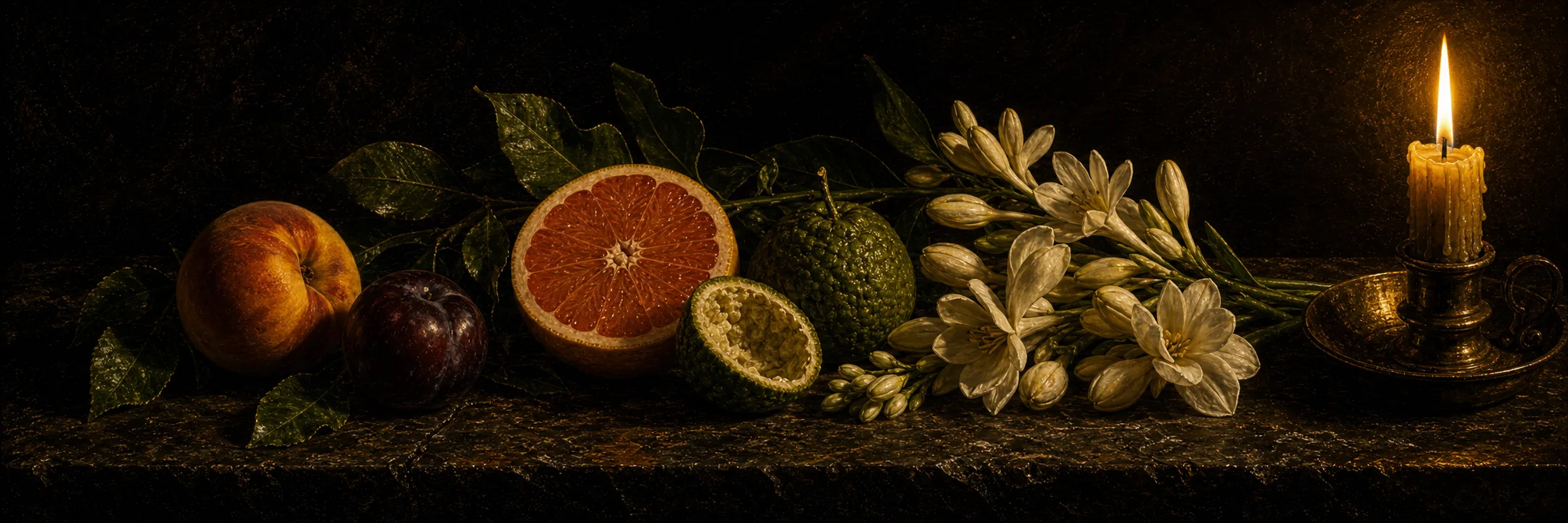
The heart of Angelique is tuberose, and it is the note reviewers rave about. One wearer calls it “a beautiful white floral with a creamy tuberose… this tuberose may be one of the finest I have smelled,” describing how it “changes throughout, from green to fruity to creamy.” Around it sits a fruity-green top of peach and plum (most wearers get more plum than peach), grapefruit, bergamot and subtle green notes that give “a fresh lift to the opening.” Supporting florals - jasmine, ylang-ylang, heliotrope, rose, carnation, orchid - work, in one description, “collegial, working together to create a spring meadow effect.” The base is the payoff: “a beautiful balsamic Tonka bean - vanilla - amber - benzoin accord, matched with an otherworldly sandalwood,” with a “non-gourmand, dry and slightly boozy vanilla” carrying a distinct “plum wine nuance.” The overall impression is sweet, romantic, and skin-warm - “a skin scent quality, like warm human skin, with the tuberose floating above.”
Performance
Wearers describe Angelique as strong yet gentle and lasting through the day, with the tuberose persisting from open to close. The balsamic tonka-amber-benzoin foundation is the part that endures longest on skin, while the floral heart keeps the aura plush rather than loud.
Wearing Context
Reviewers frame Angelique as a “perfect floral sweet romantic date evening scent,” leaning sweet enough that even admirers note it can be “too sweet for my taste.” It suits cool-weather evenings and romantic occasions rather than office or hot-weather wear. Its creamy-tuberose-plus-balsamic-vanilla profile places it firmly in the plush, feminine, after-dark register of its era.
Comparisons & DNA
The most frequently drawn comparison is to Lancôme Poem: a wearer who calls Angelique “hands down, the best fragrance of Shiseido” says it “reminds me of Poem… the same warmth, plum note, yellow and white flowers and the same romantic aura.” Within Shiseido’s own vintage canon, it belongs to the constellation of sought-after discontinued Japanese florals - Inouï, Murasaki, Chant du Coeur, Myth of Saso - that collectors hunt on eBay; but where Inouï and Murasaki are green floral-chypres, Angelique is the sweeter, creamier, more overtly oriental sibling. Its creamy-tuberose-over-balsamic-base architecture is the DNA to flag for anyone deciding whether to chase it.
Reception
With no major critic coverage of Angelique specifically, the record is wearer-led and strongly positive within a small group of vintage Shiseido devotees. The standout claims - “the best fragrance of Shiseido” and “definitely one of a kind” - come from collectors who lament that Shiseido “discontinued most good ones along with the economy.” The sentiment is admiring but niche: this is a connoisseur’s vintage rather than a widely reviewed classic, and the honest framing is that its reputation rests on a handful of devoted voices and the Warhol/bubble-era mystique.
Versions & Reformulation
Angelique was issued in multiple concentrations, including an Eau de Parfum and a pure parfum (the 20 ml sealed vintage parfum surfaces on eBay); some listings treat the parfum as a concentration variant of the EDP. Production is discontinued across all formats. Because it predates the major IFRA-driven reformulation waves and is no longer made, there is no “current” version to compare against - what circulates is original vintage stock of differing ages.
Acquisition Notes
This is a vintage or secondary-market purchase rather than a normal retail item. Condition, fill level, storage history, and top-note freshness matter more than nominal bottle size; sample where possible and verify packaging details before paying collector prices.
Notable Facts & Lore
- The Warhol connection is the headline piece of lore: the 1991 Angelique campaign and posters featured Warhol’s cherub drawings, and original advertising posters still trade in poster galleries.
- The fragrance is emblematic of Shiseido’s late-80s/early-90s largesse, when the company commissioned high-profile French perfumers and spent freely - a context multiple collectors cite directly when explaining why scents of this vintage smell richer than what the house released afterward.
- Its discontinuation is generally attributed by collectors to the contraction of that lavish era as Japan’s bubble economy deflated.
- Angelique is a 1991 floral-oriental from Shiseido’s bubble-economy golden age, a period collectors single out as the moment “Shiseido produced many great perfumes spending big budget for ingredients and PR.”
- It is credited to Jean-Louis Sieuzac, the same nose associated with YSL Opium and Dior Dune, though no documented commentary from Sieuzac on Angelique specifically survives - the attribution is the relevant fact, not a biography.
- What makes Angelique notable today is twofold: it is a genuinely accomplished creamy-tuberose floriental that has become a quietly worshipped vintage discovery, and its advertising used artwork by Andy Warhol (“Two Angels with a Flower,” from his drawing book In the Bottom of My Garden).