Shiseido — Vocalise
Essence
Vocalise is a 1997 floral-oriental from Shiseido’s high-period of art-directed Japanese perfumery, composed by a young Jacques Cavallier Belletrud (the nose behind L’Eau d’Issey and, later, the entire Louis Vuitton line) and now long discontinued. What makes it distinctive is structural rather than merely olfactory: Shiseido built it deliberately against the classic top-heart-base pyramid. Per the brand’s own Corporate Museum, the fragrance was developed on the key phrase “in praise of contradiction,” embracing the contradictions of the human heart, and the composition is built so the notes circle a single sustained accord rather than evolving in stages - a near-linear, white-orchid-centered fruity floral on a vanilla-musk bed.
Scent Profile
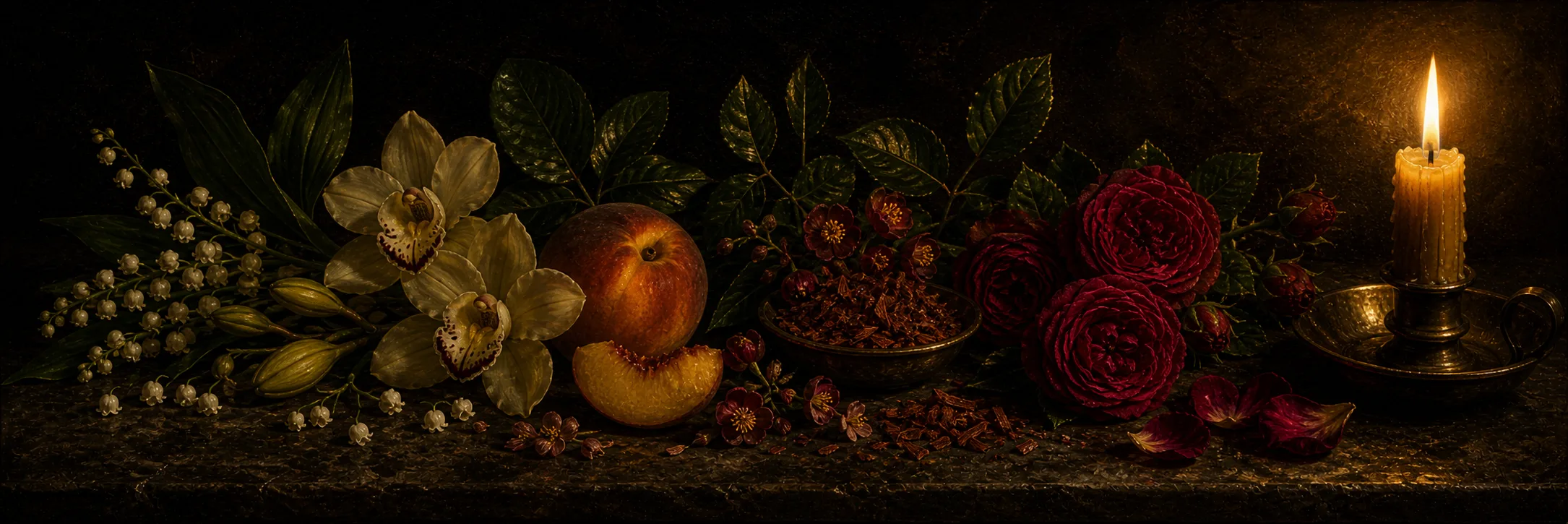
The opening is a juicy, slightly green fruit basket - peach and blackcurrant up front, a watery orchid “tropical punch,” with neroli and a faint Brazilian-rosewood sharpness keeping it from going syrupy. Within thirty minutes the fruit recedes and the floral heart blooms: a soft bouquet of rose, lily-of-the-valley and jasmine, threaded with yuzu and a cool, resinous Japanese cypress (hinoki) that gives the middle an unusual, almost incense-adjacent crispness uncommon in Western fruity florals of the period. The drydown is where Vocalise shows its house signature - heliotrope and vanilla deliver a powdery, faintly almond sweetness, sandalwood and cedar a clean woodiness, and a whisper of pepper keeps the base from collapsing into pure dessert. The signature accord is best described as a cool, white-floral-and-orchid veil resting on soft powdery vanilla - sweet but never gourmand. Wearer consensus is that it is essentially linear and very well-blended: no single note shouts, everything works together. One wearer reviews reviewer captured it perfectly as “a whisper rather than a shout.” Detractors find it discreet to the point of faceless; admirers find it elegant and seamless.
Performance
Performance reports are split, which is typical for a transparent late-90s floral. Several wearers report it lasting strongly - one says she can still smell it “the next day nose to skin” with sillage of “a couple of feet” - while others report the opposite, that it sits close to the skin and that “even when I spray it, the smell doesn’t spread.” The likeliest explanation is batch-to-batch and skin-chemistry variance compounded by the fragrance’s deliberately quiet construction, plus the existence of an alcohol-free formulation (see Versions).
Wearing Context
This is a cool-season, daytime-to-early-evening fragrance that several wearers nonetheless call genuinely versatile - “you can wear it anywhere.” The powdery-floral elegance skews feminine and classic rather than trendy; reviewers repeatedly use words like “elegant,” “classy,” “sophisticated,” and “in good taste.” It reads as refined office wear, dinner, or a comfort scent for grey winter days, and its discretion makes it office-safe and broadly inoffensive. Perception-wise, it is the kind of scent that earns “you smell nice” rather than “what are you wearing” - a quiet signature rather than a statement. Some wearers frame it nostalgically as a 90s/early-2000s scent tied to a more understated, art-directed era of Japanese beauty.
Comparisons & DNA
Vocalise sits in the late-90s sheer-fruity-floral idiom but is cooler and woodier than its peers. The closest in-house reference points are other Cavallier-era Shiseido releases and the brand’s later women’s launches; Now Smell This, in its March 30, 2006 review of Shiseido Rose Rouge, noted that Rose Rouge “by perfumer Nathalie Lorson, is their first major fragrance launch for women since Vocalise in 1997 and the recent re-release of Zen in 2000” - placing Rose Rouge as a jammier, rosier successor, warmer and less crisp than Vocalise’s orchid-and-cypress signature. Against the broader market, it shares the transparent, “you just smell good” quality of the Clinique Happy school of late-90s clean florals but is more vanillic and powdery in the base and less citrus-soapy. Its hinoki/Japanese-cypress facet is the real point of difference: where a Western fruity floral of 1997 would lean on a synthetic woody-amber, Vocalise uses a cool coniferous resin that gives it a distinctly Japanese, almost meditative middle. Compared to Cavallier’s own L’Eau d’Issey (1992), Vocalise is sweeter, fruitier and far less aquatic, but shares the same interest in transparency and a single sustained accord rather than dramatic development.
Reception
Praise centers on the blending (“well-blended fragrances that don’t push any one note out in front”), elegance, and the bottle. Criticism is consistent and specific: a minority find it characterless (“just plain and has nothing to smell,” “no lasting power”) and some find the vanilla base too prominent. There is mild polarization on performance rather than on quality. The blind-buy verdict from wearers is cautiously positive - one forum member, warned that it was “expensive now (as many discontinued ones),” was reassured by another long-time wearer that “it is not an ordinary floral without character.” Given the price of vintage bottles, the safer move is a decant first; but for lovers of cool, powdery, woody-vanilla florals the hit rate is high.
Versions & Reformulation
There is documented evidence of an alcohol-free EDP formulation (sold as “Alcohol Free 100ML”), which likely accounts for some of the wildly divergent performance reports. Beyond the concentration variants there are no known reformulations of the juice itself - the fragrance was discontinued rather than reworked, so a current-production version does not exist. One secondary-market commenter warned of a “modern version” that is a “poor quality, synthetic mess… plastic & bubblegum,” but this claim is unverified and may reflect a degraded or counterfeit bottle rather than an official reformulation; treat it with caution.
Acquisition Notes
This is a vintage or secondary-market purchase rather than a normal retail item. Condition, fill level, storage history, and top-note freshness matter more than nominal bottle size; sample where possible and verify packaging details before paying collector prices.
Notable Facts & Lore
- The lore here is unusually rich for so obscure a scent, and almost all of it traces to Shiseido’s own design ambitions.
- The fragrance was built on the concept “in praise of contradiction,” per the Shiseido Corporate Museum, which also describes the bottle: from the front it “seemed a simple circle, but with a ridge line full of waverings,” so that changing the viewing angle brought “fineness” and “strength” - two contradictory elements - into contrast.
- That bottle, designed by Aoshi Kudō, won the Good Design Award in 1998 for product design (Shiseido’s design pedigree on the project is notable - the broader Vocalise visual identity is documented in the archives of designer Keiko Hirano via the Alliance Graphique Internationale).
- The original advertising copy leaned into the vocal metaphor of the name: a “vocalise” is a wordless sung melody.
- A frequently repeated discographic note dates Cavallier’s Vocalise to 1998, but Shiseido’s own museum and major reference listings place the launch in 1997; the 1997 date is authoritative.