Shiseido — Murasaki
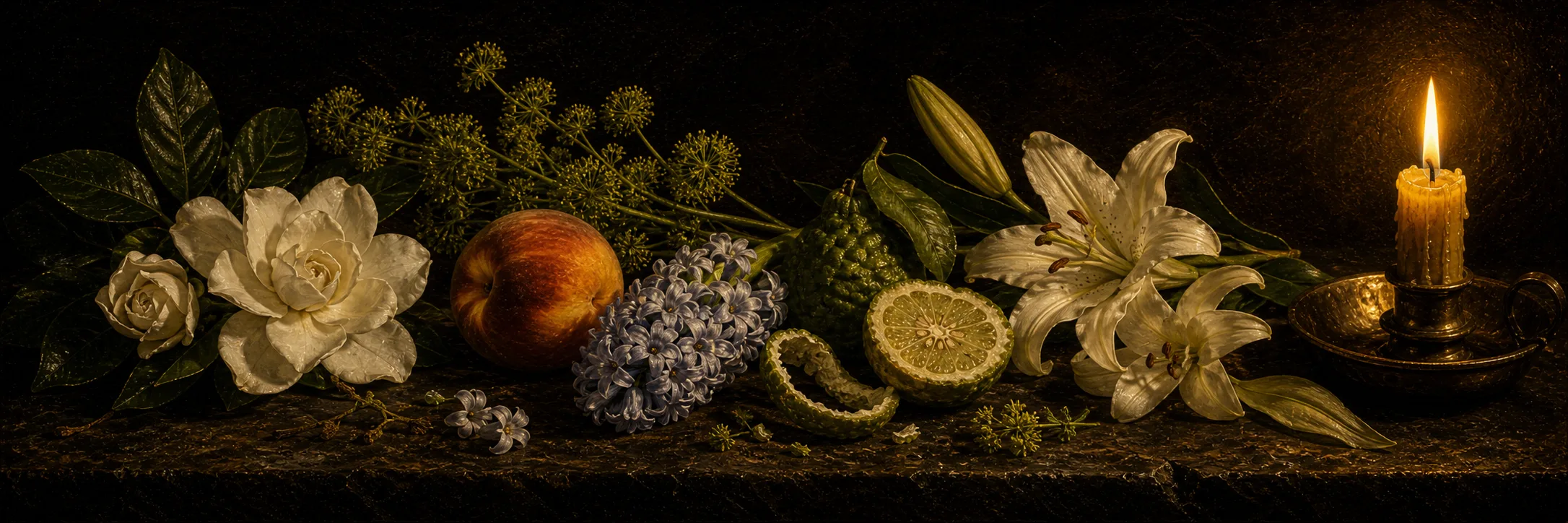
Essence
Murasaki is a refined, restrained floral chypre from Shiseido - a quietly revered cult classic that exemplifies the house’s “watercolor,” balance-above-all aesthetic. Its name (むらさき) means the color purple in Japanese, signifying nobility, spirituality and wisdom, and evokes Murasaki Shikibu, the 11th-century author of The Tale of Genji; purple recurs throughout the fragrance’s presentations. While the catalog lists 1980 (its U.S./Europe rollout, tied to Shiseido’s 1976 push to widen its clientele in the U.S. and Italy), some historians note it actually launched in Japan in the 1960s. What makes it distinctive is its delicacy: a fully-built classical chypre that nonetheless refuses to let any single element dominate - a green-floral-leathery chypre rendered in a deliberately Japanese, understated key designed to appeal to both Eastern and Western sensibilities.
Scent Profile
The opening is crisp bergamot quickly joined by bold, resinous galbanum - a galbanum green so assertive it “would normally stop you in your tracks,” except that here everything is held in equipoise. A soft peach and indolic-leaning white florals (hyacinth, gardenia) sit alongside. The heart is the classical floral bouquet: lily-of-the-valley (muguet), orris root, rose, lily and jasmine, with the orris contributing a powdery “quietness” and the florals reading as “elegance” rather than as soloists. Çafleurebon’s Ida Meister catalogs the full materials list - “bergamot, galbanum, gardenia, hyacinth, peach, chrysanthemum, iris, lily, jasmine, lily of the valley, rose, ambergris, musk, sandalwood, oakmoss, vetiver, leather” - and observes that each component “has the potential to seize center stage,” yet “scented sovereignty never takes place.” The drydown is a fine, dry chypre base: oakmoss, vetiver, musk, sandalwood, amber and a murky fantasy leather, leaving “the lightest dusting of a fine French chypre powder” and a velvety, talc-y finish. Perceptible: galbanum green, the powdery orris/muguet floral blend, the soft mossy-powdery base. Submerged: the leather (described as “murky,” barely legible), and individual florals which blend rather than stand out. Linearity: it is an evolving classical chypre but a soft-spoken one; stage transitions are gentle, not dramatic. Signature accord: balanced galbanum-green floral over a dry, powdery oakmoss chypre. Stage timing is not precisely documented and varies by version/vintage.
Performance
Wearer reports diverge sharply by version. Vintage/original (deep purple bottle) wearers report “amazing,” “surprisingly long” staying power and a sillage that starts big then settles to skin; one wearer calls it “not a sillage monster, but noticeably present for a long time with amazing longevity.” Modern/reformulated and aged-decant wearers frequently report the opposite - one wearer logged “initially big” sillage pulling back within an hour and only “2 - 4 hours” duration; Amazon-era buyers repeatedly complain it “doesn’t last more than 30 minutes.” Weather: described as working “in any weather, for any occasion,” but its delicacy suits temperate conditions; it is a soft daytime scent rather than a projection beast.
Wearing Context
Quintessential daytime, spring and temperate-weather fragrance - repeatedly described as “a young pretty daytime fragrance,” “clean green floral,” and office-appropriate. One wearer pointedly frames the modern version as something that “could discreetly beautify the mundane everyday life in open-plan offices.” It is restrained enough to never be “too much,” making it suited to professional settings, refined casual wear, and anyone wanting elegance without loudness. Social-perception skew: sophisticated, modest, “noble,” slightly serious; older reviewers associate it with timeless restraint and a “kimono to business look” transition across its versions. Some note it can read as “dated” or “old-ladyish” to those who dislike classical chypres.
Comparisons & DNA
The most frequently cited comparison is Chanel No. 19 (Chanel) - the galbanum-green chypre benchmark; reviewers say “if you like Chanel No. 19, you’ll surely like Murasaki,” though Murasaki is softer and more powdery. The Vintage Perfume Vault explicitly compares it to Cacharel Anaïs Anaïs (Cacharel), noting Anaïs Anaïs “smells overly sweet, plasticy and crude next to Murasaki,” whose muguet is far more refined. Other DNA touchstones from wearers include Shiseido’s own Zen (Shiseido) (the shared mossy note), Niki de Saint Phalle (Niki de Saint Phalle) (mysterious dark floral chypre character), and the broader family of discontinued green chypres like Deneuve, Vent Vert (Balmain) and adjacent powdery florals. As a green-floral chypre it sits in the lineage of Cristalle and No. 19 but in a deliberately quieter, more powdery Japanese register. No designer/clone “dupes” exist; this is a vintage classic, not a dupe target.
Reception
Among vintage-perfume enthusiasts the original is deeply loved - Çafleurebon’s Ida Meister calls it “a marvel of balance and delicacy, symphonic in scope,” “a hidden marvel,” and “universal, timeless, and in exquisite taste.” Longtime users describe it as a signature scent they mourned when discontinued, praising its galbanum, refinement and “impeccably balanced” character. The strongest axis of polarization is version/vintage: the original deep-purple-bottle formula is revered, while the 1990s reformulation (clear glass, purple cap) is widely judged lighter, “watery,” less mossy/woody - “perfectly nice but bears little resemblance to the nuanced original” (Çafleurebon). A second axis is taste: classical-chypre lovers adore it; others find it “dated,” powdery, or (in poor/aged decants) merely “powdery aldehydes” or “a clean scented diaper.” Blind-buy verdict: for classical green-chypre fans, a low-risk delight if you secure a good vintage; modern/aged bottles are a gamble on performance and condition.
Versions & Reformulation
This is a fragrance defined by reformulation. Wearer consensus: original Japanese launch in the 1960s as a dense, woody/mossy floral with an aldehydic top, sometimes turning balsamic/incensey/leathery - “dark” and “sophisticated,” in the tall deep-amethyst-purple bottle. In the 1990s Shiseido reformulated and repackaged much of its line; Murasaki became lighter, less mossy/woody, “watery green floral,” in clear glass with a purple cap - a “contemporary Japanese style,” zen/minimal character. Çafleurebon notes it has been reformulated “a few times.” Per a historian it remained in production in Japan at a low price: “It’s still in production in Japan, with a relatively low retail price - a 60ml splash edp bottle costs about 3500 yen (less than 40 dollars), and you could get it easily at the shiseido counter,” though it was treated as discontinued/hard-to-find in North America.
Acquisition Notes
This is a vintage or secondary-market purchase rather than a normal retail item. Condition, fill level, storage history, and top-note freshness matter more than nominal bottle size; sample where possible and verify packaging details before paying collector prices.
Notable Facts & Lore
- The fragrance was created as part of Shiseido’s mid-1970s internationalization (collaborating with the U.S. and Italy from 1976) to bridge Eastern and Western tastes.
- Its name and purple theme tie directly to Lady Murasaki Shikibu and The Tale of Genji, and to purple as the imperial color (historically dye reserved for the court).
- The perfumer is undisclosed - Çafleurebon notes Shiseido’s history mixes famous French noses (Catapano’s Zen, Leroy’s Nombre Noir, Bourdon/Sheldrake’s Féminité du Bois) with “talented anonymous creators,” and Murasaki belongs to the latter.
- It was also reportedly the scent used in Shiseido’s skincare line in the late 1970s - 80s, which is why many wearers associate the smell with the brand’s creams.
- Its lore is essentially that of a beloved, quietly discontinued classic that fans have spent decades trying to repurchase.