Shiseido — Feminite du Bois
Essence
Féminité du Bois is one of the foundational fragrances of contemporary perfumery - the 1992 Shiseido release that effectively invented the modern “feminine woody” category, recast cedar as a feminine note, and birthed Serge Lutens’ entire artistic signature. It was conceived by Lutens (then Shiseido’s artistic director) as a meditation on the smell of Moroccan Atlas cedar he had encountered in the souks of Marrakech; the formula was developed primarily by Pierre Bourdon at Quest and then refined by Christopher Sheldrake. The composition is a dense, honeyed, animalic cedar overlaid with stewed plum, peach, dried spices, and a violet-orange-blossom floral haze - Luca Turin has called it a milestone, and the perfumers’ answer to “what scent do you wish you had made yourself” comes up Féminité du Bois with what Persolaise calls “predictable frequency.”
Scent Profile
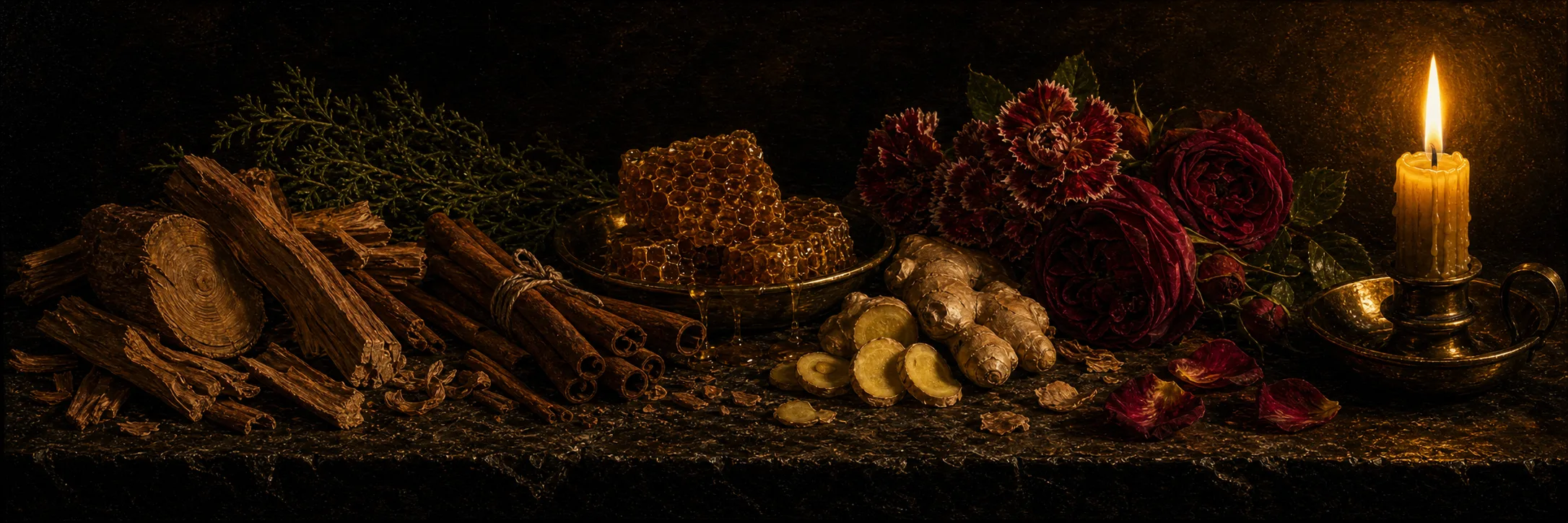
The composition is built around Texas cedarwood oil dosed at roughly 8% of the formula - an extraordinarily high cedar concentration that Ohloff, Pickenhagen and Kraft’s Scent and Chemistry documents and that ’s editorial coverage cites. The 60% wood figure Lutens himself uses in interviews refers to the total woody material in the composition. Around that cedar spine, Bourdon and Sheldrake built the now-canonical Lutens framework: stewed dark fruits (plum dominating, peach softer), heavy spices (cinnamon and clove leading, with ginger, cardamom, and a faint cumin underneath), beeswax and honey adding the animalic-sweet thickness, and a violet-rose-orange-blossom floral cushion that gives the composition its “feminine” reading. The opening of the Shiseido version, by Wearer consensus from those who own vintage bottles, is heavier, more honeyed, more animalic, and more balsamic than the Serge Lutens reformulation. The cumin facet is more present (the Kafkaesque review explicitly notes the cumin “actually makes me laugh a bit - it’s sexy, surprising and tricky”). The plum reads as genuinely stewed, almost wine-like - Persolaise and the editorial coverage both reach for plum wine and overripe fruit imagery. The heart settles into the Lutens-signature accord of “dark sweet fruit nestled in spiced wood.” This is where the violet flashes register most clearly, where the orange blossom adds a slightly powdery white-floral lift, and where the cedar starts pushing forward from underneath the fruit. The waxy beeswax facet stays present and contributes to the composition’s tactile, almost edible quality - the sense, repeated by multiple reviewers, that you’re smelling something that exists in three dimensions rather than a flat scent. The drydown is sandalwood, vanilla, benzoin, musk, and the persistent cedar.
Performance
The Kafkaesque review notes that even with two large sprays the projection bubble settles to roughly 2 - 3 inches within 10 minutes - describing the fragrance as “very potent up close, but you have to be up close indeed.” Longevity is generally reported at 6 - 10 hours for the EDP. The Lutens 2009 reformulation is reported by multiple sources to wear noticeably weaker than the Shiseido version, which is part of the vintage’s enduring premium. As with any 30+ year old fragrance, individual vintage bottle performance will depend on storage, fill level, and whether top notes have turned.
Wearing Context
Cool to cold weather, evening, intimate settings. The composition is too dense and too animalic for hot weather (the cumin and beeswax facets bloom unpleasantly in heat) and too unusual for routine office wear. It wears best in autumn and winter, at dusk, indoors. Social-perception skew is “sophisticated, unusual, mature, faintly old-fashioned in the best way” - the composition was never trying to be approachable and isn’t now. It reads more easily on someone who can carry an idiosyncratic fragrance than on someone wearing it as background. The gender skew is feminine by branding but masculine by composition; this is one of the foundational unisex fragrances and wears that way.
Comparisons & DNA
Féminité du Bois is the DNA, not the comparison subject - most of the relevant comparisons are downstream of it. The clearest mappings: - Serge Lutens Féminité du Bois (2009) - the direct reformulation, restructured under Sheldrake alone for the Collection Noire. Lutens has publicly insisted the formula is “99. 99999 per cent the same” but the Wearer consensus is that the modern version is lighter, less animalic, less honeyed, and weaker in performance. Cumin is reduced; the cedar is drier; the overall density is significantly softer. Both are recognizably the same composition; only the Shiseido is the “vintage.” - Serge Lutens Bois et Fruits, Bois de Violette, Bois et Musc, Un Bois Vanille - the entire Bois Collection that Lutens built off the Féminité du Bois template. Bois de Violette is the violet-amped version; Bois et Fruits is the fruit-amped version; Un Bois Vanille is the gourmand-vanilla rework. - Dior Dolce Vita - repeatedly mentioned by wearers vintage-FdB owners as the closest department-store cousin; lighter, fruitier, less animalic, but recognizably in the same plum-cedar-spice family. - Tom Ford Lost Cherry - Victoria Frolova at Bois de Jasmin explicitly traces Lost Cherry’s “sophisticated blend of woods” to “the style of Serge Lutens’s original Feminité du Bois.”
Reception
Critical reception was historic. Luca Turin and Tania Sanchez in Perfumes: The A - Z Guide discuss Féminité du Bois as a pivotal work and trace the formula development from Bourdon to Sheldrake. Persolaise has devoted dedicated coverage including a 30th-anniversary episode in 2022 and continues to call it a “wonder of a perfume.” Kafkaesque, Bois de Jasmin, and Now Smell This have all engaged with it as a reference point. The vintage Shiseido is essentially universally praised within the critical and serious-wearers establishment; the only divisive question is whether the Lutens reformulation honors it or weakens it, with most serious vintage owners falling on “weakens it.” ’s editorial coverage situates it within the broader Shiseido / Salons du Palais Royal artistic project and discusses the technical history (the Texas cedarwood at 8%, the perfumer-credit sequencing, Maurice Roucel’s possible advisory role) in unusual depth.
Versions & Reformulation
This is the central versioning story in modern perfumery. The 1992 Shiseido eau de parfum - the catalog entry - is the original, discontinued release in the curved dusty-pink-and-plum bottle designed by Lutens. The 2009 Serge Lutens Collection Noire eau de parfum is the reformulation, attributed to Sheldrake, in the rectangular bell-shaped Lutens flacon; it is the only version currently in production at retail. A Shiseido parfum-strength version also existed in smaller quantities during the original run and trades at higher vintage premiums than the EDP. Lutens has publicly maintained the reformulation is essentially the same composition adjusted for new regulations (notably IFRA restrictions on certain materials); the Wearer consensus, particularly among long-time wearers, is that the difference is real and material - the Shiseido is heavier, more honeyed, more animalic, and stronger.
Acquisition Notes
This is a vintage or secondary-market purchase rather than a normal retail item. Condition, fill level, storage history, and top-note freshness matter more than nominal bottle size; sample where possible and verify packaging details before paying collector prices.
Notable Facts & Lore
- The origin story is well-documented and somewhat romanticized.
- Serge Lutens, working as Shiseido’s artistic director, encountered Atlas cedar in Marrakech and dragged the Shiseido and Quest perfumery teams to Morocco so they could understand what he was trying to capture.
- Multiple perfumers attempted the brief; Sheldrake’s design was closest to Lutens’ reference but couldn’t be executed with the cedar quality Sheldrake wanted; Pierre Bourdon took over the formula’s completion.
- The composition launched in 1992 alongside the opening of Les Salons du Palais Royal Shiseido in Paris, a Lutens-curated boutique designed essentially as a stage for the perfume.
- The launch year context is worth noting: 1992 also saw Thierry Mugler Angel (the first modern gourmand) and Issey Miyake L’Eau d’Issey (the first major aquatic).
- Féminité du Bois is the third foundational release of that year and arguably the one whose influence on subsequent perfumery has been deepest - Angel created the gourmand category, L’Eau d’Issey created the aquatic mainstream, and Féminité du Bois created the modern woody-oriental-feminine lineage that runs through Lutens, much of niche perfumery, and downstream into work like Lost Cherry.