Shiseido — Chant Du Coeur
Essence
Chant du Coeur (“song of the heart,” glossed by Shiseido as “a song born from the Earth’s heart”) is a 1993 Japan-market floral that has become a quietly treasured discontinued cult object among vintage-Shiseido hunters. Though the catalog lists the perfumer as unknown, multiple credible enthusiast sources attribute it to Edouard Fléchier - the nose behind Dior Poison and Frédéric Malle Une Rose - and the gingko-leaf bottle was designed by jewelry designer Angela Cummings. It is a green, multifaceted floral that several long-time wearers describe as the antithesis of the sweet, sugary mainstream: serious, natural, and a little wild.
Scent Profile
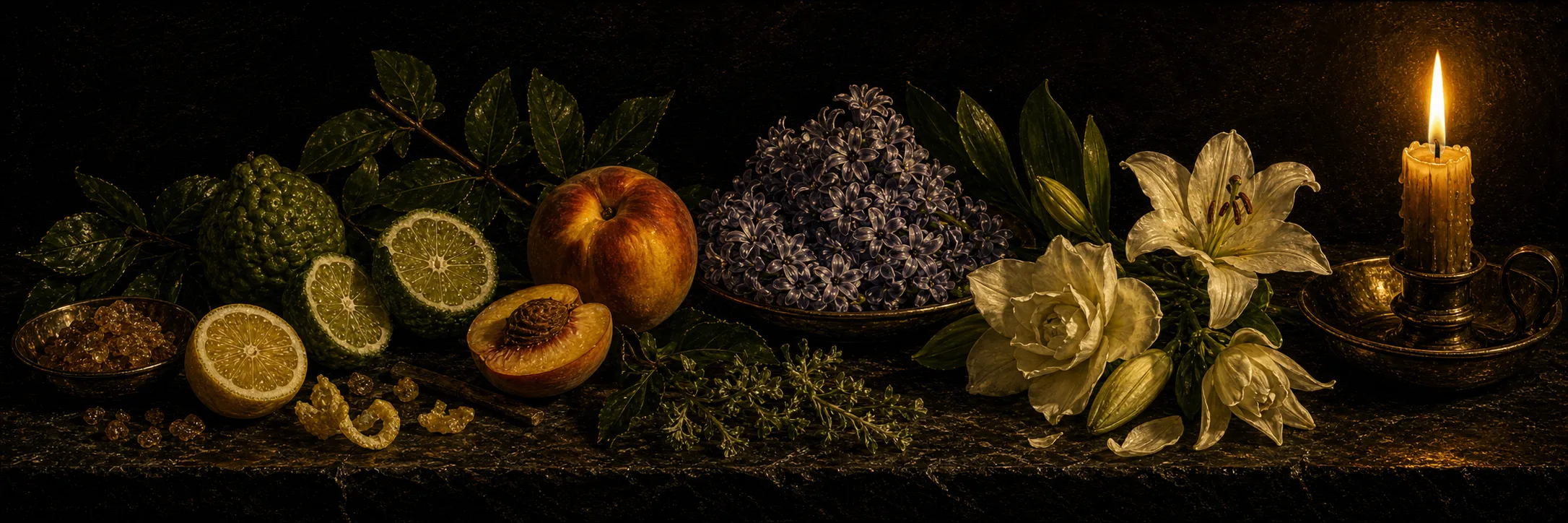
The fragrance opens green and bright - galbanum-tinged green notes, bergamot, lemon, a touch of peach, and hyacinth - and then unfolds into a seamless floral heart of lily, narcissus, jasmine, rose, iris (with lily of the valley and rosewood also documented), settling on a base of musk and cedar with oakmoss. What distinguishes it, per the most detailed surviving critical description, is its blending: Marina of Perfume-Smellin’ Things called it “one of those smooth blends where not a single note stands out and where all notes appear at once and stay together till the end, without making the fragrance either linear or busy,” likening it to “a precious stone with its many facets,” where one moment a spring-like mimosa is highlighted, another moment rose “comes alive with its sweet, summery aroma,” and at times the green hyacinth dominates. Crucially she framed it as wildflowers rather than a manicured garden - “born without any human interference, indeed ‘from the Earth’s heart’… growing on a hilltop somewhere, overlooking the wide expanse of the sea and the sky.” A wearer’s shorthand is blunter and complementary: “very green, musky… It starts strong, green, then musk and a lot of notes of nature come thru.”
Performance
Documentation is limited but consistent: this is not a shy fragrance. Marina, who collected and compared several Japan-only Shiseidos, noted in discussion that “Chant du Coeur is not shy either” - i.e., it projects with real presence rather than the polite quietness sometimes assumed of Japanese-market florals. As a vintage parfum-strength composition, longevity should be strong, though precise modern data is scarce given its rarity.
Wearing Context
A green floral of this character reads as daytime, spring-into-summer, and somewhat formal in the early-’90s mode - the kind of “serious” floral One wearer explicitly contrasted with “all the sugary, sweet, flowery fragrances out there.” It is feminine in classical orientation but green and musky enough to avoid the saccharine. Best appreciated by those who love galbanum-green florals and vintage construction.
Comparisons & DNA
The most natural lineage is the green-floral tradition that runs through Chanel No. 19 and the wilder, naturalistic florals of the late 1980s and early 1990s. Within Shiseido’s own Japan-only canon, contemporaries and stablemates frequently mentioned alongside it by collectors include Murasaki (the galbanum/hyacinth/agarwood “Chanel No. 19 wannabe,” in one critic’s description) and Saso. Fléchier’s authorship also ties it conceptually to his green-rose and white-floral work elsewhere, though Chant du Coeur is its own greener, breezier creature. The Fléchier attribution and the Cummings bottle are corroborated by comparison listings and a firsthand collector account.
Reception
Among the small circle who have actually smelled it, reception is warm to reverent. A wearer called it “an absolutely gorgeous floral scent” treasured in a mini bottle “very difficult to find,” and lamented prices of “$600+” for full bottles. Collector Hiro Nakayama, who pre-ordered it off a Japanese TV ad as a high-schooler, described it years later as “green floral, nature, transparent but heavier scent to Japanese taste,” and movingly framed it as “not just a scent. A whole. An art. A visual image, a music, a package… a promotion. Everything.” Marina’s review is the closest thing to a canonical critical writeup and is unambiguously admiring.
Versions & Reformulation
Released in 1993 (some listings give 1992) and available in parfum; it was distributed essentially only in Japan and has been discontinued for many years. No reformulations are documented because it simply went out of production rather than being relaunched. A 20 ml pure parfum was the format collectors most often cite.
Acquisition Notes
This is a vintage or secondary-market purchase rather than a normal retail item. Condition, fill level, storage history, and top-note freshness matter more than nominal bottle size; sample where possible and verify packaging details before paying collector prices.
Notable Facts & Lore
- The bottle, with its gingko-leaf motif meant to signal “closeness to nature,” was designed by Angela Cummings, a jewelry designer also associated with Tiffany and with Shiseido’s Hanatsubaki design objects.
- The fragrance is part of a broader phenomenon - the “flower snowing” cohort of Japan-only Shiseido florals (Murasaki, Saso, Tentatrice and others) that Western perfume bloggers in the mid-2000s obsessively tracked down through Japanese eBay sellers, treating them as semi-mythical because so little English-language information existed.
- Nakayama’s anecdote that he later “met a Shiseido perfumer who witnessed the creation of Chant du Coeur right next to Edouard Fléchier” is among the few firsthand provenance details that survive.
- Chant du Coeur (“song of the heart,” glossed by Shiseido as “a song born from the Earth’s heart”) is a 1993 Japan-market floral that has become a quietly treasured discontinued cult object among vintage-Shiseido hunters.
- Though the catalog lists the perfumer as unknown, multiple credible enthusiast sources attribute it to Edouard Fléchier - the nose behind Dior Poison and Frédéric Malle Une Rose - and the gingko-leaf bottle was designed by jewelry designer Angela Cummings.
- It is a green, multifaceted floral that several long-time wearers describe as the antithesis of the sweet, sugary mainstream: serious, natural, and a little wild.