Shiseido — Saso
Essence
Saso (沙棗, 1987) is a discontinued floral-aldehyde/floral-woody from Shiseido’s celebrated 1980s art-perfumery era - the same window that produced Nombre Noir and the Serge Lutens - Shiseido experiments. Conceived around the scent of the saso flower (Elaeagnus angustifolia, the Russian olive / oleaster), it is a green-yet-powdery, animalic-based floral that aimed to capture a specific, almost site-specific olfactory image rather than to flatter as conventional perfumery. It is remembered fondly by a small group of devotees as a “lost treasure” of a bolder era of Japanese perfumery, and is genuinely rare today.
Scent Profile
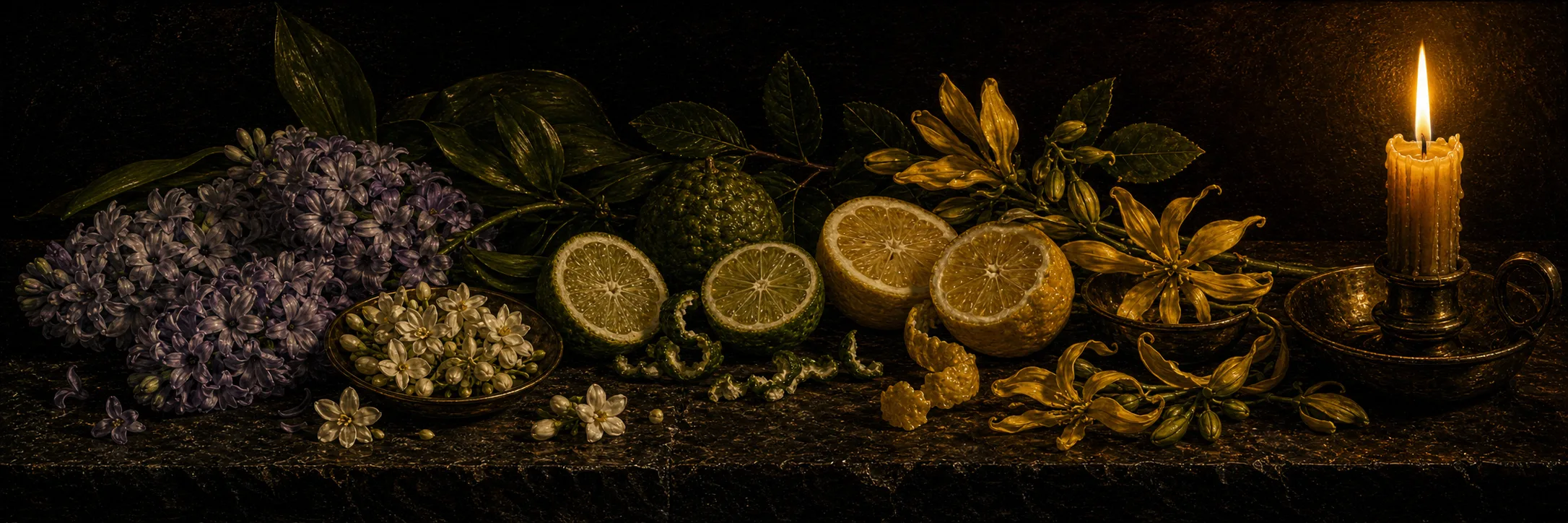
Saso opens aldehydic and green, with fruity nuances, hyacinth, bergamot and lemon. The heart is a soft-focus floral - jasmine, lily-of-the-valley, orris root, rose, violet and ylang-ylang - that several wearers liken to the smell of Russian olive / autumn olive blossom: a citrusy, spicy white-floral cross between honeysuckle and jasmine. The base is the memorable part: a “caressing, dense like a mink stole” accord (Vosnaki’s phrase) of civet - and, in the companion Myth of Saso, castoreum - plus musk, sandalwood, amber, benzoin, tonka and vanilla, with vetiver. One wearer reads it as “green, softly focused” with “a nutty yellow pollen note” reminiscent of vintage Miss Dior, calling it a “GREEN/YELLOW day time perfume that has no artifice” - well-crafted but calibrated to evoke a place and season (a specific plant, a time of year) rather than to decorate skin sensually. Others detect a civet-like animalic streak and find it quite aldehydic, best in deep winter. Shiseido itself documented the saso plant’s natural aroma as containing ester compounds (ethyl cinnamate, ethyl phenylacetate, ethyl benzoate) giving an osmanthus-like fruity sweetness, plus a natural castoreum-like animalic facet - the perfume mirrors this dual fruity-sweet/animalic character.
Performance
Documented performance evidence is sparse given its rarity. Some listings describe the longevity as above average. Vosnaki’s “mink stole” framing implies a dense, lasting, enveloping base. Aged bottles risk top-note degradation (a standard vintage caveat Vosnaki notes), though the rich base is described as worth the gamble.
Wearing Context
Read by its few reviewers as a daytime, cool-to-cold-weather floral - One wearer specifically wore it “sparingly in the middle of winter when I longed for spring,” finding it too aldehydic for warm weather. The autumn-olive/Russian-olive blossom association ties it to a spring-garden or high-end-florist mood. A wearer frames it as the “most ‘Gothic Lolita’ scent” with a mysterious quality. Skews feminine/vintage; arguably more unisex than its darkly-fruity-woody-floral peers given its green restraint.
Comparisons & DNA
The most-cited reference point is Shiseido Nombre Noir: Saso is described as sharing that era’s “darkly fruity, woody floral” sensibility but in a more subtle, signature-Shiseido manner. Vosnaki notes Saso “was soon discontinued, following the abrupt discontinuation that surrounded Nombre Noir.” Where Nombre Noir is alleged to feature a prominent osmanthus accord, Saso has more prominent jasmine and ylang-ylang and reads greener. Dior Poison is invoked as the originator of the late-80s darkly-fruity woody-floral trend that Saso approaches more subtly. Vintage Miss Dior appears through one wearer’s comparison to Saso’s “nutty yellow pollen” lily-of-the-valley-ish facet and high-end-florist greenness. The closest internal relative is Myth of Saso, the related companion with osmanthus in the heart and a pointed castoreum entrance in the base, described by enthusiasts as stronger and sweeter (“MoSaso”) than the greener, lighter original Saso.
Reception
A cult/nostalgia object more than a widely reviewed fragrance. The richest critical-style coverage comes from Elena Vosnaki’s editorial “Three More Shiseido Treasures: Saso, Myth of Saso and Murasaki,” which frames these as evidence of “a time when even the famously reticent Far Eastern brands were bolder and unapologetic in their fragrant offerings.” Reader sentiment in that thread is mournful - “I am still so angry they discontinued one of their best: Saso. They continue to offer some of the plainer ones but kill off the gems!” Saso also has a niche second life as the reference scent people seek when hunting a true Russian-olive/oleaster blossom fragrance. No major (Turin/Sanchez) review is documented.
Versions & Reformulation
Saso launched in 1987 in both eau de parfum and a richer parfum/extrait (one owner reports the Parfum is lighter and sweeter than the EDP). Vosnaki documents distinctive packaging: a black EDP bottle hand-painted with a foliage motif (echoing Zen’s black-and-gold treatment) and an even more exquisite extrait whose flacon sat in a flat bell-shaped sleeve box with a red silk thread at the neck, evoking a bottle of calligraphy ink. A related/companion release, Myth of Saso, exists (some sources vaguely date it to “the 1980s,” while some listings give no year) - stronger, sweeter, with osmanthus and a pointed castoreum base. There is also a separate Murasaki. No reformulation of Saso itself is documented; it was simply discontinued, with collector memory linking the discontinuation to the broader withdrawal that also claimed Nombre Noir.
Acquisition Notes
This is a vintage or secondary-market purchase rather than a normal retail item. Condition, fill level, storage history, and top-note freshness matter more than nominal bottle size; sample where possible and verify packaging details before paying collector prices.
Notable Facts & Lore
- Name and plant: 沙棗 (Saso) literally translates to something like “sand date/jujube” (“Date Palm of the Desert”), but the plant is Elaeagnus angustifolia - Russian olive / oleaster, an Oleaster-family shrub with tiny, intensely aromatic yellow bell-shaped flowers. Shiseido’s own documentation described the flower’s natural aroma as fruity and osmanthus-like with a castoreum-like animalic facet, which the perfume reproduces.
- The “Fragrant Concubine” legend: Saso is tied to the Chinese legend of Xiang Fei (香妃), the “Fragrant Concubine” of the Qianlong Emperor, whose mesmerizing natural scent was said to derive from the Elaeagnus growing in her homeland in China’s far northwest.
- Perfumer attribution is uncertain. A wearer asserts Saso was created by Shōji Nakamura, Shiseido’s documented chief/exclusive perfumer of that era (Nakamura is real and was active in 1987), but no authoritative non-retailer source confirms he composed Saso, and another commenter calls the perfumer “uncertain.” The catalog’s “perfumer: unknown” is the safest position; treat the Nakamura attribution as plausible wearer lore, not fact.
- Saso (沙棗, 1987) is a discontinued floral-aldehyde/floral-woody from Shiseido’s celebrated 1980s art-perfumery era - the same window that produced Nombre Noir and the Serge Lutens - Shiseido experiments.
- Conceived around the scent of the saso flower (Elaeagnus angustifolia, the Russian olive / oleaster), it is a green-yet-powdery, animalic-based floral that aimed to capture a specific, almost site-specific olfactory image rather than to flatter as conventional perfumery.
- It is remembered fondly by a small group of devotees as a “lost treasure” of a bolder era of Japanese perfumery, and is genuinely rare today.