Houbigant — Apercu
Essence
Apercu is a classic floral chypre marketed by Houbigant in 2000 as the revival of a 1925 formula. It functions as a kind of museum piece: one of the very last newly-sold, in-production oakmoss chypres of its type before IFRA restrictions and shifting taste pushed the genre off retail shelves. What makes it distinctive is not novelty but fidelity. It is a full-bodied, spice-laced, oakmoss-saturated chypre built in the grand pre-war manner, sold briefly in a 21st-century department store, and remembered as a faithful and affordable way to own a reference-grade classical chypre.
Scent Profile
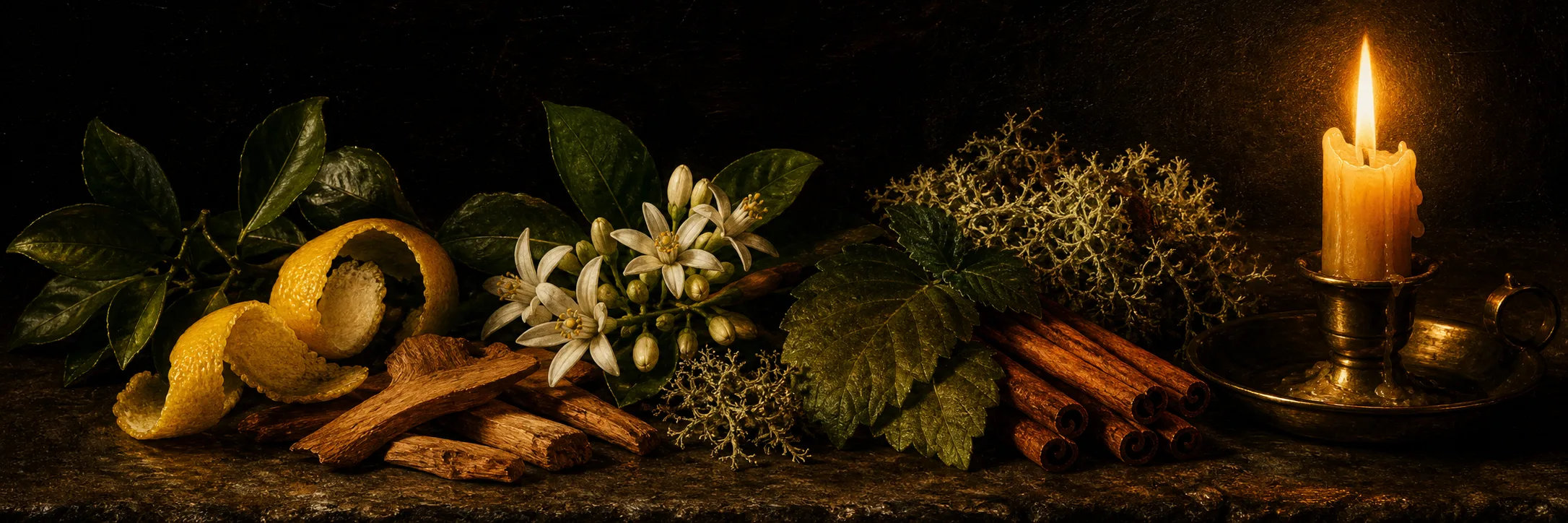
The opening is heady and perfume-y, with several wearers noting an aldehydic lift that isn’t in the official note list, plus a quick burst of clove-cinnamon spice over green, citrus and neroli. That spice retreats and then returns in the drydown, bracketing the composition from both ends. The heart is where the chypre identity asserts itself. The florals are deliberately muted and blended rather than soliflore: the tuberose is well-behaved, and the rosy impression several people detect is actually a geranium and bois de rose illusion rather than a true rose note. The defining structure is the textbook bergamot, oakmoss and patchouli triangle, with oakmoss prominent but restrained rather than musty. The drydown turns woody and dry, smoothed by sandalwood, with vetiver and patchouli giving an earthy floor. Several noses report a phantom stone-fruit facet, peach or plum darkened by moss, that isn’t in the pyramid but is a hallmark of the genre. The fragrance is not strictly linear, evolving slowly and coherently over hours. Its signature is a dry, spicy oakmoss-chypre that reads green and earthy rather than sweet or powdery, which sets it apart from the powdery house style Houbigant is otherwise known for.
Performance
Apercu is potent and long-lasting despite its refined demeanor, often described as understated but very powerful, and as a fragrance where a little goes a long way. Multiple wearers report up to 12 hours from the parfum on skin, though at least one EDP wearer found it gone within an hour, pointing to real skin-chemistry variance. The parfum reads less green and more plummy and pillowy; the EDP is greener. It favors cool weather and damp autumn days and can turn heavy or cloying in heat. The standing advice is to spray sparingly, since it is full-bodied and rewards restraint.
Wearing Context
This is a year-round but cooler-weather-favoring scent, leaning toward autumn and damp days, daytime or evening. It is repeatedly described as a wear-everywhere, always-proper type: formal-leaning, sophisticated, and reading in social perception as classic, grown-up and distinctly mature rather than youthful or trendy. It is also frequently called genuinely unisex, with a man comfortable in green chypres able to wear it successfully. Against the department-store backdrop of its launch era, full of fruity florals and tea scents, it would have felt, and still feels, like a deliberate throwback.
Comparisons & DNA
This is squarely classical floral-chypre DNA. The most common reference is Guerlain Mitsouko, with several writers calling Apercu the more approachable of the two and a good entry point for anyone who finds Mitsouko a bit strange. It is compared to Jean Patou 1000, said to be similar but without 1000’s more questionable undertone, and to Clinique Aromatics Elixir, where Apercu reads poised and upright against Elixir’s sharper, edgier character. Writer Gaia Fishler also smells shades of YSL Champagne and Yvresse in its original form. It sits alongside discontinued autumnal chypres such as Schiaparelli Shocking and Raphael Replique, and reads as a lighter-bodied cousin to Catalyst by Halston.
Reception
Among the small circle who know it, Apercu is held in high regard as an underknown and therefore underappreciated classic. Praise centers on its construction, its balance with no single note dominating, and its authenticity as a true classical chypre. Niche-blog reception is warm: affectionate, detailed reviews came from Robin at Now Smell This, Gaia Fishler at The Non-Blonde, and Donna at Perfume-Smellin’ Things, who dubbed it a Goldilocks everyday scent. The polarization runs along two axes. The first is the genre itself, since chypre-skeptics and the powder-averse find it old-fashioned, heavy or cloying. The second is a specific sour-green facet a minority detect, sharp enough that one wearer who loved the structure still couldn’t get past it. On value, the verdict is broadly favorable given its low secondary-market price, especially for established chypre lovers.
Versions & Reformulation
The central documented ambiguity is whether the 2000 release is a faithful reproduction or a reformulation of the 1925 original. Houbigant and Neiman Marcus marketed it as a recreation of a recovered antique recipe, and the consensus leans toward reformulated to some degree but stylistically faithful, with observers noting that if it was changed at reintroduction it was not changed much. It existed in at least three concentrations: EDT, EDP, and pure parfum, with the parfum noted as less green and more plummy. A mid-20th-century vintage parfum is also referenced by collectors as exquisite. The 2000 version was itself discontinued by roughly 2005 to 2006, plausibly an early IFRA-era casualty but, by one account, most likely simply because it didn’t sell.
Acquisition Notes
Apercu is discontinued and obscure, but unusually affordable for a quality classical chypre. At launch it sold at Neiman Marcus, Bergdorf Goodman and Saks, with the parfum priced around $150 for a quarter ounce and $225 for a half ounce, and EDP spray offered in 1.7 oz and 3.3 oz sizes. The bottle is a round-shouldered flacon, with the parfum version finished with a red tassel. Counterfeits are not a concern given its obscurity, and batch-code decoding for it is unreliable.
Notable Facts & Lore
- Houbigant is one of the world’s oldest perfume houses, founded in Paris in 1775 by Jean-Francois Houbigant of Grasse.
- The original shop was named A la Corbeille de Fleurs, “At the Basket of Flowers,” at 19 rue du Faubourg Saint-Honore.
- The 2000 release arrived during the troubled Renaissance Cosmetics licensing era, marked by litigation over Houbigant fragrances being watered down, which sharpens the irony of Apercu being praised as faithful.
- The house’s golden-age chypre credibility traces to Quelques Fleurs of 1912.
- Houbigant’s royal associations, including Queen Marie of Romania’s beloved Mon Boudoir, belong to the house rather than to Apercu specifically.
- The name is pronounced ah-perr-SUE.