Houbigant — Iris des Champs
Essence
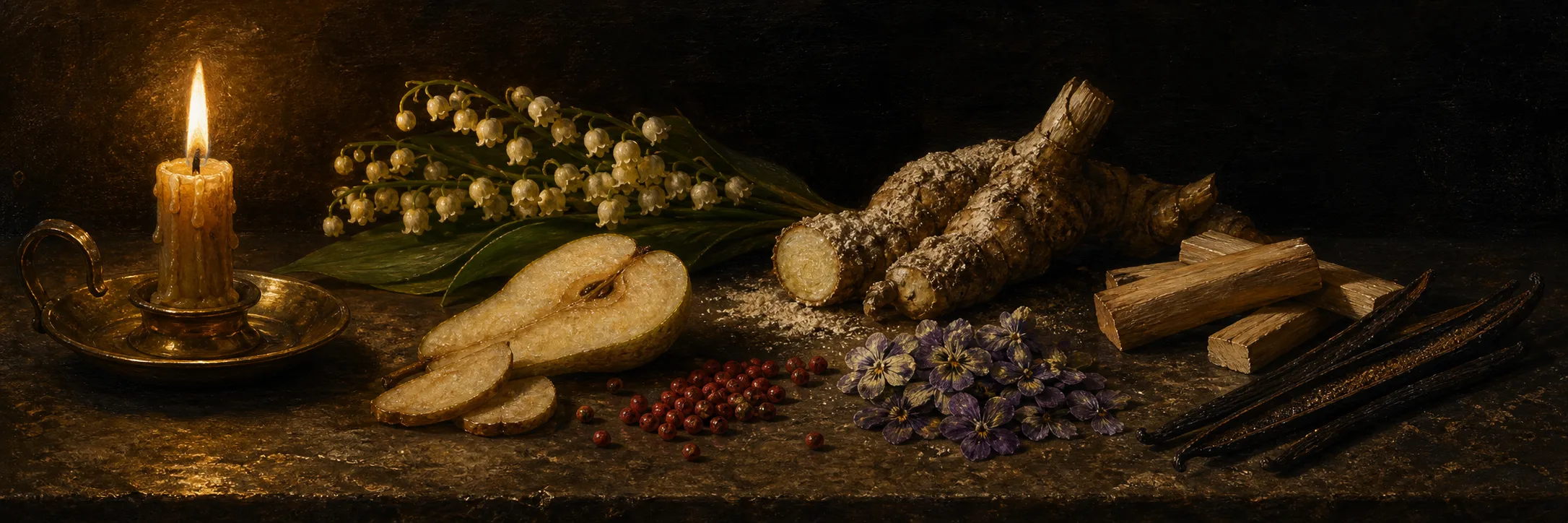
Iris des Champs is Houbigant’s 2014 attempt to do something unusual: render the smell of the iris flower rather than the customary rooty orris butter. Composed by young perfumer Mathieu Nardin under creative director Elisabetta Perris, it is a sheer, fresh-floral interpretation - green and dewy up top, powdery in the heart, soft and musky-woody in the base. The house’s conceit is that since the iris flower itself has virtually no scent (the prized material comes from the rhizome/root), Nardin built an imagined flower iris from lily of the valley, pear, and white florals. The result is divisive: marketed as a heady, plush homage to iris, it reads to many critics as a clean, contemporary soapy floral closer to Prada Infusion d’Iris than to a deep classical orris.
Scent Profile
The opening is fresh, green, and slightly aquatic: aromatic bergamot, dewy lily of the valley, a watery-crisp pear, pink pepper’s faint spice, and a touch of rose - evoking, as a published review put it, a rooty-green iris accord, and to one reviewer, iris fields covered in rain drops after a downpour. That promising rooty iris is fleeting; a published review found that weirdly, that iris only lasts about a half-hour, to be replaced by a lighter heart of soapy orange blossom. The middle is where opinions fork - a soapy bouquet of orange blossom-ish white florals, iris (using both iris butter and absolute per the official notes), ylang-ylang, and jasmine sambac, powdery but, to skeptics, soapy with something unclean underneath. The base is a quiet, clinging vanilla-musk with sandalwood, amber, and soft woods. Linearity is moderate; the much-anticipated iris is more a passing facet than the through-line the name promises. The signature accord is dewy muguet-and-pear over a powdery-soapy musk.
Performance
Reports are inconsistent and skin-dependent. a published review found the EDP/extrait quiet but clings to my skin for hours as a vanilla-musk skin scent. Others, however, flag genuine disappointment with performance and projection. The net: moderate, intimate projection with respectable longevity, but variable enough that it reads as a soft personal scent on many. Spring and mild weather flatter it; go light on application.
Wearing Context
A daytime, spring-and-summer floral, best suited to casual and office wear. Reviewers repeatedly tie it to a specific image: a walk through blooming iris fields on a bright spring day after rain, fresh and sunny but delicate. It is marketed feminine and reads that way to most - a scent made for a classy woman, the young gorgeous teacher you had in elementary school - but at least one forum reviewer wears it as unisex and calls it without hesitation, unisex with a forest walk character. Social perception: elegant, clean, inoffensive, vintagely elegant yet youthful. Not a seductive or evening fragrance; its register is fresh and polite.
Comparisons & DNA
The dominant comparison, made by critics and users alike, is Prada Infusion d’Iris and Infusion d’Iris Absolue - a published review placed Iris des Champs midway between the two in terms of intensity, a sheer contemporary iris rather than an homage to the classics. The same reviewer’s iris benchmarks that it failed to displace were Le Labo Iris 39 and the discontinued L’Artisan Orchidée Blanche. One reviewer who loves the original Prada Infusion d’Iris found Houbigant’s significantly different - Prada’s iris is more bright and sunny, Houbigant’s is more retro but not in a powdery way, timeless. For greener classical-LOTV character, reviewers invoke Diorissimo. Acqua di Parma Iris Nobile came up as a richer alternative one disappointed user preferred. There are no clones; inspired-by oil houses are not accounts.
Reception
Reception is genuinely mixed-to-lukewarm, and notably so among the very critics asked to love it. verdict was a clear disappointment: it didn’t quite live up to my expectations, the iris vanishes fast, and it ends as a vanilla-musk skin scent with a dash of pink pepper that won’t replace Iris 39. The blog Chemist in the Bottle, reviewing Nardin’s composition, concluded this is not the kind of iris that I favor the most, there’s too much muguet in it, judging it pretty but not a daily wear. On wearers, opinion divides between devotees who find it fragile and noble, the iris flower with its leaves and the morning dew, beautifully balanced and signature-worthy, and detractors who call it a generic soapy floral with a musky base, a boring musk note that belongs in a drugstore fragrance, or compare it unfavorably to a very poorly put together Prada Infusion d’Iris. A recurring practical point: it performs and reads very differently across seasons and skins - at least one reviewer dismissed it in winter then fell in love with it on a mild rainy spring day. Blind buy verdict: risky if you want a deep, rooty, classical iris - this is not that. Safer if you want a fresh, soapy, dewy spring floral and can sample first; the iris-as-flower concept is polarizing.
Versions & Reformulation
Iris des Champs launched in two concentrations in the same Orangers en Fleurs-style 100 ml bottle: an Eau de Parfum (blue label) and a richer Extrait de Parfum (gold label). a published review reviewed the Extrait and speculated the EDP might read richer to some noses; wearers suggest meaningful character differences between the two, but there is no documented IFRA reformulation. The fragrance is part of Houbigant’s Collection Les Matières and is marketed by the Perris Group, which acquired the Houbigant name in 2005. Single composition across its run, no known reformulations beyond the EDP/Extrait split.
Acquisition Notes
Per a published review (January 2015), Houbigant Iris des Champs is available as 100 ml Extrait de Parfum ($600) and 100 ml Eau de Parfum ($190). It remains in production and is sold through niche boutiques (Les Senteurs, Bloom Perfumery, H Parfums) and Houbigant’s own channels, with samples and decants widely available. Sample before committing given the polarizing iris execution.
Notable Facts & Lore
- The fragrance was Houbigant’s first launch since Orangers en Fleurs (2012) and is positioned within the house’s storied heritage - Houbigant, founded in Paris in 1775, created Fougère Royale (1882, the first fougère and an early use of a synthetic coumarin accord) and Quelques Fleurs (1912, the first multi-floral abstract bouquet).
- The marketing leans on the iris’s symbolism - sacred to the Egyptians, the heraldic fleur-de-lis of French royalty - and on the technical fact that the iris flower is essentially odorless, the scent residing in the rhizome’s irone molecules; the iris must grow about three years before the rhizomes are harvested.
- Nardin’s conceptual hook - composing the imagined smell of the flower rather than the root - is the fragrance’s central story and the source of both its originality and the where’s the iris?
- disappointment some critics voiced.
- Perfumer Mathieu Nardin, Grasse-raised and trained at Robertet before moving to Mane, has cited citrus and floral accords as the inheritance of his childhood; his catalog also includes Etro Jacquard and later work for Miller Harris.