Houbigant — Le Parfum Idéal
Essence
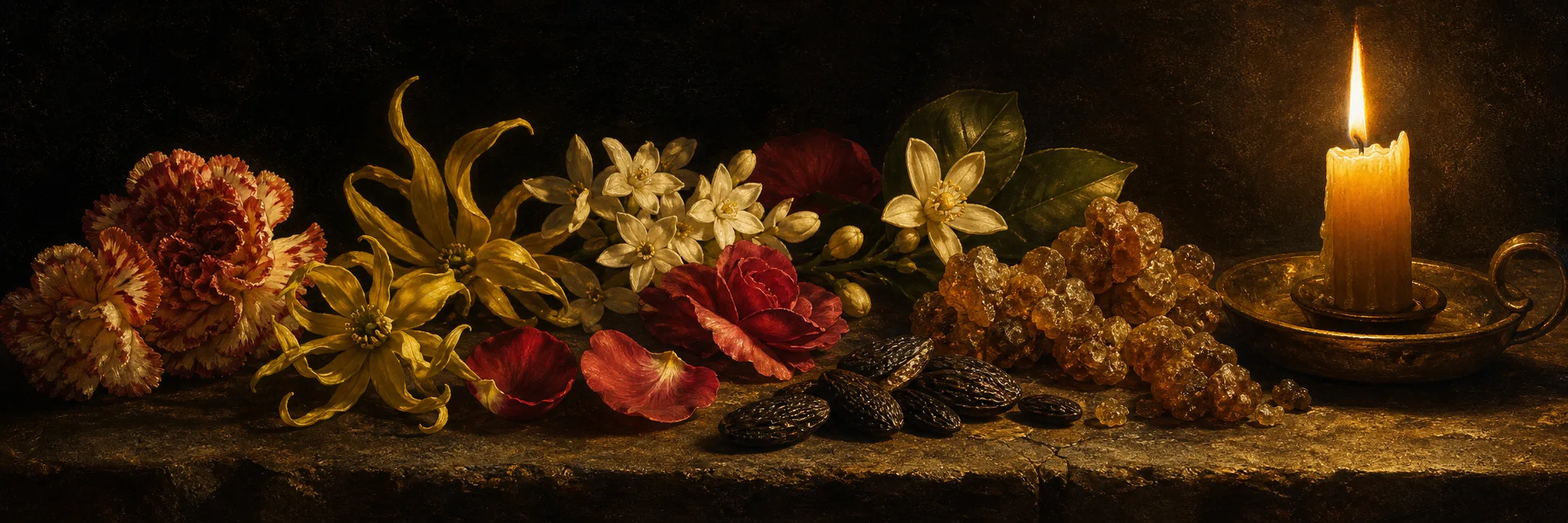
Le Parfum Idéal is a historically significant late-19th-century floral-oriental from Houbigant, created by Paul Parquet - the perfumer who a few years earlier had launched the synthetic age of perfumery with Fougère Royale (1882). First created in 1896 and famously presented at the 1900 Paris Exposition Universelle, it is an early example of an abstract, synthetic-aided floral bouquet: a warm, powdery, ambery cloud of carnation, ylang-ylang, jasmine, rose and orange blossom over a balsamic tonka-benzoin-ambergris base. It survives today mostly as a vintage-collector’s object - discontinued by around 1970 - and as a milestone in perfume history rather than a living, widely-worn scent.
Scent Profile
Reliable first-hand modern olfactory evidence is thin (most living noses encounter only aged vintage), so this is necessarily cautious. The catalog and surviving descriptions point to a carnation-led top with citrus - carnation bringing its spicy, clove-like (eugenol) bite. The heart is a rich, abstract white-floral bouquet of ylang-ylang, jasmine, Bulgarian rose and orange blossom, and the base is a sweet-balsamic, powdery accord of benzoin, tonka bean, ambergris, sandalwood, musk and patchouli. The most detailed surviving hands-on account, from a reviewer, describes the odd green/herbal/bitter amyl salicylate in the top shaping the abstract floral core, with ylang-ylang’s warm humanness, jasmine’s indolic sweetness, and a sharp clove that is tempered by an almondy and sweet tonka. A forum reviewer of an EDT bottle reported a lovely rush of green with neroli and a touch of galbanum, then settles into a long-lasting soapy, powdery phase. The through-line: a green/spicy-floral opening collapsing into a soft, soapy-powdery, balsamic-sweet drydown. Stage timing is not reliably known and varies by how the vintage has aged.
Performance
Reliable documented performance evidence is thin and complicated by age - surviving juice is decades old. Reviewers describe the drydown as long-lasting soapy-powder, consistent with a period parfum/extrait built on heavy salicylate, benzoin and musk materials that historically projected and lasted well. Treat any hour/distance estimate as unreliable for modern bottles.
Wearing Context
Given the documented profile - a warm, powdery, balsamic floral-oriental - the practical reading (not consensus, since coverage is sparse) is a cool-weather, evening/formal, classically dressed scent in the vein of early-20th-century florals. It would feel ornate and old-world by modern standards: a collector’s and history-lover’s wear rather than an everyday or office choice. There is no meaningful modern social-perception data.
Comparisons & DNA
Its DNA sits with the great abstract florals that bridge the 19th and 20th centuries. The most authoritative framing comes from perfume historian Victoria Frolova (a published review), who places Parquet’s work - Fougère Royale (1882) being the first fragrance that successfully fused the manmade ingredient coumarin with natural aromatics - at the root of modern perfumery, and lists Le Parfum Idéal among Parquet’s major (now largely lost) creations. Ernest Beaux, creator of Chanel No 5, called Parquet the greatest perfumer of his time, and Parquet’s successor at Houbigant, Robert Bienaimé, reportedly called Le Parfum Idéal a masterpiece of fragrant equilibrium, harmonious and of good taste as shall never be surpassed. Direct olfactory comparisons are scarce; one hands-on reviewer felt rare early Guerlains (Bon Vieux Temps, Sillage) seemed to share its structure of strong, harmonious aromatic floral chords, and speculated a lineage toward the ylang-inflected aromatic florals that culminate in Chanel No 5 - but a documented causal line from Le Parfum Idéal specifically to No 5 does not exist and should be treated as soft inference. The closest living relatives in the Houbigant line are the multi-floral Quelques Fleurs (1912) and other Parquet-era bouquets.
Reception
There is limited modern consensus and limited critic coverage of Le Parfum Idéal specifically - coverage is split between (a) collector/historical writing and (b) a handful of vintage-bottle reviews. Among vintage collectors the tone is reverent: it is treated as a beautiful, warm, soft, historically important parfum (truly stunning. Warm and soft. Smells heavenly). The reception that matters here is historical rather than contemporary-popular: it was, by period accounts, the most successful odeur of perfume history alongside Quelques Fleurs, a commercial mainstay for decades. Blind-buy in the modern sense is not applicable; acquisition is a vintage-collecting decision.
Versions & Reformulation
This is a complex, important point. Houbigant’s corporate history is fractured: after 1993 bankruptcy, the name and formulas passed through Renaissance Cosmetics and later New Dana Perfumes/Dana, with widely acknowledged dilution of the originals, before the Perris family reacquired control of Houbigant (2005) and production moved to LOFT in Monaco under the original specifications. Le Parfum Idéal was made over many decades in numerous concentrations and presentations - parfum extrait, eau de toilette, toilet water, plus face powder, talcum, dusting powder, a 1953 Skin Sachet, and more - and in iconic flacons (Baccarat apothecary and Louis XV bottles; later pressed-glass EDT flacons). Note a frequent date discrepancy: the catalog lists 1896 (creation date), while many sources and wearers/wearers entries cite 1900, the year of its public launch at the Exposition Universelle. Both are correct in context - created 1896, launched 1900. The line was discontinued around 1970. Any contemporary Le Parfum Idéal-type recreations are not authentic Houbigant and fall outside reliable sourcing.
Acquisition Notes
Strictly a vintage-collector market: there is no current authentic production. Buy from reputable vintage dealers and judge by bottle/label authenticity.
Notable Facts & Lore
- The fragrance is steeped in Belle Époque lore.
- Its iconic label depicts a Gibson Girl inhaling a flower, rendered in embossed gilded foil.
- It debuted at the 1900 Paris Exposition Universelle (the World’s Fair symbolized by the newly built Eiffel Tower), alongside Houbigant’s Coeur de Jeannette.
- Houbigant - founded 1775, perfumer to European royalty including, per house history, Queen Victoria, Napoleon and the Russian imperial court - credits Parquet as a pivotal innovator; he became joint owner in 1880 and moved operations to Neuilly-sur-Seine.
- The widely repeated collector claim that Le Parfum Idéal was the first floral composite bouquet perfume, containing synthetic compounds of coumarin and salicylates should be flagged with care: it traces to collector blogs (Cleopatra’s Boudoir; the Houbigant Perfumes blog) rather than to a peer historian, and it conflicts with the better-sourced attribution of first multi-floral bouquet to Houbigant’s own later Quelques Fleurs (1912, Robert Bienaimé).
- The defensible historical framing is that Fougère Royale (1882) was the synthetic pioneer (coumarin), Quelques Fleurs (1912) the landmark multi-floral, and Le Parfum Idéal (1896) an important early/transitional abstract synthetic-aided floral in between.
- Notably, if it truly used amyl salicylate (trèfle) in 1896, it would predate Piver’s famous Le Trèfle Incarnat (1898) - a striking but collector-sourced claim worth treating cautiously.